The Leadership Transition Playbook
A practical playbook for navigating complex leadership transitions—balancing immediate leadership needs with thoughtful, long-term executive decisions.
September 30, 2026
14m to read

“When leadership needs are urgent, companies often face a difficult choice: solve today’s challenge or focus on tomorrow’s needs. Combining interim leadership with executive search allows organizations to do both—stabilizing the business while securing the right long-term leader.”
Sunny Ackerman
Global Managing Partner, On-Demand Talent
Global Managing Partner, On-Demand Talent
Combining interim leadership and executive search to navigate change with confidence
Rethinking leadership transitions
There is no such thing as a convenient time for a leadership transition. In fact, gaps tend to emerge at the very moment stability matters most—periods of growth, transformation, or widespread uncertainty. While these moments are inevitable, the response need not be reactive. Too often, organizations feel forced to choose between speed and precision: fill the role quickly and risk a poor fit, or take the time to find the right leader and accept the disruption of waiting. Neither option fully addresses the challenge.
Leading organizations are discovering a different approach, treating interim leadership and executive search as interconnected parts of a single strategy—one designed to balance continuity, long-term success, and risk.
Leadership transitions are not purely operational events—they are human ones. How they are managed shapes not only outcomes, but also confidence, trust, and organizational cohesion.
The hidden cost of a leadership gap
When a critical leadership role remains unfilled, the impact quickly cascades across the organization. Decision-making slows; accountability becomes unclear; teams lose direction; momentum stalls on strategic initiatives. In many cases, high-performing employees disengage or look elsewhere.
Leadership transitions can be highly visible moments. The presence—or absence—of leadership sends a signal to the market, to employees, and to stakeholders about the organization’s stability and direction. The longer a leadership gap persists, the more difficult and costly it becomes to recover from.
And yet, the stakes of a new hire are high as well. A mis-hire at an executive level can have multi-year consequences. These are not isolated hiring decisions—they are enterprise-level risks.
A false tradeoff: Speed vs. the right hire
In periods of disruption, organizations often need a leader with highly specific expertise—someone who can step in quickly, make confident decisions, and stabilize the business. Increasingly, organizations are calling on leaders who have chosen to specialize in interim and project-based work, building careers around guiding companies through moments of change. They are selected for immediate impact, bringing experience from similar situations with less emphasis on long-term organizational fit.
A permanent hire, by contrast, must meet a broader set of requirements. Beyond capability, this leader must align with the organization’s culture, leadership style, and strategic direction. Long-term leadership is not just about performance—it is about shaping the organization’s future.
Attempting to find one person who can satisfy both immediate execution needs and long-term strategic alignment often leads to compromise. Organizations either prioritize urgency and make a rushed decision or prioritize fit and leave the business without leadership for too long. The most effective approach recognizes these as distinct needs and addresses each with the right solution at the right time.

Every transition is different. Some require immediate stabilization; others demand specialized expertise, careful succession planning, or a longer search for a leader who can shape the next phase of growth. In many cases, the immediate leadership need and the long-term hiring profile overlap. In others, they differ significantly. By integrating executive search with interim talent, organizations gain both confidence and agility: the ability to respond quickly to the moment while continuing to make a thoughtful, well-informed decision about permanent leadership.
The interim track provides immediate relief and impact. Experienced leaders and experts can be deployed quickly to maintain continuity, address urgent priorities, and provide leadership capacity when the organization cannot afford to wait. Their value lies not only in their ability to step in quickly, but in the depth of experience gained from leading similar moments time and again for other organizations.
The search track runs alongside that work, focused on identifying the right permanent executive. Rather than operating from a static view of the role, the process can evolve as the organization learns more about what the business truly needs. Insights from the interim engagement can help refine the permanent hire profile, sharpen the job description, and clarify the capabilities required for long-term success. In some cases, candidates can be dual-tracked for interim and permanent consideration, creating more optionality and a more informed decision-making process.
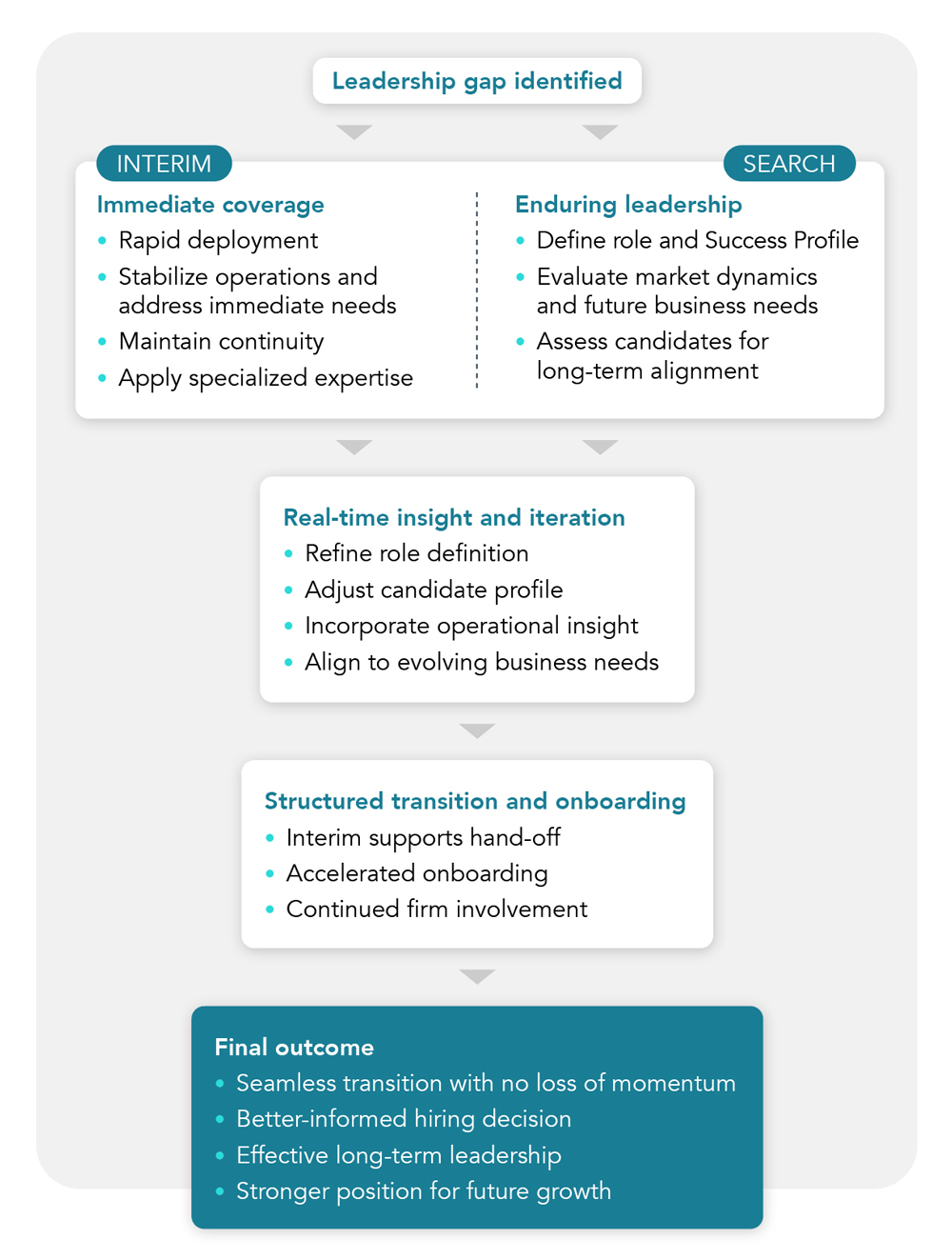
Executing a combined approach effectively requires access to a broad, global talent network and the ability to coordinate interim and search processes in parallel—capabilities most organizations do not maintain internally.
A combined model gives companies access to:
• Best-in-class in-seat and independent executives
• Immediate leadership support when timing matters
• Pragmatic, market-driven guidance on the right solution
• A more adaptive search process that reflects real-time business needs
The result is faster relief, stronger decision-making, smoother handoffs, and greater confidence that the right leader is in place for what comes next.
How to bring a layered search process to life
A coordinated approach enables organizations to respond quickly, learn in real time, and make more informed leadership decisions as circumstances evolve. While every transition is different, the process typically unfolds across a series of overlapping stages.
1. Clarify the immediate need
Begin with a focused assessment of the situation. What must be stabilized, accelerated, or delivered in the near term? Where is leadership most urgently required? This stage defines the mandate for interim support and establishes clear priorities. Our interim team helps assess the situation, refine requirements, and identify precisely matched talent.
2. Deploy interim leadership or expertise
Experienced interim leaders or specialized experts are deployed quickly—often within days—to provide continuity, lead critical decisions, and address pressing challenges. Selected for their experience in similar situations, they can integrate rapidly and begin creating impact immediately.
3. Generate real-time insight
As interim talent engages with the business, a clearer picture of the role, team, and organizational needs emerges. Initial assumptions can be tested, priorities refined, and new opportunities or constraints identified. Rather than defining leadership requirements in theory, organizations gain insight grounded in current operating realities.
4. Run and refine the search in parallel
While interim leaders are driving progress, the search process advances in parallel. As new insights emerge, the role specification and candidate profile can be refined to reflect evolving needs. In some cases, organizations may also assess talent for both interim and permanent opportunities, creating additional flexibility and optionality.
5. Transition with structure and support
Once a permanent leader is selected, the transition is managed deliberately. Interim talent can support knowledge transfer, maintain momentum, and help accelerate onboarding, while the broader team provides additional support to position the new executive for success.
This process is rarely linear. Stages often overlap, and the approach adapts as new information emerges. That flexibility is one of its greatest strengths. What remains constant is the outcome: organizations maintain momentum today while making stronger, more confident decisions for the future—without being forced into unnecessary tradeoffs.
High-risk, high-reward transition situations
An integrated approach is particularly valuable in moments where both speed and precision matter—and where the cost of getting either wrong is high. These are typically periods of change, uncertainty, or acceleration, when leadership continuity is critical but the long-term requirements of the role may not yet be fully defined.
One of the most common scenarios is an unexpected executive departure. When a key leader exits suddenly, organizations must act quickly to stabilize operations and maintain direction. At the same time, rushing to fill the role permanently can introduce significant risk. A layered approach allows the business to regain control immediately while creating the space to make a more nuanced long-term decision.
This model is equally effective during periods of transformation or turnaround. The leadership needed to run a business frequently differs from that needed to change the business. In these situations, the organization may need an immediate leader with highly specific experience—someone who has navigated similar challenges before and can drive change quickly. That expertise may not perfectly align with the profile required to lead the organization once the transformation is complete. A combined approach allows both needs to be addressed in tandem, without compromise.
In high-growth or scaling environments, leadership requirements often evolve rapidly. What the business needs today may look very different in six to twelve months. Deploying interim leadership can help manage immediate demands while allowing time to define the permanent role with greater clarity and foresight.
This approach is also well suited to newly created or evolving roles, where the scope and expectations are not yet fully established. Rather than locking into a fixed job description too early, organizations can use interim leadership to shape the role in practice—informing a more accurate and effective search process.
Finally, during mergers, acquisitions, or broader organizational restructuring, leadership needs can shift quickly and unpredictably. An integrated model provides the flexibility to respond to changing conditions while ensuring continuity across the business.
While this approach introduces additional flexibility, it also reframes the economics of leadership transitions. The cost of interim leadership is often outweighed by the cost of delay, mis-hire, or lost momentum—making it a practical investment in both performance and risk mitigation.
What to look for in an interim vs. permanent leader
While interim and permanent leaders may occupy the same role, they are not interchangeable. Many interim leaders intentionally choose this path as a long-term career, specializing in high-impact, time-bound leadership assignments. Each type of leader is selected for a different purpose and evaluated against different criteria, and the distinction is the key to getting both decisions right.
Interim executives: Built for immediate impact
Interim leaders are chosen for their ability to step into complex situations quickly and deliver results with minimal ramp-up time. Look for:
• Speed to effectiveness—able to assess, decide, and act quickly
• Relevant, repeatable experience—have navigated similar challenges before
• Comfort with ambiguity—operate effectively in evolving or uncertain environments
• Execution focus—prioritize outcomes, stabilization, and momentum
• Independence and objectivity—bring a fresh perspective without internal bias
Their role is to stabilize, lead, and create traction from day one.
Permanent leaders: Built for long-term impact
Permanent leaders are selected for their ability to lead the organization over time—shaping strategy, culture, and performance. Look for:
• Strategic alignment—closely matched to the organization’s long-term direction
• Cultural fit and leadership style—able to build trust and lead within the organization
• Scalability and agility—capacity to grow with the business and evolve the function dynamically
• Sustained performance—track record of delivering results over time
• Leadership durability—ability to build teams, systems, and long-term value
Their role is to own the function, lead the organization forward, and deliver sustained impact.
Trying to find one individual who perfectly meets both sets of criteria—immediate, situation-specific execution and long-term leadership alignment—can lead to compromise. A layered approach allows organizations to optimize for each need separately, resulting in stronger outcomes in both the short and long term.
Common missteps during leadership transitions
Even with the best intent, organizations can undermine the effectiveness of a leadership transition by falling into a few common—and often avoidable—traps. These pitfalls typically stem from acting under pressure, relying on incomplete information, or treating leadership transitions as more straightforward than they actually are.
• Waiting too long
Organizations often delay action in the hope that the situation will resolve itself or that the right permanent hire can be found quickly. In reality, leadership gaps tend to compound over time. The longer a role remains unfilled, the greater the impact on decision-making, team performance, and overall momentum.
• Treating interim as a stopgap
Interims are sometimes viewed as placeholders rather than strategic assets, which can limit their effectiveness. When thoughtfully engaged, interim leaders can do far more than “hold the seat”—they can stabilize the business, drive progress, and generate insights that materially improve the eventual hiring decision.
• Locking the role definition too early
Organizations often feel pressure to define the role and candidate profile upfront and proceed quickly into search. But in periods of change, those initial assumptions may not hold. Committing too early can result in a misaligned search and, ultimately, a weaker hire.
• Rushing the permanent hire
When leadership is missing, the urgency to “solve the problem” can lead to a compressed hiring timeline. This can result in compromise—either on fit, capability, or long-term alignment. Having interim leadership in place reduces this pressure and allows the organization to make a more deliberate decision.
• Failing to plan the handoff
The transition from interim to permanent leadership is sometimes treated as a simple handoff. In practice, it requires structure and support. Without a deliberate transition plan, organizations risk losing continuity, delaying onboarding, or creating confusion around priorities and expectations.
An integrated model helps organizations avoid these risks by introducing flexibility, real-time insight, and the ability to respond thoughtfully—without sacrificing speed or momentum.
Client stories: Proven results in complex moments
The most effective leadership transitions address both the immediate challenge and the long-term solution. These case studies demonstrate how organizations used interim leadership and executive search in tandem to maintain momentum, reduce risk, and strengthen outcomes.
Fractional finance leadership during a CFO search
Immediate and long-term needs align
A multi-site auto services company had experienced a lot of leadership turnover and lacked a CFO. Pressure from the board was mounting due to limited financial insight, a junior team, and a lack of FP&A leadership. The CEO and board were in desperate need of keen financial reporting and decision-making.
For immediate leadership in parallel to the ongoing search process, we deployed an experienced fractional CFO, who quickly brought structure to monthly close, improved forecasting and cash flow visibility, and established clear processes. Our search team identified an experienced multi-industry permanent CFO, who was then able to step into the role with clarity, taking over a more mature, stable, and well-equipped finance department.
Stabilizing plant operations during a COO search
Immediate and long-term needs diverge
A multi-site food and beverage manufacturer lacked a COO during a major plant reorganization and risked failing on customer commitments. With key facilities struggling to execute multiple line deployments and no clear strategy, the company couldn’t wait for a new leader to stabilize operations.
During the permanent search, we placed an interim VP of Engineering who quickly implemented clear project plans, improved execution across critical processes, and brought hands-on, collaborative leadership to a complex environment. Our search team then placed a permanent COO with deep operations experience for major consumer brands. With manufacturing stabilized, the new leader benefited from a smoother transition and could take a more strategic, forward-looking approach to the role.
Emerging stronger on the other side
When a leadership transition is managed well, it is often invisible from the outside. The business continues to move forward. Decisions are made with clarity. Teams remain aligned and focused. Momentum is preserved.
But beneath that continuity is a deliberate approach—one that balances immediate action with long-term thinking. Interim expertise ensures that critical priorities are advanced without interruption, while the organization gains the time and perspective needed to define the role properly and evaluate permanent candidates with confidence.
The result is not just continuity, but better positioning for the future.
Organizations are able to make informed, intentional choices about their long-term leadership. The permanent executive who steps into the role is not only capable, but aligned—equipped to lead the organization through its next phase with clarity and purpose.
Equally important, the transition itself is smooth. Knowledge is transferred, context is preserved, and the incoming leader is supported in a way that accelerates impact rather than delaying it.
Ultimately, the goal is to navigate the transition in a way that leaves the organization stronger—more aligned, more informed, and better positioned for what comes next. The most effective organizations don’t just respond well to leadership transitions. They use them to strengthen how they plan for leadership over time.
Plan for a successful transition
Surface needs, evaluate readiness, and decide on a course of action with our decision-making workbook in the full playbook.
Stay connected
Stay connected to our expert insights, thought leadership, and event information.
Leadership Podcast
Explore the latest episodes of The Heidrick & Struggles Leadership Podcast.