Why this moment is different
The waste and environmental services industry has long been characterized by a strong “grow-your-own” culture, with companies investing in developing leaders internally and promoting from within. At the same time, the sector has historically been quite insular, with many executives spending the majority of their careers within the waste ecosystem, often moving between waste companies rather than leaving the industry altogether. This continuity has produced leaders with deep institutional knowledge, long-standing customer and industry relationships, and an understanding of the industry’s regulatory and operating complexity that takes years to replicate from the outside.
Those qualities remain a competitive advantage, but the sector itself is changing rapidly. Industry consolidation continues to reshape the competitive landscape while companies expand their geographic footprint, broaden their service offerings, and invest in AI digital capabilities to drive organic growth. These shifts are also reshaping the executive capabilities companies value most, particularly at PE-backed platforms, where leaders are often expected to integrate acquisitions, professionalize organizations, and accelerate value creation within defined investment horizons.1
As a result, companies are rethinking how they develop and build their leadership teams. Rather than abandoning their long-standing commitment to internal development, leading organizations are becoming much more deliberate about where deep institutional knowledge remains indispensable and where outside perspectives can accelerate growth.
Drawing on our analysis of executive leadership teams across publicly-traded and privately-held waste and environmental services companies, as well as conversations with industry leaders, we identified the following talent trends shaping the sector’s next generation of leadership.
“Grow your own” remains the foundation
Although companies remain committed to internal development, they are also building broader leadership capabilities as the sector evolves. To understand how that shift is playing out, Heidrick & Struggles analyzed the executive leadership teams of the 10 largest publicly-traded and 10 largest privately-held companies by revenue in February 2026.
Internal development remains deeply embedded in the industry’s leadership model. Executives at publicly-traded companies average 17.4 years of waste industry experience and 15.2 years with their current employer, compared with 12.5 years of industry experience and 8.1 years of tenure across privately-held platforms. At WM, Clean Harbors, and Republic Services, average executive tenure stretches into the mid-to-high teens, with internal promotion rates exceeding 80%. For many of the industry’s most successful companies, “grow your own” is not simply a talent philosophy, it is the operating model.
That continuity has created a meaningful competitive advantage. Leaders who have spent decades in the sector develop deep institutional knowledge, trusted relationships with customers and industry partners, and a strong understanding of the industry’s regulatory and operational complexity. Those capabilities take years to develop and are particularly valuable in highly decentralized organizations.
The strongest internal leaders are not simply lifers. They are lifers with breadth. Many of the executives we analyzed built that breadth through stretch assignments outside their core function, P&L leadership roles, major acquisition integrations, and enterprise-wide strategic initiatives. These experiences expanded their perspective beyond a single discipline, strengthened their enterprise mindset, and prepared them to lead increasingly complex organizations.
What is changing is not the industry’s commitment to internal development, but how companies are developing their future leaders.
Public and PE-backed companies are diverging on talent strategy
One of the clearest findings from our research is that ownership structure fundamentally shapes executive talent strategy. Public and PE-backed companies value sector experience, but they often make different trade-offs when building leadership teams.
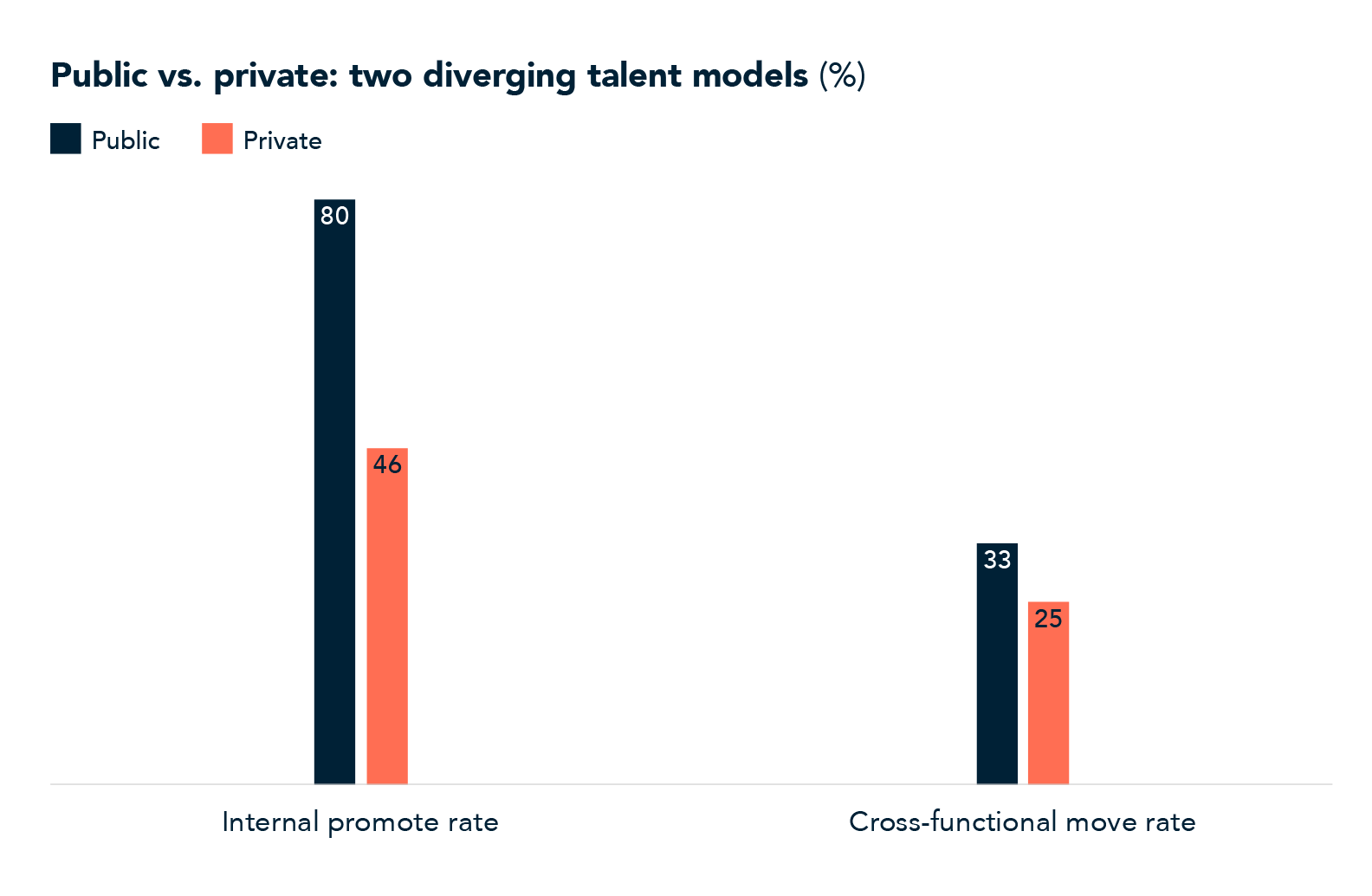
Public companies tend to follow a “build-and-broaden” model. Our analysis found an internal promotion rate of approximately 80%, compared with 46% across private and PE-backed platforms. Public company leadership teams also exhibit higher rates of cross-functional movement, reflecting a stronger emphasis on succession planning, leadership development, and the preparation of high-potential leaders for enterprise roles over time.
PE-backed companies often face a different set of priorities. Defined investment horizons place a premium on leaders with demonstrated growth track records and prior experience in PE-backed environments. Particularly at the C-suite level, direct experience in waste and environmental services can become less critical when an executive has successfully executed an analogous value-creation mandate in another sector.
That distinction extends to leadership development. Public companies are generally more likely to prepare high-potential leaders for future executive responsibility through stretch assignments and cross-functional experiences. PE-backed companies are often more inclined to recruit executives who have already gained those experiences elsewhere.
Importantly, this does not mean waste experience is less valuable. Across both ownership models, companies continue to rely heavily on experienced waste operators in frontline and operational leadership roles where institutional knowledge, regulatory expertise, and customer relationships remain essential. Public companies are generally more willing to build for potential; PE-backed companies are more likely to buy for proven experience.
The definition of “executive readiness” is expanding
Historically, many enterprise leaders followed relatively linear career paths, progressing through increasingly senior leadership roles within their respective functions before assuming broader executive responsibility. Deep functional expertise remains foundational, but it is increasingly the starting point rather than the complete profile. Leaders who have gained exposure to enterprise-wide initiatives, acquisition integration, transformation efforts, and cross-functional experiences are better positioned to lead increasingly complex organizations.
That breadth matters because the job itself is expanding. As companies expand geographically, broaden their service offerings, and invest in AI and digital capabilities, leaders are expected to think across the enterprise rather than through the lens of a single business, service line, or function. They must identify opportunities to drive commercial growth across multiple service lines, leverage technology to improve operational performance and efficiency, and navigate increasingly sophisticated investor expectations. Success depends not only on functional expertise but also on the ability to connect strategy, operations, and commercial execution while leading change and aligning a diverse set of stakeholders.
How executives gain that breadth varies. Some organizations develop it internally through cross-functional rotations, stretch assignments, and enterprise-wide initiatives. Others recruit leaders who have already built those capabilities elsewhere. Either way, the definition of “readiness” has changed. Depth gets leaders into the conversation; breadth increasingly determines who is prepared to lead at the enterprise level.