PE-backed CFOs: Evolving from experience to context-specific capabilities
The changing CFO market
The private equity investment model is changing. Longer ownership periods mean firms have more time to create value—but also more phases of value creation to navigate. Buy- and-build strategies are increasing the scale and complexity of portfolio companies, while new technologies are creating new opportunities to reshape operating models. Naturally, these factors are changing what PE firms require from the CFOs leading their portfolio< companies.
Leadership is one of the few remaining sources of competitive advantage that sits within a company’s direct control. And the CFO profile that created value during the last PE cycle may not be the CFO profile that creates disproportionate value in the next one. Private equity firms, whose investment success depends heavily on management teams' ability to execute ambitious value-creation plans, have long recognized this reality. So it makes sense that they place even greater emphasis on leadership than their peers in public markets.
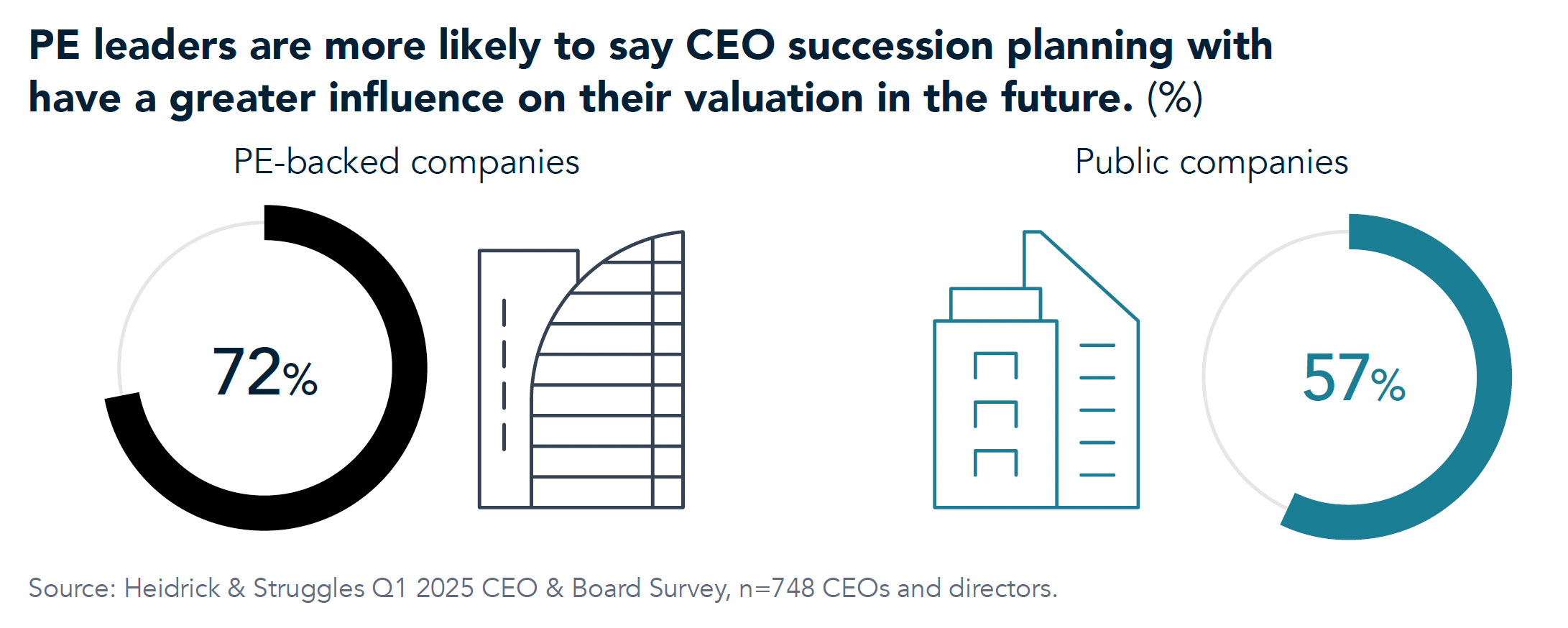
Our research shows that CEOs and directors at private equity-backed companies are more likely than their peers elsewhere to view leadership quality as a driver of enterprise value. Of those who expect change over the next five years, nearly three-quarters (72%) believe CEO succession planning will have a greater influence on company valuation five years from now than it does today, compared with only 57% of leaders at public companies who say the same.
In that context, PE firms are facing an increasingly competitive market for a relatively limited pool of CFOs with full life-cycle experience. One reason is that PE hold periods now average more than six years, while the average CFO tenure is closer to three. The implication is clear: For many PE-backed companies, the CFO in place at acquisition will not be the CFO at exit. In fact, portfolio companies may have multiple CFOs over the course of a single investment period. This dynamic is creating a structural need for CFO succession across PE portfolios and a sustained demand for experienced finance leaders.
Indeed, before 2022 the overwhelming majority of CFO searches were the result of sponsors building out leadership teams following a transaction. Between 2022 and 2025, a higher share of searches have been associated with existing portfolio companies, driven by both planned succession and unexpected turnover. This year, new leadership teams and successions at existing portcos are becoming more balanced.
A second reason for the competitive market is the CFO candidates are applying increased scrutiny to opportunities, as they see the increasing demands placed on leadership teams in the current context. They are thinking like investors before evaluating opportunities through an operator lens.
All this is causing PE firms to reconsider how they evaluate and hire portfolio company CFOs.
Looking beyond traditional credentials to broaden the candidate pool
As competition for CFO talent has intensified, sponsors have become more willing to consider candidates outside the traditional PE-backed CFO profile.
The numbers help explain why. While approximately one-third of CFOs at PE-backed companies have more than 15 years of experience as a CFO or lead finance executive, only 9% have spent more than 15 years in PE-backed businesses.1 There is considerably more deep finance leadership experience in the market than there is deep private equity experience. There is even a smaller share of candidates who have taken part in a recent successful liquidity event, exacerbated by a challenging environment for buying and selling assets.
In this context, the crucial question for sponsors is no longer how many years a candidate has worked in PE-backed companies or how many successful exits have they been a part of, but what they have demonstrated during their CFO tenure. Management teams are being asked to create more operational value to generate the same investment outcomes and in a shorter period of time. For CFOs, that raises expectations from simply reporting to providing insights, clear recommendations, and decisions. Sponsors do not simply need to know what happened. They increasingly expect the CFO to explain why it happened, what it means for the investment thesis, where risks are emerging, and what management should do next.
This is an area where we continue to hear frustration. A CFO may report the numbers accurately and still fall short of what the board needs. When finance reports information without interpreting it, board members are left to reach their own conclusions— sometimes different ones—from the same set of numbers. In an environment where alignment and speed matter, that is increasingly problematic.
The strongest CFOs operationalize finance and connect financial performance to the broader value creation plan. They turn information into insight and insight into decisions.
As demand continues to outpace the supply of proven PE-backed CFOs, sponsors are becoming more willing to look beyond traditional credentials to find the capabilities they need. In fact, step-up candidates may already exist within the sponsor’s portfolio, but may be deeper within the organization and not yet visible to the board.
More selective candidates
The supply challenge is only one side of the equation. While sponsors are competing for a limited pool of experienced CFOs, those executives are also becoming more selective about which opportunities they pursue.
Many experienced CFOs now evaluate potential roles like an investor. They want to understand the investment thesis, entry multiple, exit assumptions, equity structure, waterfall model, cap table, strike price, management team, and underlying value creation plan. Before they commit, they are asking a fundamental question: Is the thesis credible?
That increased scrutiny reflects the expectations placed on CFOs in today’s PE-backed environment. As sponsors navigate a more challenging investment landscape, there is less room for leadership teams that fail to deliver against the value creation plan.
There is clear evidence of that pressure at the CEO level. In 2025, 44% of CEOs hired into PE-backed companies were brought in because value creation under the prior leadership team had fallen short of expectations, compared with 38% the year before.2 The underlying return equation has also become more demanding. As Bain & Company has observed, “twelve is the new five,” meaning a deal may now require roughly twelve turns of EBITDA growth to generate the same return that five turns once delivered. 3
No perfect CFO profile
Broadening the candidate pool may help address the supply constraint, but it introduces a different challenge: determining which capabilities matter most for a particular company.
CFO candidates are generally evaluated across three broad dimensions: technical finance competency, leadership and behavioral attributes, and relevant career experience. What is their record of business performance improvement and value creation, and at what pace? Was the CFO only fulfilling someone else’s mandate, or were they setting direction, originating initiatives, and acting with independent conviction? Can they operate effectively with a sophisticated board and investor group? Have they demonstrated an ability to scale financial architecture to effectively support a business? Can they provide the right information at the right time, withstand rigorous scrutiny, and represent the business credibly with sponsors and lenders? Have they developed the qualitative attributes needed to succeed in the operating environment, such as a deep level of curiosity, evidence of seeking more complex challenges, or the ability to create value as opposed to completing tasks?
Ideally, sponsors want evidence across all three, with a track record that can be externally validated to reduce hiring risk.
That record of experience can be more instructive than tenure alone. In fact, roughly one in eight CFOs hired in 2025 had two years or less of PE-backed company experience. Sponsors are also increasingly considering “CFO minus one” candidates—finance executives who have already assumed much of the strategic and operational responsibility of the CFO role but have not yet held the title. These step-up candidates represent a growing share of placements.
In practice, however, few candidates are equally strong in every dimension, which means CFO selection is increasingly an exercise in understanding tradeoffs. If a candidate does not have deep PE experience, can that gap be offset by a strong finance organization with other executives who do? If a candidate does not have the depth of experience in a specific business model, have they demonstrated the ability to climb the J-curve quickly? If a candidate has exceptional strategic and operational capabilities but less experience with a particular technical requirement, is there sufficient capability elsewhere on the team? Which gaps are manageable, and which are fundamental to the investment thesis?
There is no universal answer because there is no singly, always-applicable PE-backed CFO profile.
What translates successfully in one portfolio company may not translate in another. Company structure, management-team dynamics, culture, sponsor expectations, and the value creation plan all matter. A CFO who excels in a high-growth environment may not be the right leader for a distressed turnaround asset. Similarly, an executive with deep restructuring experience may be less suited to a business whose primary challenge is accelerating organic growth.
The relevant question, therefore, is not whether a candidate looks like a successful PE- backed CFO in the abstract. It is whether their capabilities match what this particular company needs from its CFO over the next phase of the investment.
From credentials to capabilities
Longer hold periods have changed more than the timing of CFO transitions. They have reshaped both sides of the CFO market.
Sponsors face sustained demand for finance leaders at the same time that experienced CFOs have become more discerning about the opportunities they pursue. That combination makes relying on traditional credentials an increasingly incomplete approach to CFO selection.
Prior PE experience still matters, as well as technical expertise and a proven track record. But none of those on their own answer the most important question: As you consider the next CFO for a specific portfolio company, which attributes are truly non-negotiable—and where are you willing to make tradeoffs?
Sponsors and leadership teams that answer that question before beginning a search—and align around what the investment requires—will be better positioned to quickly identify CFOs who can deliver in the specific context they are entering, rather than simply candidates who look right on paper.
About the author
Joseph Huddle (jhuddle@heidrick.com) is a partner and sector lead for the Private Capital and Financial Officers practices; he is based in the New York office.
References
1 “2025 Private Equity-Backed Chief Financial Officer Compensation Survey,” Heidrick & Struggles, April 15, 2026, heidrick.com.
2 “2025 Private Equity-Backed Chief Financial Officer Compensation Survey,” Heidrick & Struggles, April 15, 2026, heidrick.com.
3 “Global Private Equity Report 2026,” Bain & Company, February 22, 2026, bain.com