PE-backed CEOs: Evolving from operator to transformation leader
The private equity investment model is changing. Longer ownership periods mean firms have more time to create value—but also more phases of value creation to navigate. Buy-and-build strategies are increasing the scale and complexity of portfolio companies, while new technologies are creating new opportunities to reshape operating models. Naturally, these factors are changing what PE firms require from the CEOs leading their portfolio companies.
Leadership is one of the few remaining sources of competitive advantage that sits within a company’s direct control. And the CEO profile that created value during the last PE cycle may not be the CEO profile that creates disproportionate value in the next one. Private equity firms, whose investment success depends heavily on management teams' ability to execute ambitious value-creation plans, have long recognized this reality. So it makes sense that they place even greater emphasis on leadership than their peers in public markets.
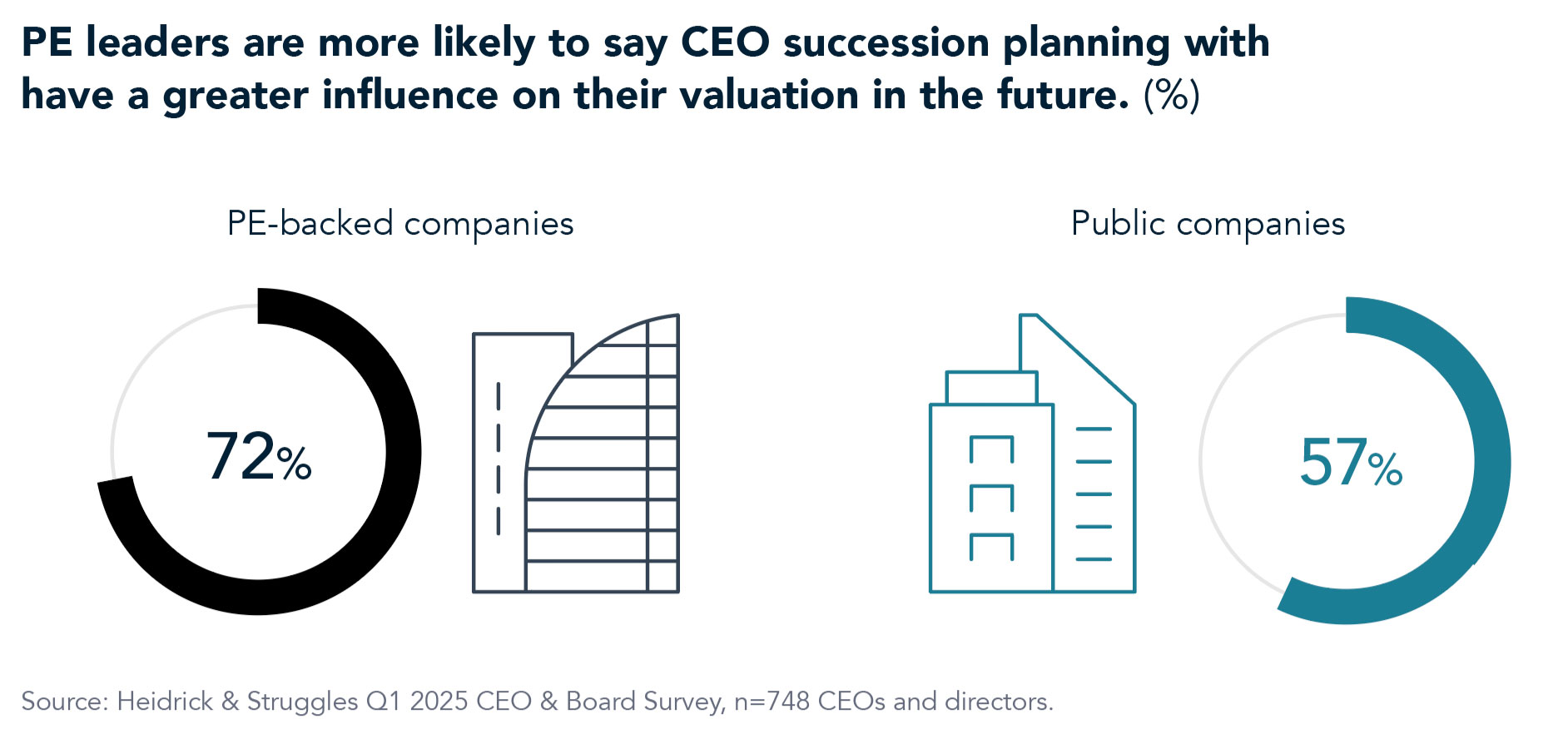
Our research shows that CEOs and directors at private equity-backed companies are more likely than their peers elsewhere to view leadership quality as a driver of enterprise value. Of those who expect change over the next five years, nearly three-quarters (72%) believe CEO succession planning will have a greater influence on company valuation five years from now than it does today, compared with only 57% of leaders at public companies who say the same.
This growing focus on succession triggers a fundamental change in the CEO mandate. Historically, private equity firms sought CEOs who could execute a proven value-creation playbook: improve operations, accelerate growth, manage investors, and prepare the business for exit. Those capabilities remain essential. But longer investment horizons, AI-driven transformation, and increasingly sophisticated value-creation strategies are expanding the definition of a successful PE-backed CEO. In addition to being exceptional operators, today's portfolio company CEOs must also be transformation leaders—executives capable of reshaping how value is created over the course of an investment.
The investment model has changed
Average private equity hold periods now exceed six years. Longer ownership periods mean companies must navigate multiple phases of value creation. A CEO may initially focus on stabilizing operations and improving profitability. Still, they inevitably must shift to integrating acquisitions, scaling the business, implementing new technologies, or preparing the company for exit.
Meanwhile, value creation itself is becoming more complex. Many firms are pursuing increasingly ambitious buy-and-build strategies, requiring CEOs to integrate acquisitions, standardize operations across platforms, and scale organizations more effectively than ever before. As portfolio companies grow in size and complexity, leaders must orchestrate transformation across multiple businesses rather than optimize individual assets.
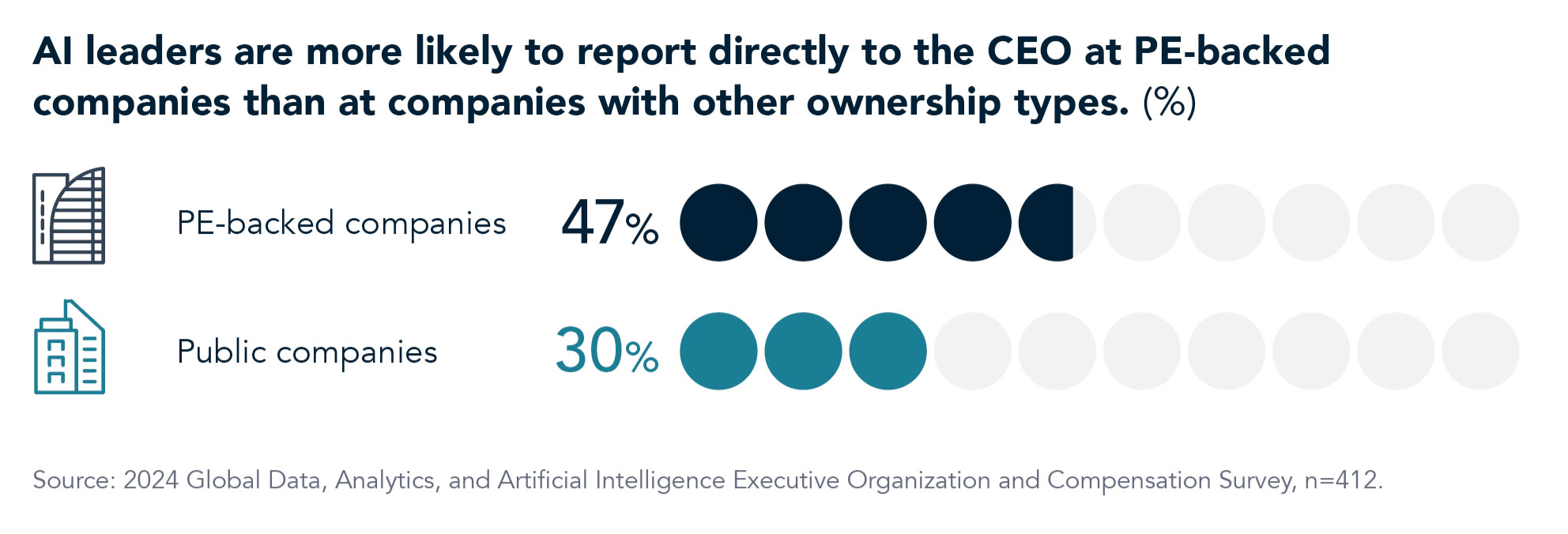
AI adds another dimension to this changing investment model, by creating opportunities to reshape the economics of portfolio companies, from productivity and operating models to customer propositions and growth. For CEOs, however, the competitive advantage does not come from becoming an AI expert. AI has emerged far too recently and quickly for deep technical expertise to be widespread, regardless of industry or prior private equity experience. Instead, a CEO’s energy is better spent focusing on where AI can create value, redesigning operating models to capture those opportunities, assembling leadership teams with the right technical expertise, and leading the organizational change required to implement new ways of working. The governance structures that make this possible are already largely in place at PE-backed companies, where almost half (47%) of AI leaders report directly to the CEO compared to only 30% at other companies.
For PE firms, longer holds, more complex value-creation strategies, and new technologies mean the investment thesis itself may need to evolve repeatedly during a single ownership period. The CEO is increasingly responsible not simply for executing a value-creation plan, but for helping redefine it as opportunities and conditions change.
The CEO mandate has changed too
This evolution places a different set of demands on portfolio company CEOs. Operational excellence remains the foundation, but it is no longer enough for a CEO to be highly effective at executing a familiar playbook. Firms increasingly need leaders who can move between different phases of value creation, adapt the organization as priorities change, and drive enterprise-wide transformation.
CEOs must combine execution with adaptability. A leader who is ideally suited to stabilize operations and improve profitability at the beginning of an investment may face a very different mandate several years later, when the priority has shifted to integrating acquisitions, deploying AI, accelerating growth, or preparing for exit. Ideally, CEOs would be able to stretch across multiple phases of that journey. But no executive has unlimited range, and firms should not assume that the leader best suited to one phase of ownership will necessarily be the leader best suited to the next.
Rather than expecting one executive to excel equally across every phase of ownership, firms should consider that each stage of the investment life cycle may call for a different leadership profile. This is where succession becomes more than a response to underperformance. Viewed through this lens, it becomes a strategic tool for aligning leadership with evolving value-creation priorities.
PE firms are already demonstrating a willingness to change leadership when value creation falls short: more than half (55%) of CEOs at PE-backed companies with two years or fewer of tenure as CEO said inadequate value creation under prior leadership was one reason they were hired. As hold periods lengthen and AI creates new opportunities to reshape businesses, investors are becoming less willing to accept leaders who can execute yesterday's value-creation playbook without adapting it for tomorrow's opportunities.
And many PE firms are already demonstrating a willingness to reassess: 76% of CEO searches at PE-backed companies launch at least one year after acquisition.1
The old definition of CEO readiness is becoming inadequate
Understandably, private equity firms have long preferred CEOs with prior experience leading PE-backed companies. This makes sense; executives familiar with private equity ownership generally understand the pace of decision-making, investor expectations, governance structures, and focus on value creation.
The share of CEOs with zero to two years of PE-backed experience in any role declined in 2025. While multiple factors may contribute to that trend, it is consistent with longer CEO tenures accompanying longer investment horizons, reducing the turnover that historically refreshed the CEO market.
As the mandate changes, prior PE experience alone becomes a less complete proxy for CEO readiness. An executive may know how to operate effectively within a PE environment without necessarily having demonstrated the ability to transform a business repeatedly as the value-creation agenda evolves. Conversely, executives without prior PE CEO experience may have led precisely the kinds of transformations that portfolio companies increasingly require.
This creates a challenging paradox. Longer hold periods increase the need for experienced leaders while simultaneously limiting the supply of qualified executives available to lead new portfolio companies. Meanwhile, firms are searching for leaders who combine operational rigor with transformation leadership—capabilities that are increasingly difficult to find in a single executive.
Unsurprisingly, many private equity firms have already begun looking beyond the traditional pool of executives who have previously served as CEOs in PE-backed environments. And the market is demonstrating an openness to transferrable leadership capabilities: 52% of CEO placements at PE-backed companies involve executives changing industries.2 That shift is likely to accelerate.
Four implications for private equity firms
As the CEO role evolves, PE firms should rethink how they identify, assess, and develop leadership through the investment cycle.
- Redefine what great looks like. Operational excellence should remain a core criterion, but CEO assessment should place a larger emphasis on transformation capability, adaptability, learning agility, and the ability to lead organizations through sustained periods of change. Firms should assess not only whether an executive has delivered results before, but how that executive has responded when the source of value, strategic mandate, or operating model had to change. The profile of an exceptional PE-backed CEO is expanding from proven operator to transformation leader.
- Broaden the CEO talent pool. Rather than treating prior PE CEO experience as a primary qualification, firms should increasingly prioritize demonstrated transformation leadership. Executives from public companies, especially technology businesses, founder-led organizations, and digitally enabled services firms may possess capabilities that are becoming increasingly valuable in private equity-backed environments.
- Evaluate AI transformation capability—not AI expertise. During due diligence and CEO assessment, firms should evaluate both the CEO and the broader leadership team through an AI transformation lens. The objective is not to identify technical specialists, but leaders who can recognize AI-enabled value-creation opportunities, redesign operating models, attract technical talent, and drive enterprise-wide adoption.
- Treat succession planning as a value-creation lever. Longer ownership periods make leadership transitions more likely—and, in many cases, more strategically valuable. The executive needed to stabilize a business may not be the same leader best positioned to drive new initiatives or prepare the company for exit. Firms that view succession planning as a continuous strategic capability rather than a contingency plan will be better positioned to maximize value throughout the investment life cycle.
Private equity firms can no longer simply search for proven operators. Instead, they must expand their criteria for leaders to find those who can both execute today’s value-creation agenda and adapt as the next one emerges.
In the next era of private equity, CEO succession shouldn't be viewed primarily as replacing an under-performing leader. It should be viewed as continuously matching leadership capability to the next source of value creation.
About the Authors
Jane Bargmann (jbargmann@heidrick.com) is a global managing partner of the Private Capital, Industrial, and Healthcare & Life Sciences practices; she is based in the Boston office.
Gustavo Alba (galba@heidrick.com) is a global managing partner of the Private Capital Practice; he is based in the Miami office.
References
1 Heidrick & Struggles analysis of 310 private equity-backed CEO appointments, 2023-2026 YTD.
2 Heidrick & Struggles analysis of 310 private equity-backed CEO appointments, 2023-2026 YTD.