AI & Technology Officers

The most valuable Physical AI leaders won’t be defined by tech credentials alone
Winning with Physical AI requires leaders who bridge technology and operations. Explore the leadership capabilities driving AI transformation at scale.
August 05, 2026
7m to read
The image that dominates most conversations about Physical AI is a humanoid robot walking across a factory floor. It makes for a compelling headline, but despite the airtime humanoids receive in everyday news, it misses the important conversation about what successful Physical AI transformations will really take.
For the past two years, most AI conversations have focused on productivity tools for speeding up office work. But Physical AI shifts the domain of adoption to anywhere where decisions have physical consequences: manufacturing lines, logistics networks, maintenance environments.
As a result, the leaders who drive successful Physical AI adoption probably won't just come from AI labs. They'll also come from operations, engineering, manufacturing, and supply chain—leaders who can coordinate decisions across people, machines, and physical assets at pace. That may sound counterintuitive until you consider where the next wave of AI is actually creating value.
Why the basis of competition is changing
Many people still think of AI as software answering questions; you put in words and get answers. Some go a step further and think in terms of agents. Physical AI forces us to go beyond both and think in terms of what are now being called “world models”: representations and predictions of how total environments—including LLMs and agents—behave, how equipment interacts, and the causal relationships and dependencies across the system.
That matters because what often limits industrial performance is the difficulty of coordinating thousands of interconnected decisions across complex physical systems. Most enterprises were designed for a slower world: one where humans made judgment calls; coordination happened through meetings and email; and planning cycles were quarterly.
Physical AI changes that equation by quickly exposing a system’s integration problems. Gaps that were previously manageable when a system could pause for human intervention will now be exposed because information doesn't flow, decision rights are unclear, and functions optimize locally instead of systemically.
Facilities that still depend on manual data entry and localized knowledge will quickly lose out to better-integrated competition. Advantage will be measured by uptime, throughput, labor productivity, safety, and margin. And unlike the efficiency gains won from office AI adoption (which will soon be just the cost of entry), Physical AI’s impact will change the cost curve, safety profile, and learning speed of the business.
Where it is already going wrong
Most organizations will fall behind because their operating model, leadership system, and coordination mechanisms aren’t engineered for continuous, machine-speed decisions.
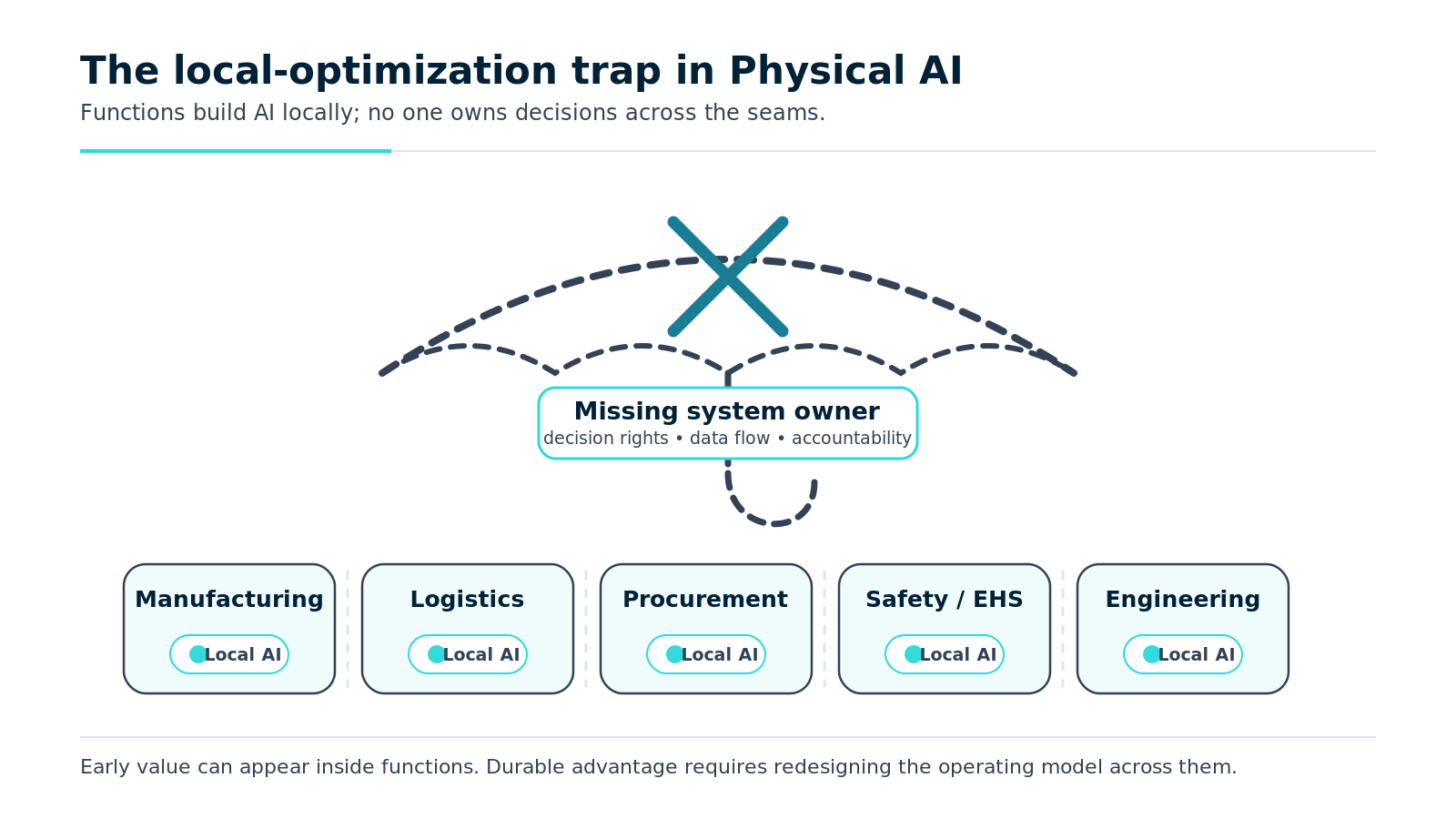
The most common failure pattern we see is functional AI being built in siloes without anyone running the broader system: manufacturing builds its own model, as does logistics, then procurement builds one too. No one is running the system as a whole. The insights and value stay local. Meanwhile, the operations that actually need to change sit at the seams between those functions—exactly where no single AI team has authority or accountability.
A close second: what we call the human patch. The integration looks clean on paper, but when you follow actual decisions through the system, someone somewhere is correcting the output before it reaches the floor. Though the AI is providing information, a human is still making the call. That’s a failure to redesign decision rights around technology. As a result, the value case that assumed full integration is never realized because the actual operating model never got there.
Underneath both failures is a leadership problem. Many operational leaders in asset-intensive companies were selected and rewarded for their ability to keep complex systems running predictably in a high-consequence environment. That is an important skill. But Physical AI runs at faster cycles; decisions that once took days must happen in seconds, or they are made without human input at all.
This has deep implications for the familiar career ladders that organizations have built for leaders. Traditionally, someone who runs a factory well will be promoted to run multiple factories. Physical AI complicates that: leadership teams must now ask how they develop someone who is an excellent human operator into someone who can make paired decisions with machines. They also have to ask where an outside technologist or systems thinker might add value, precisely because old-fashioned industry assumptions do not constrain them.
Answering these questions will help organizations understand whether they’re actually built to absorb intelligence at scale:
• Are leadership responsibilities clear?
• Are workflows designed for machine-speed decisions?
• Can the organization coordinate as a single system rather than as a collection of functions?
That's ultimately where competitive advantage will be won or lost.
The talent gap no one is talking about
It’s increasingly clear that many of the most valuable AI leaders of the next decade won’t come exclusively from tech. The organizations getting AI transformation right see the AI leadership challenge as comprising two distinct capability sets rather than a single job description.
One is technical: the ability to build and understand models, and integrate them into physical systems. These leaders will often be sourced from outside the organization, from AI labs or adjacent industries where the Physical AI muscle has already been built.
But the other is operational, and lies in the institutional credibility to translate technical capability into real change on the floor, understand risk tolerances, decision rights, and informal systems that actually determine what will make a transformation stick.
These two capabilities are frequently treated as an either/or: bring in outside AI talent and risk losing the operational trust needed to drive adoption, or promote from within and risk moving too slowly to keep pace with the technology. That framing is a false choice. The organizations pulling ahead are treating these as complementary tracks rather than competing ones, building technical capability externally where it doesn't yet exist, while deliberately developing AI fluency in leaders who carry institutional authority. Getting this balance right, rather than defaulting to one path, is likely to be the single biggest differentiator in how quickly successful Physical AI transformations scale.
That means some of your strongest leaders may come from operational functions that haven’t historically been considered hot career paths: safety and EHS, maintenance, network operations, logistics, supply chain. These leaders understand what a deviation on a production line actually means; they know the difference between a sensor anomaly and a process failure, and they’ve managed safety outcomes at scale.
Even so, companies shouldn’t confuse domain experience with readiness. A competent plant leader may have the credibility to drive adoption but likely needs help becoming more fluent in AI. A safety leader may understand frontline trust but needs a broader mandate to influence design and capital decisions. Bolstering those capabilities may require externally sourced talent.
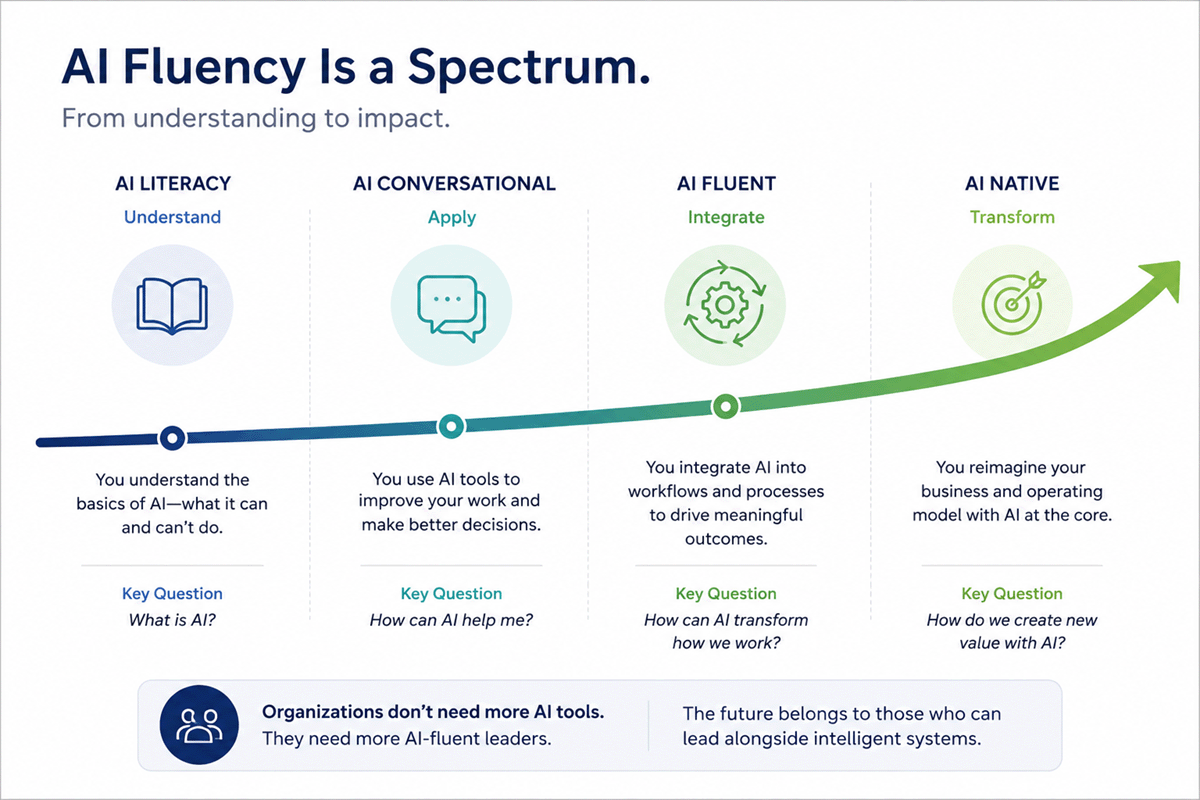
Not every leader needs the same level of AI fluency; some will just need basic literacy. But a small group in the operational camp will need sufficient competence to redesign how work gets done when machines become active participants in the operating system.
For many companies, the raw material for this leadership bench already exists. It sits in the functions that know the assets, processes, constraints, and people. Those leaders have domain authority and operational credibility. What many of them lack is the AI fluency and the organizational mandate to lead a transformation across the seams of different functions.
That gap is exactly what the coming leadership cycle will expose, and the companies that move earliest on the leadership question, not just the technology question, are the ones that will build lasting advantage.
About the author
Ryan Bulkoski (rbulkoski@heidrick.com) is co-global managing partner of the Technology & AI Officers Practice; he is based in the San Francisco office.


Stay connected
Stay connected to our expert insights, thought leadership, and event information.
Leadership Podcast
Explore the latest episodes of The Heidrick & Struggles Leadership Podcast.