CEO Succession Planning
Route to the Top Europe 2026: Companies are seeking experienced CEOs—but that isn’t enough
As geopolitical and economic volatility accelerate and technological disruption intensifies, European boards that align CEO development with a broad range of strategic scenarios will be better positioned to navigate disruption, implement fundamental changes, and sustain performance.
June 18, 2026
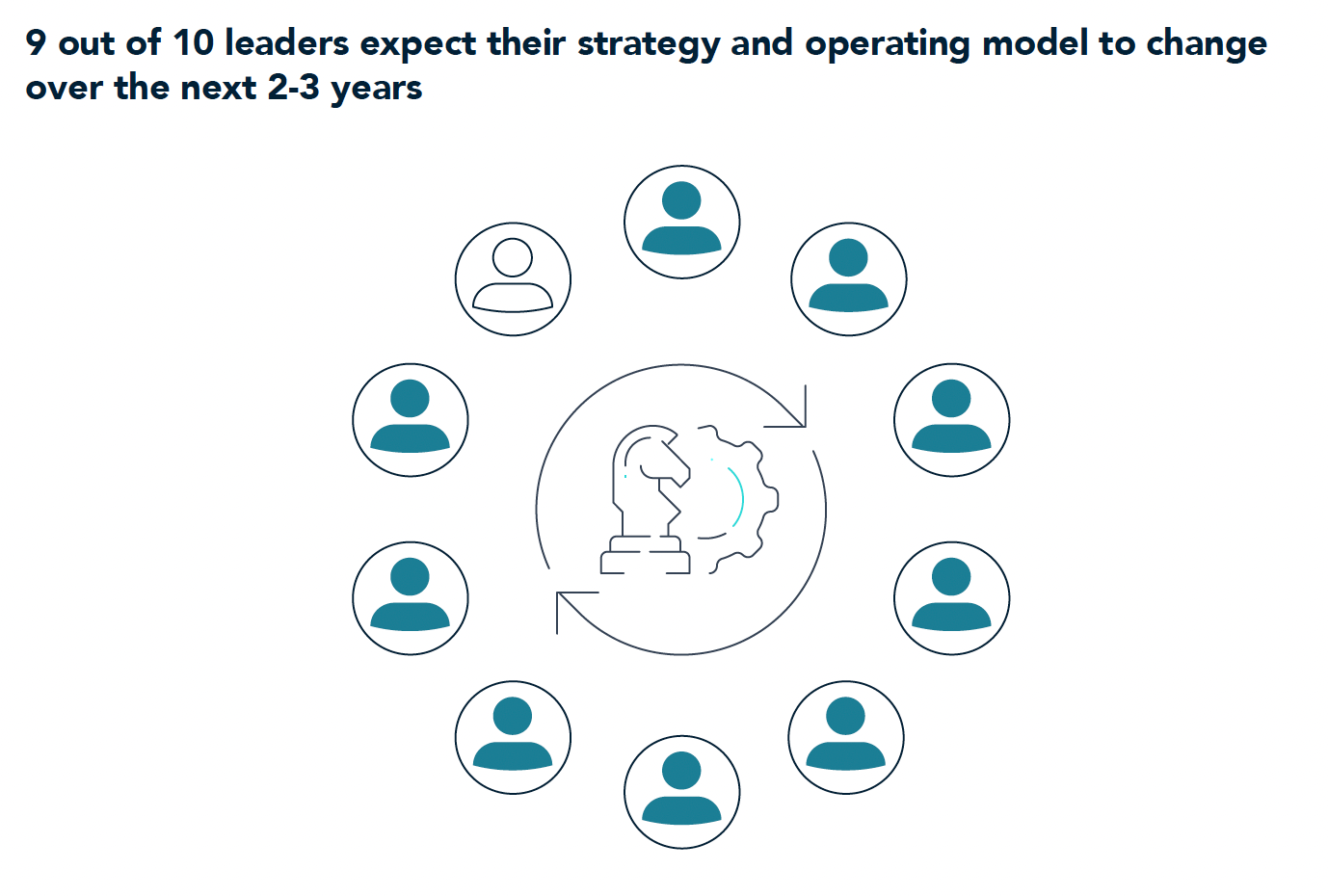
Europe’s business leaders are having to manage a confluence of pressures that have few modern precedents. Growth in gross domestic product across the region is projected to hit just 1.1% in 2026. The war in Iran has reignited fears of energy supply disruptions just as the continent had started to move past its dependence on Russian energy. And the ongoing recalibration of Europe’s relationships with Beijing and Washington is creating a leadership environment that demands measured judgment and strategic clarity. Amid all of this, artificial intelligence (AI) is consuming every board’s focus. It’s no surprise that 90% of European leaders expect their strategy and operating model to change in the near future, with half anticipating significant change, according to our recent survey of 1,033 CEOs and directors, including 299 in Europe.
Given these developments, European companies’ boards have responded by choosing leaders who have already been tested. Almost half of CEOs at Europe’s largest, publicly-listed companies have previously held the CEO title elsewhere, and the average age of sitting CEOs has risen steadily from 56 in 2021 to 57.5 in 2026.
Yet experience alone hasn’t helped companies find the right leaders for today’s environment. Indeed, 38% of respondents report a mismatch between what they think is most important for their company’s success over the next two to three years and their current CEO’s greatest strengths. Succession planning is still too reactive and held back by the idea that finding the next CEO is centered purely on replacement instead of foresight.
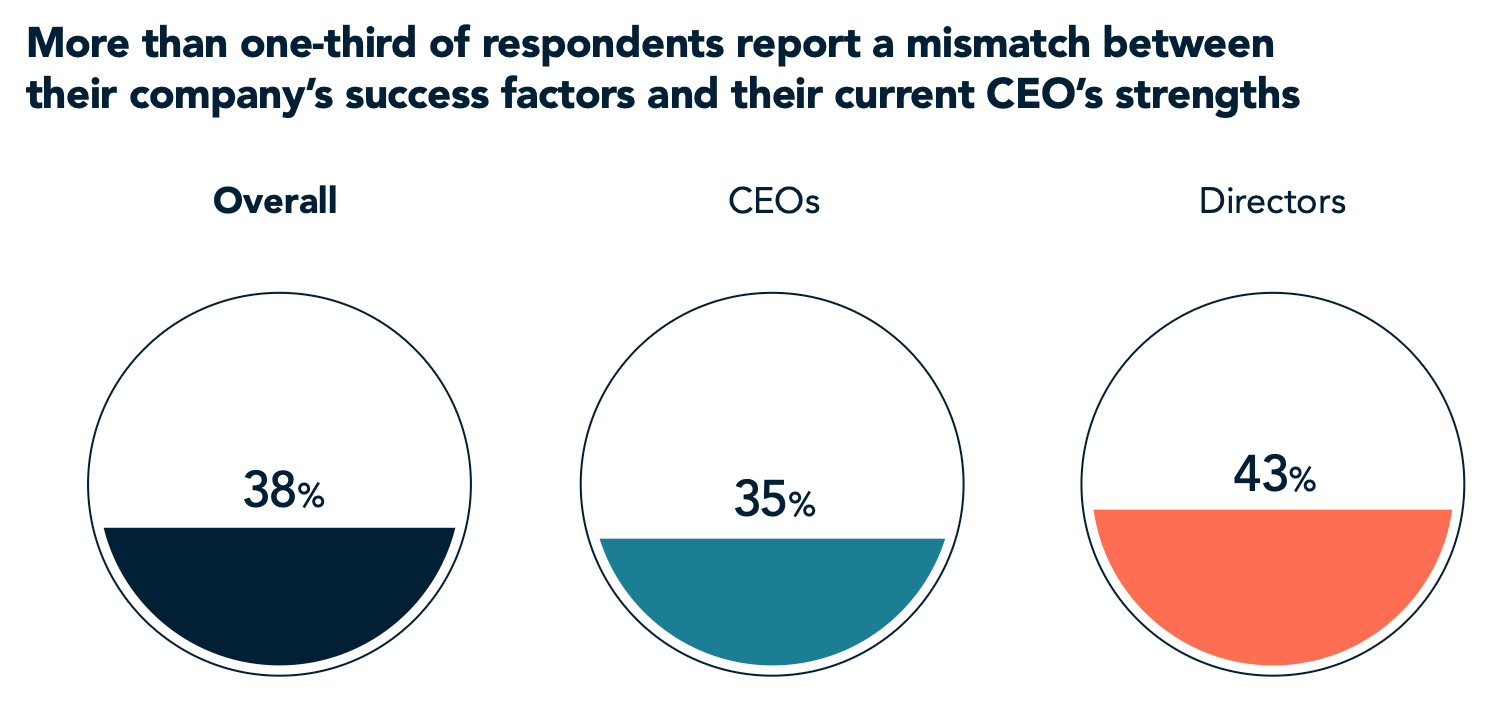

Almost 4 out of 10 European leaders report that their current CEO’s strengths do not match the skillset their organization will most need to succeed over the next two to three years. In the Benelux and Nordics regions, this situation is even more acute, with about half of respondents acknowledging the distance between what their strategies demand and what their leaders currently deliver.
The persistence of the gap between skillsets and future strategic requirements—despite boards’ turn toward seasoned leaders—sheds light on a fundamental weakness in how boards approach succession planning. The problem isn’t merely who boards select for succession, but whether they’re continually reassessing if the leadership fit aligns with shifts in strategic needs. A CEO who was right for the organization’s strategy several years ago, for example, may not be right for the current strategy or the strategy of tomorrow. Boards that treat CEO capabilities as fixed qualities assessed at the point of hire and do not revisit them leave themselves exposed to a misalignment that compounds over time.
Ongoing feedback and reflection on the CEO’s leadership is vital. Our research has established a positive association between CEO strategy fit and total shareholder return: companies whose leaders are well-matched to the organization’s most critical success factors outperform those companies where a gap exists. Decades of working with leaders, combined with our research, have shown that succession planning at every level is most effective when closely aligned with business strategy. Outcomes further improve when those succession practices are carried out consistently and holistically across the organization.1
The missing link

But even companies following best practices still have room for improvement. 8 out of 10 CEOs and directors at such companies say they’re concerned they are missing potential future leaders within their organization.
Previous Route to the Top research has repeatedly identified two conditions that predict stronger succession outcomes: alignment between business strategy and succession planning, and practices woven across the enterprise rather than contained within a single function.
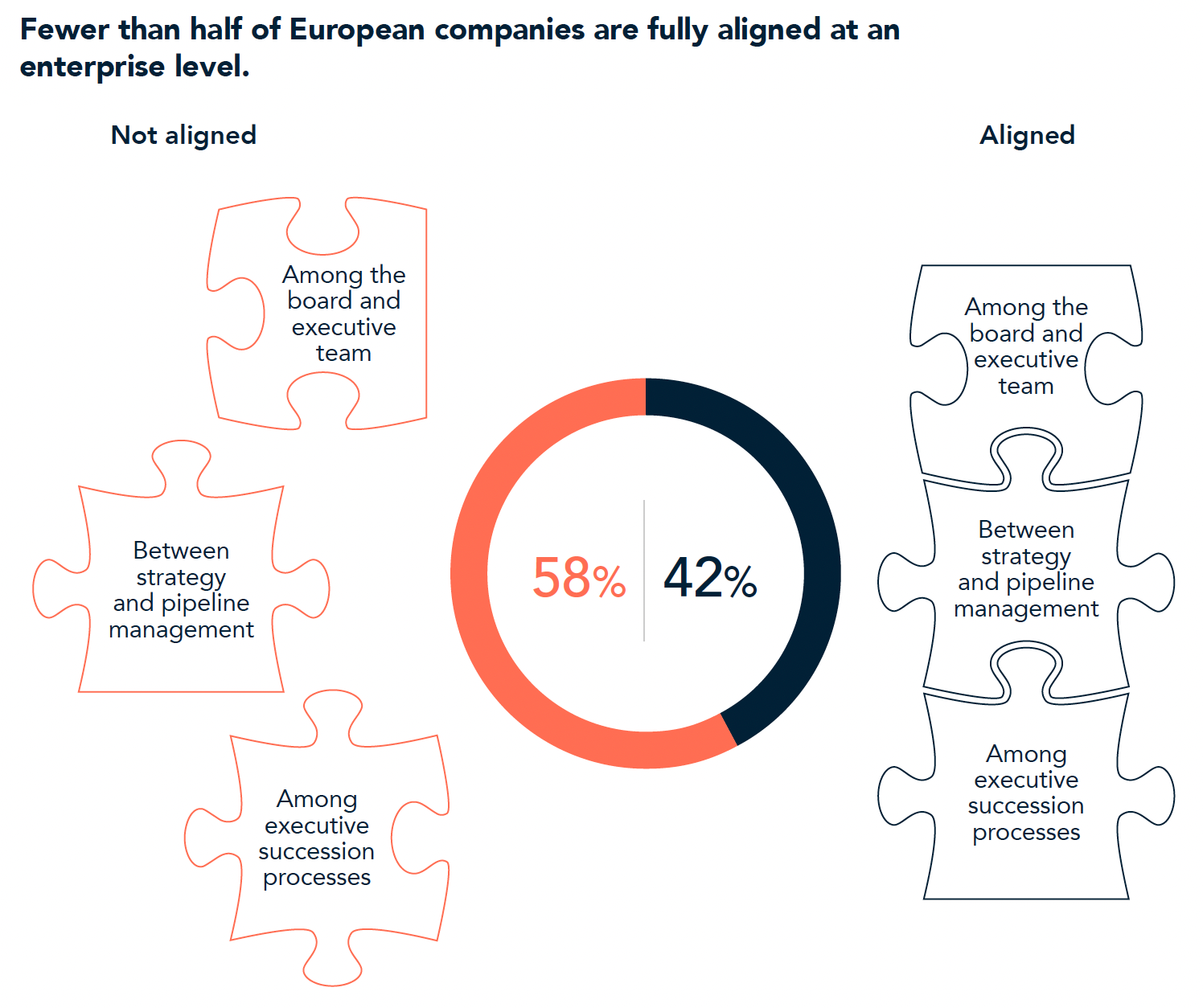
This year’s survey built on those conditions by looking at alignment across three dimensions:
• Alignment between the board and executive team: Do the CEO, board, and executive team share a common view of strategic direction and who will execute it?
• Alignment between strategy and pipeline management: Is company talent being developed today with the skills that tomorrow’s strategy will require?
• Alignment across leadership development processes: Do hiring, leadership development, and succession planning function as a coherent, mutually reinforcing system?
Our survey found that fewer than half of European companies achieve alignment across all three dimensions—and that the majority of companies that are aligned are only moderately so, suggesting alignment is fragile.2
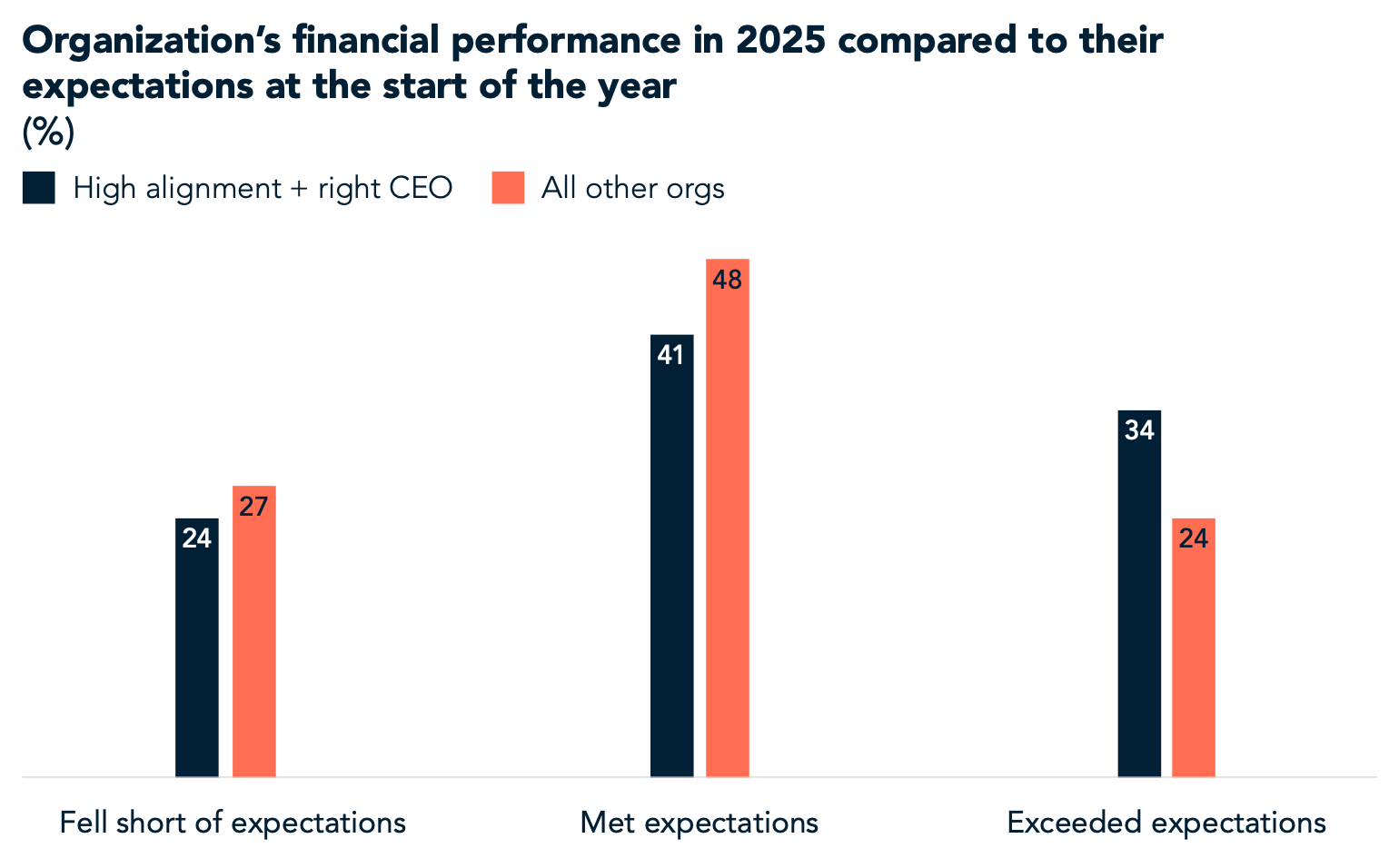
When a company has enterprise-wide alignment and a CEO whose strengths match the most important success factors for the organization, the company sees meaningfully better results. Thirty-four percent of European companies with high alignment and the right CEO exceeded their financial performance expectations over the previous year, compared with only 24% of their peers. These companies are also more likely to see improved organizational outcomes, such as a purpose-driven culture and effective decision making, both of which further support performance.
But even aligned companies with the right CEO have room for improvement. Only one-third of these companies treat succession planning as a priority and 8 out of 10 CEOs and directors at such companies say they’re concerned they are missing potential future leaders within their organization. Aligned organizations that have the right CEO are more likely to have defined success metrics, but those metrics are often limited. For example, only 10% of respondents say the quality of the pool of internal CEO candidates is a KPI for the CEO and the CHRO. Once organizations treat succession planning as a priority, our research shows their plans become more robust by continually managing succession planning and creating defined success metrics for it.
We also know that underlying leadership qualities, such as curiosity, humility, open-mindedness, and the ability to work well with others, become even more vital in volatile and complex environments. Leaders with these attributes inspire people to follow them and are better at orchestrating ecosystems of external partners. This doesn’t mean these leaders are soft or unable to make difficult decisions; instead, they have a knack for collaborative problem solving.
Simply put, companies benefit from having the right CEO today while investing in the succession planning needed to find the right CEO tomorrow. Just as companies consider a range of strategic scenarios to address volatility, they too must cultivate a broader pipeline of potential leaders capable of succeeding under different conditions. Developing multiple leaders internally while keeping an eye on external benchmarks gives boards greater optionality.
The cost of waiting
Although some boards may worry that visible succession planning efforts could lead to market disruptions or reputational rumors, an ongoing, capability-focused approach can help mitigate those risks. As organizations move away from prioritizing experience alone and focus on identifying the leadership profile best suited to a range of potential scenarios, succession planning becomes less about evaluating any one individual and more about continually aligning leadership capabilities with evolving business needs. When such a mindset is normalized, an ongoing process is less likely to become stigmatized or misinterpreted, both internally and externally.
A CEO’s experience that premium European boards have pursued through external hiring hasn’t been matched by investment in building the next generation from within the organization. Organizations that handle succession most effectively approach internal succession as a continual practice instead of a periodic exercise. They invest early in potential internal candidates and communicate openly about their development trajectories. They revisit capability frameworks as strategic requirements shift and are willing to make difficult changes when performance falls short, rather than waiting until circumstances force the issue.
With growth nearing a stagnation point and geopolitical pressures showing no sign of easing, European boards face a CEO development and selection challenge that’s not very forgiving. Opting for experienced leaders is a rational response to uncertainty, but experience is only a foundation, not a guarantee of success.
The organizations best positioned for what comes next are those that combine having the right CEO today with the alignment and succession practices needed to appoint the right CEO for the future. As European boards stress-test their strategies against a wider range of scenarios, they must mitigate the risk in appointing future CEOs by developing a wider range of potential leaders to suit those scenarios. This practice gives boards optionality at moments of transition rather than forcing decisions under pressure.
References
1 “Route to the Top 2025 | The ascent redefined: Charting more effective routes to the summit,” Heidrick & Struggles, July 23, 2025, heidrick.com; “CEO and board confidence monitor: Beating the succession planning paradox,” Heidrick & Struggles, October 30, 2024, heidrick.com. Additional research forthcoming.
2 See the online methodology for details on how the alignment score was calculated.
Stay connected
Stay connected to our expert insights, thought leadership, and event information.
Leadership Podcast
Explore the latest episodes of The Heidrick & Struggles Leadership Podcast.