CFO focus: Building future-ready CFO leadership in Asia Pacific
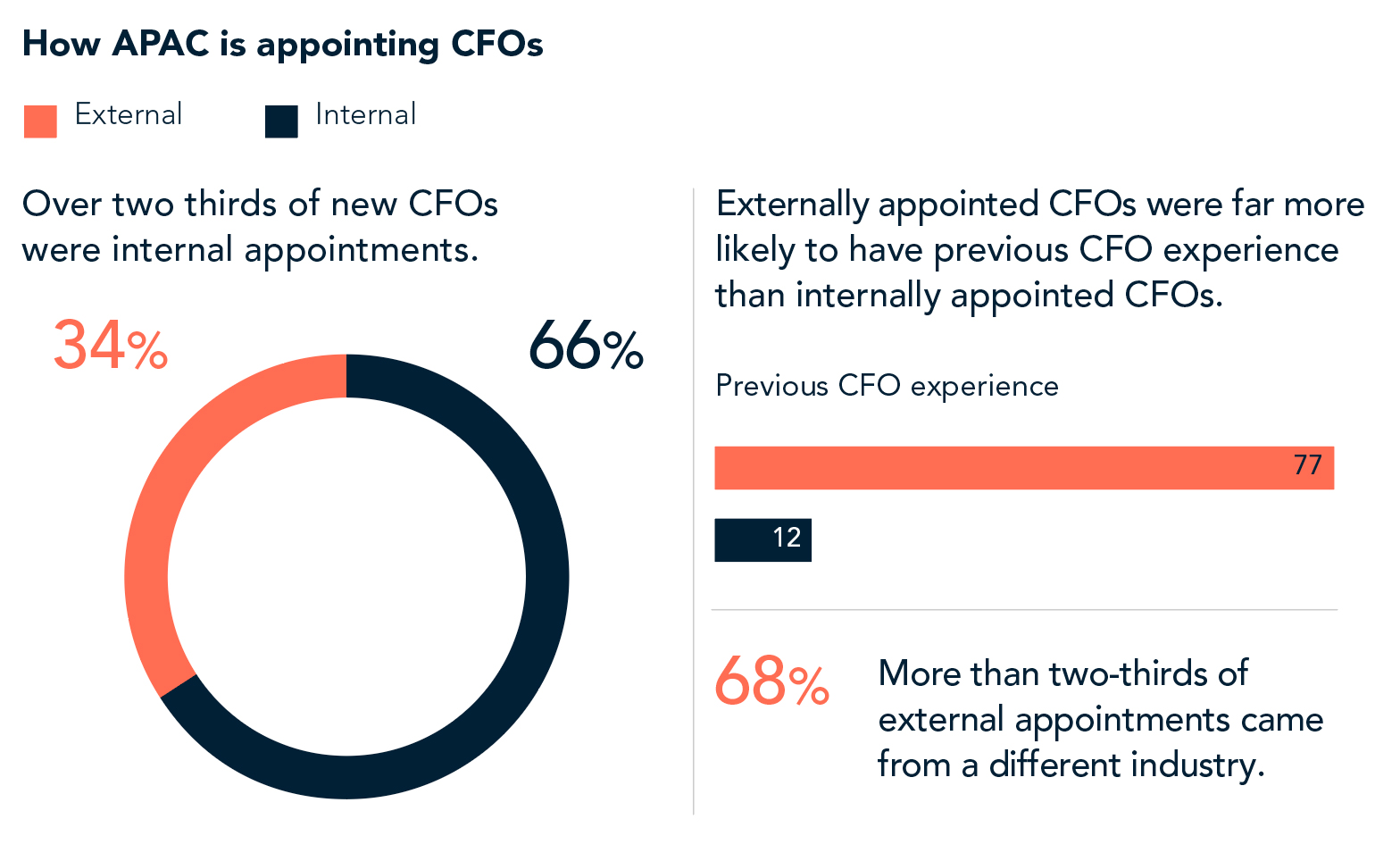
Asia Pacific (APAC) organizations are increasingly favoring proven or familiar CFO candidates: in 2026, 66% of CFO appointments across the largest listed companies in the region have been internal—the highest share in five years—and 77% of external appointees have previously held a CFO role.1
There is a clear rationale for this preference. CFOs are operating against a backdrop of economic and geopolitical uncertainty while taking on greater responsibility for capital allocation, technology investment, transformation, and enterprise strategy. Appointing someone who has already performed at the CFO level, or who is well known to the organization, provides a degree of confidence at a time when the demands of the role are increasing. Furthermore, the expanding CFO mandate is strengthening the role as a potential pathway to the CEO position. Experience with capital allocation, transformation, and enterprise strategy gives CFOs exposure to many of the decisions that sit at the heart of the CEO role.
The longer-term question is whether experience gained in yesterday’s operating environment is, on its own, the best predictor of what organizations will need tomorrow. AI and technology are changing business models; geopolitical and regulatory shifts are changing how companies operate; and investors are placing greater emphasis on future value creation. Organizations increasingly need to be clear about where future value will come from and what could disrupt it. As the business changes, the capabilities required of CFOs are evolving in tandem.
This volatility and pace of change also make the development of the next generation increasingly important. Every experienced CFO was once given a first opportunity to take on the role; if organizations increasingly draw from the same pool of established CFOs, they risk limiting both the supply and breadth of leadership available for the future. Maintaining a strong bench of potential CFOs, therefore, depends on companies continuing to name first-time CFOs and develop high-potential finance leaders by ensuring those leaders get the experiences and exposure that will allow them to develop the wide range of skills, knowledge, and adaptability needed to thrive today. This is not about choosing between experience and potential but about ensuring organizations continue to have credible options across both.
These issues are closely connected: building a business for the future requires clarity on where it will create value and the capabilities needed to deliver it; CFO succession should start from the same place. That alignment cannot be taken for granted. Across APAC, 38% of CEOs and directors report a gap between their CEO’s current strengths and the capabilities their organization will need for future success, while 49% report a similar gap for their board.2 The same risk applies to CFO succession: selecting leaders based primarily on what has worked in the past may leave organizations without the capabilities they will need next. Organizations need to consider what the future business will require from its finance leadership, develop potential successors against that mandate, and understand how their internal talent compares with the external market.
Volatility and technology are reshaping the CFO mandate
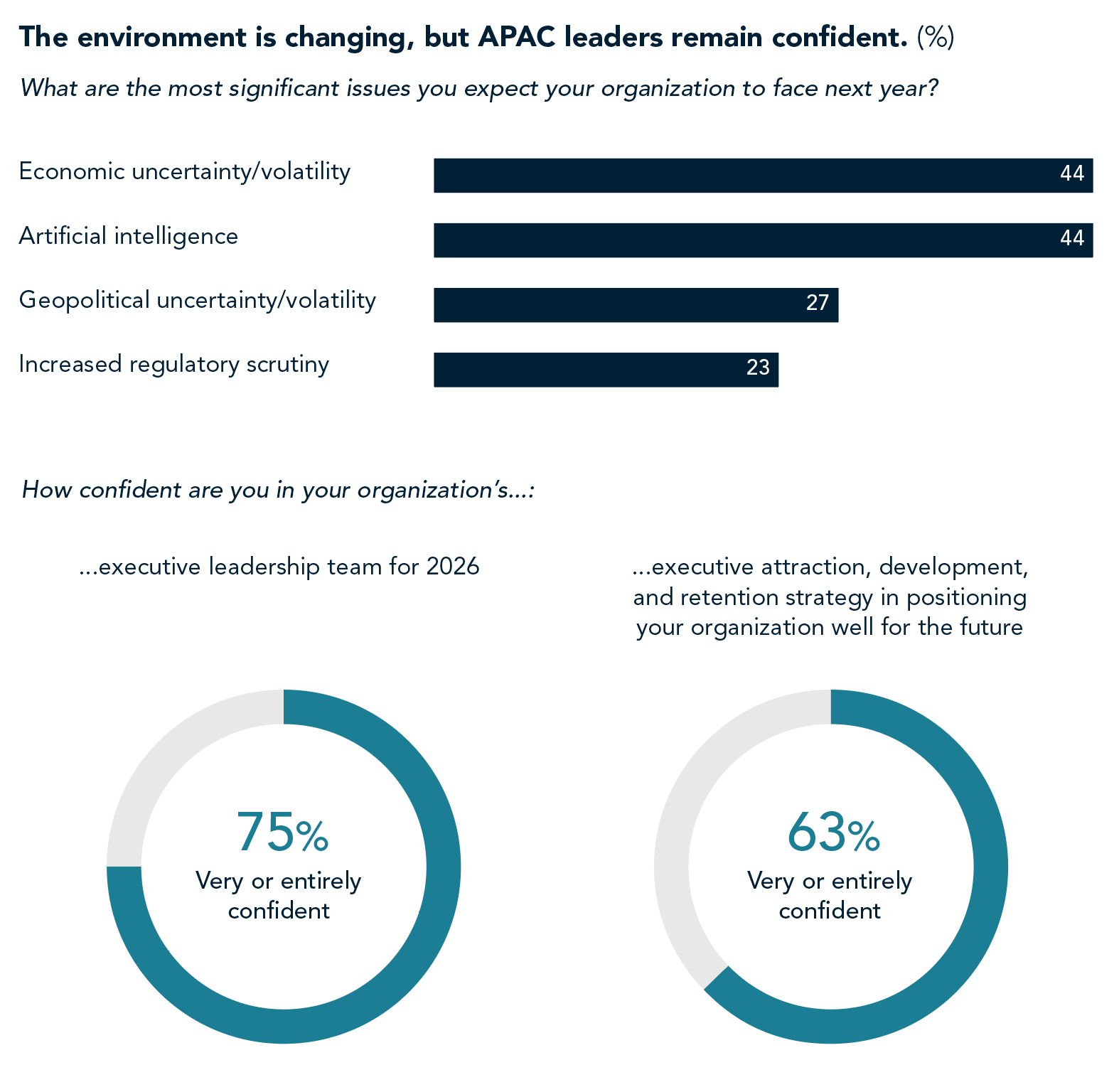
Economic volatility and AI are tied as the two most significant issues that CEOs and directors in APAC expect to face, according to our most recent Confidence Monitor report. Globally, economic uncertainty has remained the leading concern for three consecutive years, while AI was the fastest-growing concern, rising 18 percentage points year on year.
Despite this uncertainty, APAC leaders remain relatively confident in their organizations: 75% of CEOs and directors are confident in their current executive leadership teams, while 63% believe their approach to executive attraction, development, and retention is positioning the organization well for the future, the highest share of any region tracked.
For CFOs, these shifts are changing the substance of the role. Our ongoing conversations with CFOs across Japan, Korea, and Singapore reveal growing attention to capital efficiency, shareholder value, and investor engagement. This is placing greater emphasis on how CFOs allocate capital, articulate where the business will create value, and translate strategy into financial outcomes. Simultaneously, they increasingly need to evaluate the commercial returns of AI and technology investment, lead productivity and transformation, and navigate geopolitical and regulatory complexity.
Boards are reaching for known entities
The preference for familiarity is visible in the different routes organizations are taking to the CFO role. Internal appointments account for 66% of 2026 CFO hires through August, a substantial increase from 49% in 2025; these appointees are predominantly executives stepping up to group CFO for the first time. When organizations have hired externally, however, 77% of appointees have previously held a CFO role, compared with 70% in 2025. By contrast, only 12% of internal appointees have previous CFO experience.3
The pattern can be summarized simply as “proven here or proven elsewhere.” Organizations appear willing to create first-time CFOs from within, where they already know the individual’s track record, capabilities, and potential; when they go outside, previous CFO experience carries considerably more weight.
That leaves a more difficult route for the high-potential divisional or regional finance leader from another organization. They may have many of the capabilities required for the role, but they are neither known internally nor able to point to a previous CFO appointment.
Interestingly, boards appear more flexible on sector experience. In 2026, 68% of external CFO appointees came from other industries, continuing a pattern of significant cross-industry hiring. Prior CFO experience, however, appears to be a harder requirement to relax (see sidebar, “What ‘ready now’ looks like across APAC”).
As the CFO mandate changes, an important question arises: How much weight should having done the job before carry relative to having the capabilities and experience required to do the job next?
The pool of proven CFOs is finite
Despite the premium on candidates who have already held the CFO role, the pool of leaders who meet that requirement is finite and subject to pressure from both ends. A significant cohort of experienced CFOs is approaching the later stages of their executive careers at the same time that successful CFOs increasingly have credible opportunities to move beyond finance.
The demographics of the current APAC CFO population illustrate one side of that challenge. Of the 282 CFOs for whom we have age data, nearly half are 55 or older, and only 11% are under 45. This does not suggest an immediate retirement cliff, but it does mean that a meaningful share of the region’s most experienced CFO population is likely to transition over the coming years.
CFOs are more often than ever leaving the role not for retirement but for broader responsibilities. As the role has expanded across strategy, operations, transformation, capital allocation, investors, and increasingly technology, successful CFOs are building experience that can position them for roles such as CEO, president, or COO, as well as board opportunities.
The result is a structural tension in the CFO market: companies want leaders who have already proven themselves in the role, even as experienced CFOs approach retirement or pursue broader leadership opportunities. The growing use of interim CFOs offers another signal of that pressure. In North America and Europe, CFOs already account for more than half of all interim C-suite requests tracked in our 2026 High-End Independent Talent Report. Interim leadership can provide valuable experience during a transition, but its prevalence also underscores the value of developing credible CFO options before an unexpected vacancy occurs.
Continuing to create first-time CFOs is therefore essential to replenishing the experienced talent pool companies will rely on in the years ahead.
Don’t just hire known entities; create them
A preference for proven or familiar candidates also has implications for the breadth of the future CFO pool. The executives who are considered “proven” today reflect the opportunities finance leaders were given earlier in their careers: P&L responsibility, regional or divisional leadership, exposure to investors and boards, and ultimately the opportunity to become a first-time CFO.
Gender provides one example of why this matters. Women represent approximately 21% of the current APAC CFO population we track, yet they account for only 16% of appointments in 2026 through August—down from 31% in 2022. Broadening the pipeline depends on ensuring a wider range of finance leaders gain the experiences, senior-level exposure, and opportunities that build CFO readiness. Otherwise, organizations are developing future CFOs from only part of the available talent pool, further narrowing succession options in an already constrained market.
The question is therefore not only who appears on the eventual CFO short list but also whether organizations are developing a sufficiently broad range of finance leaders to create that short list in the first place.
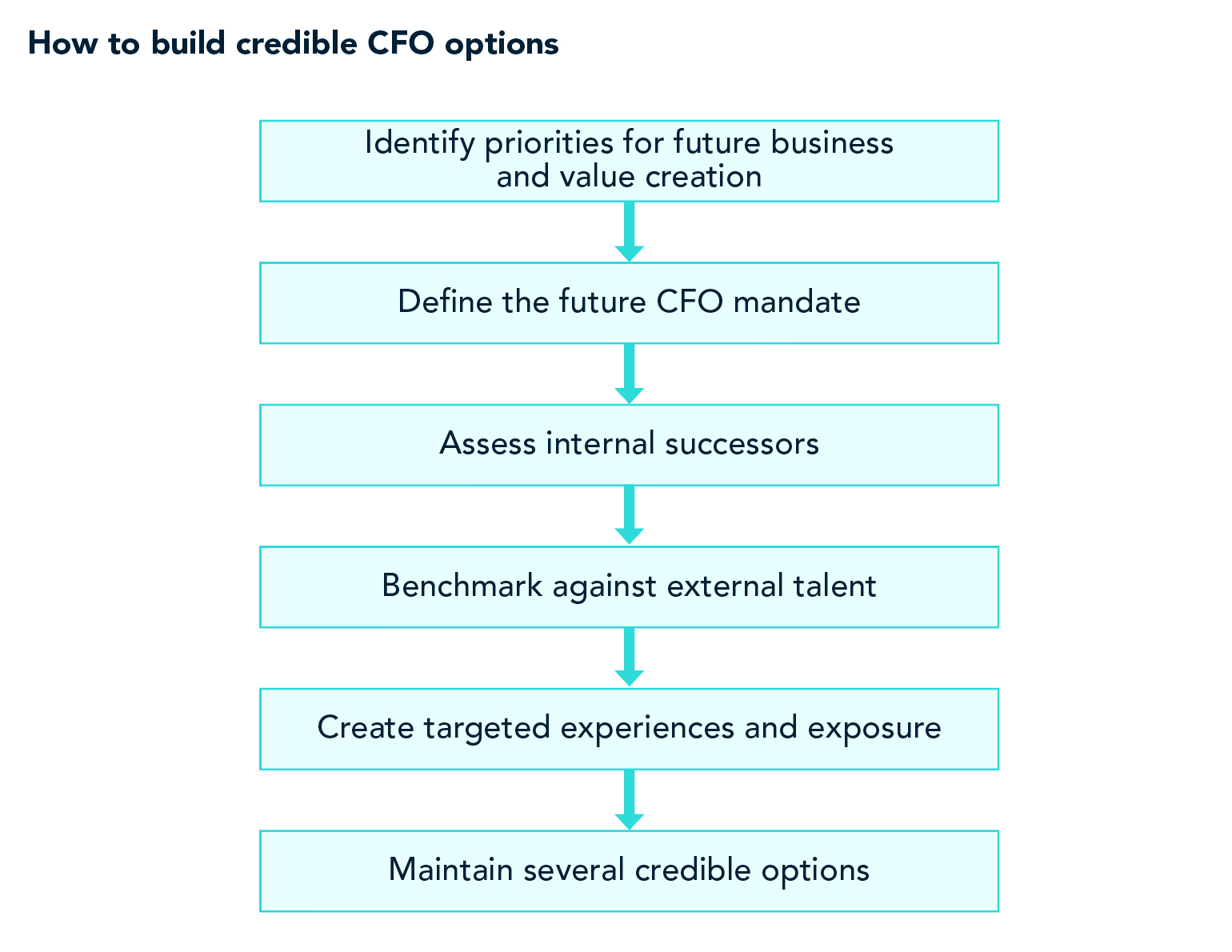
Building more credible CFO options does not require organizations to choose between proven experience and emerging potential. It requires them to be clear about what the future business will need from its CFO, understand the strengths of the leaders they have today, and deliberately develop and benchmark the options they may need tomorrow.
Define future business needs first, then define the CFO the business requires
Succession should begin with the direction of the business rather than the profile of the incumbent. Where does the organization expect to create value over the next three to five years; what could disrupt that strategy; and what will the CFO need to be able to do differently as a result? These questions should be revisited regularly as the strategy and operating environment evolve, making succession planning a continuous process rather than a periodic exercise.
The success profile can then reflect the capabilities required to execute that strategy, whether those relate to capital allocation, transformation, technology, investor engagement, M&A, international growth, or other priorities. Because the future direction of the business may change, organizations should also develop more than one potential successor, with candidates whose different strengths provide options for a range of possible future needs.
This provides a more objective basis for assessing candidates: rather than asking who most closely resembles the current CFO, organizations can consider who is best equipped for the mandate ahead.
Build several options and benchmark them against the market
Succession should provide options across different readiness horizons and strategic scenarios: someone capable of stepping in immediately, potential successors who could be ready within two or three years, and other high-potential leaders whose capabilities may become increasingly relevant as the business evolves.
The internal bench should also be tested against the external market. Regular mapping and benchmarking of CFO and CFO-1 talent can help organizations understand where their internal candidates are strong, which capabilities need further development, and how the market for finance leadership is changing.
External hiring can itself form part of succession planning. Where an organization identifies a capability gap, bringing in CFO-1 talent before a vacancy arises allows that executive to build relevant experience and become known to the business and its leadership over time.
Create the experiences that make CFOs
If organizations want credible first-time CFO options, potential successors need opportunities to develop and demonstrate the breadth required for the role. Across APAC, those experiences may include regional or divisional CFO positions, P&L and commercial responsibility, capital allocation, investor engagement, M&A and integration, enterprise transformation, AI-enabled finance initiatives, and IPO or capital markets exposure.
Visibility matters, too. Presenting to an audit or risk committee, participating in an investor day, or leading a board discussion on capital allocation gives emerging leaders the opportunity to demonstrate judgment and enterprise leadership before a succession decision needs to be made.
For incumbent CFOs, developing the next generation is also part of building a strong finance function: offering opportunities for high-potential leaders to broaden their experience strengthens the organization today while creating more credible succession options for the future.
Building credible options for tomorrow
The preference for proven CFOs is understandable, particularly in an uncertain environment; experience matters, and there will continue to be situations where it is exactly what an organization needs. But today’s CFOs built their experience in a different operating environment, and the businesses they are being asked to lead will soon look different as well.
The same discipline organizations apply to their strategy should therefore apply to their CFO succession: be clear about where the business is going and where future value will come from, understand what could disrupt that path, determine the leadership capabilities required to execute it, and start building those capabilities today.
That means looking beyond the next appointment. Organizations need leaders who are ready now, but they also need to continue creating first-time CFOs, giving emerging finance leaders the experiences through which they can prove themselves and testing the strength of that pipeline against the external market. Today’s high-potential finance leaders are part of tomorrow’s pool of experienced CFOs.
Building more credible options is ultimately about ensuring that when the business changes or a succession decision arrives, the organization has choices that reflect where it is going rather than only where it has been.
Three questions provide a useful starting point: Who could step in tomorrow? Who could be ready in two years? And who on that list would surprise you?
About the author
Dorothy White (dwhite@heidrick.com) is a principal in Heidrick & Struggles’ Singapore office and a member of the global Technology & Services and Private Equity practices.
References
1 Heidrick & Struggles proprietary analysis.
2 Heidrick & Struggles Survey of CEOs and Board Members, Q1 2026, n=1,033.
3 Heidrick & Struggles proprietary analysis.
4 Andrew Hedgman, “Women lose ground in ASX executive teams as new CEW report warns of growing backlash to gender equity,” PerthNow, October 13, 2026.