CFO focus: How comprehensive succession planning creates value
Few executive appointments are as consequential as the CFO, and the most effective CFO succession plans are the ones that prioritize optionality. Whether a new CFO comes from inside or outside the organization, the goal for the CEO and board is to create enough flexibility to choose a leader best equipped for what comes next.
Investing in credible internal successors broadens the choices available to the CEO and board, allowing companies to approach the external market as an option rather than as a dependency.
Options are critical because the CFO role today sits at the intersection of strategy, operations, performance, capital allocation, risk, technology, investor relations, and, increasingly, transformation. The capabilities of whoever fills this seat are material to an organization’s ability to execute and create value.
Yet succession planning often receives far less rigor than other decisions with comparable implications. Fewer than a third of companies say that receiving the same level of information on succession as on financial reporting or strategic risk would help in positioning their organization well for the future.1
CFO transitions are not rare events that organizations can afford to address only when a departure is imminent. They are a recurring feature of corporate life, and succession planning must become an ongoing discipline, too. When the time comes to appoint a successor, companies face a market in which deep, proven experience is increasingly concentrated among a relatively small group of CFOs. Organizations that have not developed credible internal successors can find themselves with fewer choices precisely when the stakes are highest.
Defining the capabilities the business will need from its future CFO and developing multiple leaders toward that mandate over time puts companies in a stronger position to make that choice.
The external market is one of several options
CFO turnover is inevitable, and external supply is limited. Across Fortune 1000 companies, the CFO seat turns over every 4.6 years on average, generating around 160 to 190 CFO transitions each year. Since 2022, more than 750 CFO transitions have happened, with 41% of the appointments going to external candidates and 59% to internal candidates.
For companies looking outside, the market for proven CFO talent is unusually tight. In the first quarter of 2026, 82% of externally appointed CFOs had prior CFO experience, up from 57% in 20222 But prior experience alone does not make someone a strong performer or the right fit for a particular organization and mandate. This makes the pool of experienced CFOs who also have the right capabilities, track record, and company fit narrower still.
Highly sought-after executives also have options beyond another CFO seat. Sitting CFOs may be considering a step up to CEO or board positions, while a growing number are also moving into dual roles as CFO and COO or president.
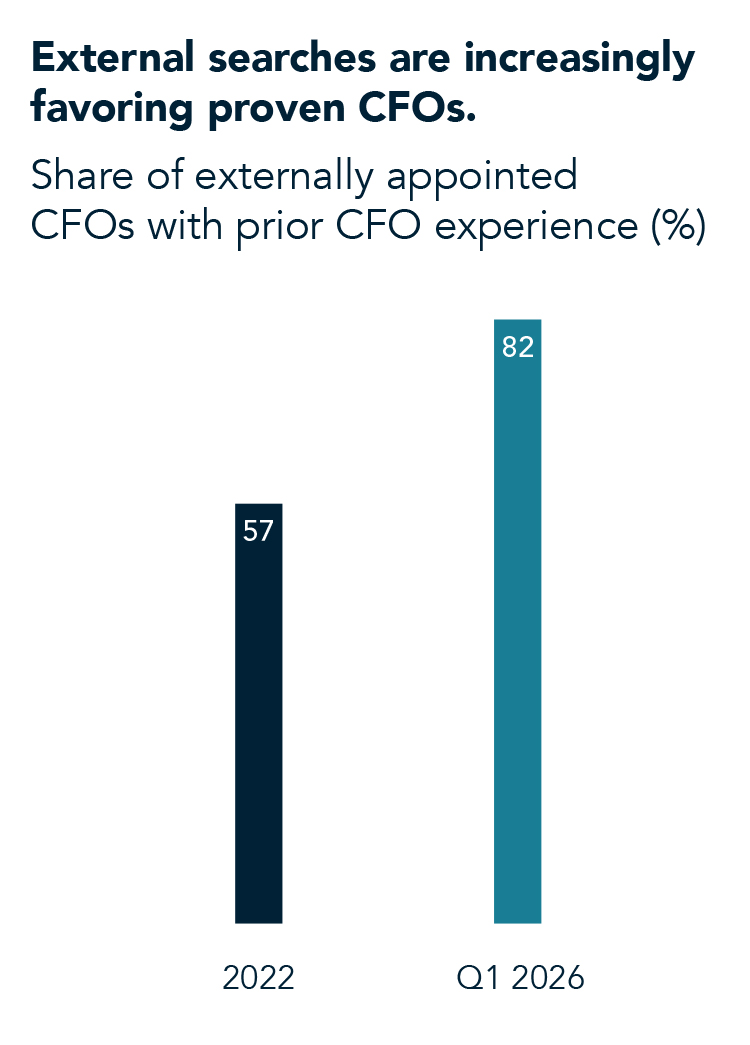
In other words, demand for proven CFO experience exceeds the supply of executives who have it. This creates a paradox: because the CFO role is so consequential, organizations understandably gravitate toward candidates who have already done the job. Fewer executives are given the opportunity to gain that experience in the first place, further constraining the future CFO talent pool.
Successful sitting CFOs may have relatively little reason to move, compounding the challenge. They have established credibility, deep organizational knowledge, relationships with the CEO and board, and potentially significant unvested equity. In our experience, attracting them to a new organization often requires a compelling reason to leave rather than the opportunity to simply take on another CFO role.
Internal succession is a clear alternative—and one that a slim 3 Without plausible internal successors, an organization has effectively decided in advance that its next CFO must come from outside.
Building a credible internal pipeline gives organizations genuine choice. They can develop leaders who already understand the business, giving these internal candidates the experiences they need to become credible successors while the organization continues to benchmark the candidates against the strongest external talent. And rather than beginning a search only when a vacancy arises, organizations can evaluate internal and external candidates against the same future-focused mandate.
That optionality matters because the strength of the leadership pipeline can affect the performance of the business. Companies that approach CEO succession strategically are nearly three times as likely as reactive companies to say the quality of their leadership pipeline is increasingly material to their valuation—51% compared with 19%.4 Seen through this lens, building the CFO pipeline is an investment in the leadership capabilities the organization will need to perform and create value in the future.
Let the future mandate define the CFO profile
The first step to developing an internal candidate pipeline is determining what the future CFO will need to accomplish in the role. Succession planning should therefore begin with the direction the business is heading rather than with the profile of the incumbent or the candidates who happen to be available today.
Starting anywhere else risks a mismatch between the capabilities an organization has and those it will need in the future. According to our recent Board Monitor and Route to the Top analysis, CEOs and directors in the United States report misalignment between the capabilities needed for future success and the greatest strengths of 61% of boards and 36% of CEOs. Organizations should avoid making the same mistake with their CFOs to position themselves well for what lies ahead.
With the future direction defined, organizations can determine the type of CFO they need. In our experience, there are four main CFO archetypes:5
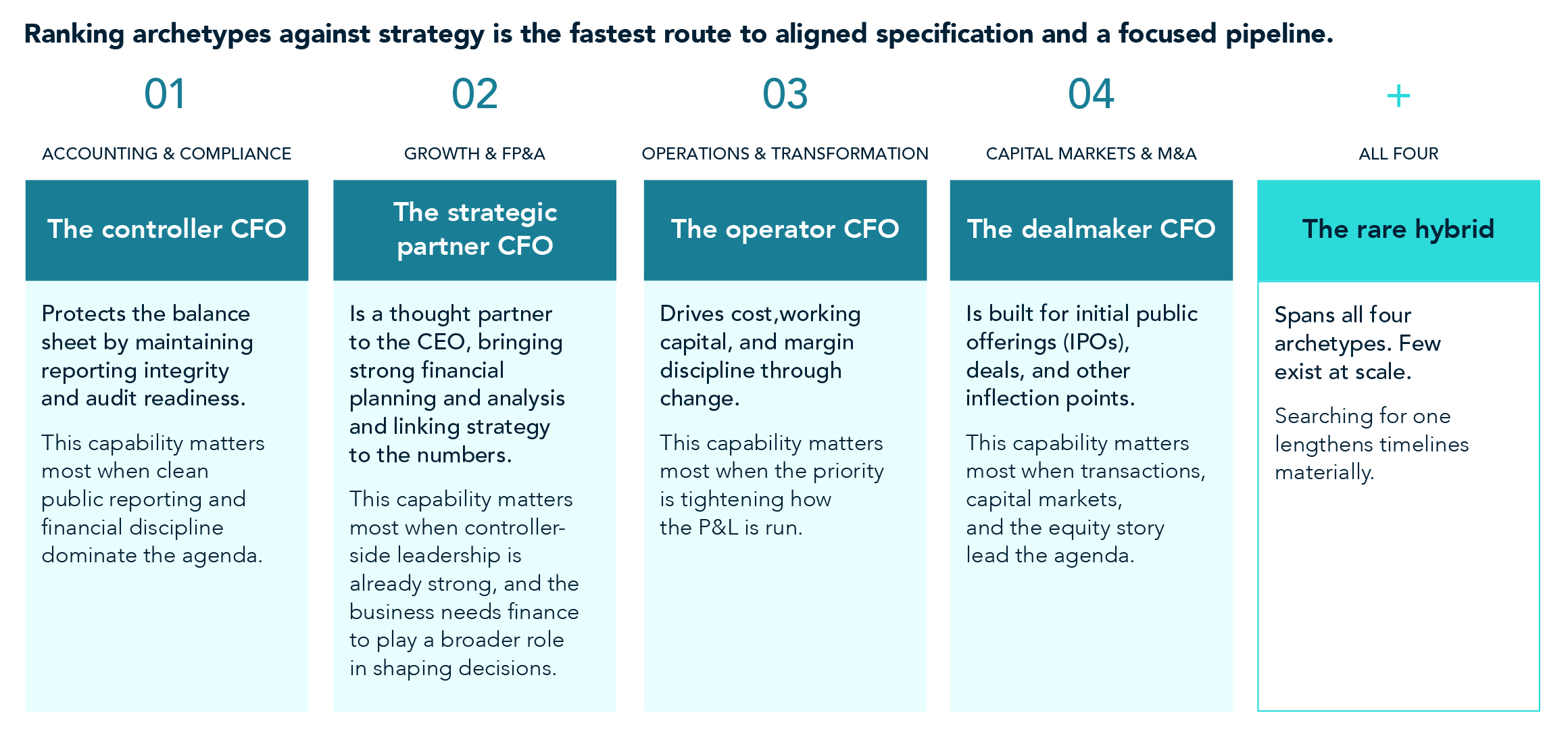
Of course, most organizations seek a CFO who is capable across control, strategy, operations, and deals, and the strongest candidates will typically bring meaningful experience in more than one area. Few, however, will be equally accomplished across all four. Holding out for that ideal can unnecessarily narrow the candidate field and lengthen the search. A more effective approach is to identify which capabilities are most critical to the organization’s future mandate and weigh candidates accordingly.
Technological fluency is a capability likely to feature prominently in nearly every future mandate. As artificial intelligence (AI), technology, and enterprise transformation become central to how organizations operate and create value, future CFOs will need to understand how technology affects the business, where it can create value, and how to make sound decisions about its investment and adoption. This expectation cuts across the different CFO archetypes, regardless of which capabilities an organization prioritizes.
Ultimately, the objective is not to replicate the CFO the organization has today. It is to define the capabilities the business will require next and to build the pipeline against that future mandate.
Make CFO succession a continuous discipline
Once the future mandate is clear, organizations can begin building multiple people toward it, considering what experiences could make more candidates ready over time. This means shifting CFO succession from an episodic exercise to a continuous discipline with clear ownership, regular review, and deliberate development:
Establish the succession architecture. If CFO succession is material to the company’s ability to deliver on its priorities, it should be governed with the same discipline as other material business risks. Organizations can determine who owns the process, how frequently the pipeline will be reviewed, what role the CEO and board or audit committee will play, and who could provide emergency cover in the event of an unexpected transition. The aim is to ensure that succession planning is an ongoing process rather than something that begins when a departure is already underway.
Build and benchmark the pipeline. The company’s three-to-five-year strategy should translate into a clear CFO success profile that reflects the capabilities the role will require. Organizations can then benchmark that profile against the external market, identify multiple internal candidates across different readiness horizons, and understand how each internal candidate compares with both the future mandate and potential external alternatives. It is best practice to avoid identifying a single “heir apparent,” instead building a bench of credible options and an understanding of what each person would need in order to become ready.
The external market can also play a role well before a CFO transition is underway. Organizations can recruit high-potential finance leaders several years in advance and develop them alongside their existing internal candidates. Doing so often requires creating an opportunity compelling enough to convince an established executive to take the risk of joining a new organization. The initial role needs to be sufficiently broad and consequential to be attractive on its own, while offering a credible longer-term path to compete for the CFO position. That path should include thoughtfully sequenced developmental experiences and set clear expectations that the CFO role is an opportunity, not a promise.
Develop through experience, not just assessment. Identifying potential successors is only the start. Readiness is built over time, so organizations should assess where each candidate has gaps and deliberately create the experiences to close them. If the right development opportunity does not already exist, companies may need to broaden or redesign roles to provide greater functional breadth, enterprise exposure, and relationship-building opportunities. Assignments can be sequenced to build additional capabilities through P&L ownership, investor interaction, M&A, transformation leadership, board exposure, international roles, operating responsibility, or major enterprise initiatives. As both the candidates and the needs of the business evolve, those development plans should evolve with them, too.
Done well, this creates a pipeline that is not only deeper but also more deliberately aligned with where the business is heading.
A robust CFO pipeline extends beyond finance
The payoff of a strong candidate pipeline goes well beyond filling one seat. Our broader research finds that companies that manage leadership succession continuously, in alignment with strategy and consistently across the enterprise, see stronger financial and organizational outcomes. Developing a strong CFO pipeline can similarly create value well before the next transition happens.
Developing multiple potential successors builds greater depth across the finance function. As candidates gain the experiences needed to prepare for the CFO role, they also become more capable enterprise leaders, strengthening the function regardless of who ultimately gets the role.
The investment can extend to the CEO pipeline, too. CFO experience is a well-established pathway to the top job: 19% of current CEOs have prior CFO experience, a share that has remained consistent since 2019.6CEO succession planning is positioning their organization well for the future.7 If organizations are struggling with succession even at the CEO level, where the issue typically receives the greatest attention, there is even greater reason to build leadership pipelines deeper into the organization.
For CEOs and boards, a succession plan should do more than name potential replacements. It should give the CEO and board a clear view of their options, the development required to strengthen those options, and the risks that remain. Five questions can help determine whether an organization has successfully built that foundation:
- Are we developing successors for the business we are becoming? Can we articulate what the next CFO will need to accomplish and how that mandate differs from the requirements today?
- Do we have multiple credible options across different time horizons? Have we distinguished between emergency coverage, candidates who could assume the role today, and those who could become ready with deliberate development?
- Are we creating the experiences that readiness requires? Does each potential successor have a specific development plan that addresses their most consequential gaps, with clear accountability for providing the necessary opportunities?
- Do we know how our internal candidates compare with the external market? Are we applying a consistent, future-focused standard to both groups, rather than assuming that internal familiarity equals readiness or that external experience guarantees a better fit?
- Does the process lead to decisions and action? Do regular reviews result in changes to assignments, exposure, development priorities, or the composition of the pipeline—or simply in an updated list of names?
Where the answers are unclear, the immediate task is to strengthen the conditions that will make a real choice possible. The goal of CFO succession planning should be to ensure that the organization never has only one viable path available.
By defining the future mandate, developing multiple credible successors, and maintaining a clear view of the external market, companies can make the next appointment from a position of choice rather than necessity—and select the leader best equipped for the future, value-creating mandate.
Acknowledgements
The author wishes to thank Adam Howe for his contributions to this article.
About the author
Sachi Vora (svora@heidrick.com) is a partner and leads the global Financial Officers Practice; she is based in the New York office.
References
1 Heidrick & Struggles research, forthcoming
2 Heidrick & Struggles’ analysis of Fortune 1000 CFOs.
3 Heidrick & Struggles corporate officers survey, Q3 2026, n=343 US respondents at public companies.
4 Heidrick & Struggles research, forthcoming
5 Heidrick & Struggles’ analysis of Fortune 1000 CFOs.
6 Heidrick & Struggles’ analysis of Fortune 500 CEOs.
7 For more, see 2026 CEO & Board Confidence Monitor, Heidrick & Struggles, February 12, 2026, heidrick.com.