Boards & Governance
Board Monitor US 2026 | Future-focused boards: Linking renewal, alignment, and performance
Fortune 500 boards have recently placed a larger focus operational expertise and prior board experience. Some boards are finding effective ways to balance short- and long-term considerations—and overseeing stronger performance than others.
May 12, 2026
Board renewal is not keeping up with the pace of change
Nearly two-thirds of CEOs and board members in the United States report a mismatch between current board strengths and what matters most to success. This is a core finding of an early spring survey of 1,033 CEOs and board members globally, including 253 in the United States. The result is that too many boards see that they lack the essential skills they need to effectively navigate ongoing changes to their strategy and operating model.
Other work we’ve done suggests a combination of reasons for these gaps.
1) First is the persistent economic, geopolitical, and technological volatility facing all organizations. For the third year in a row, a parallel global survey found that these are the most significant issues organizations expect to face in the year ahead.1 Almost all leaders who responded to this survey—93%—foresee changes to their strategy and operating model over the next two to three years, with half anticipating significant change.
2) Second, another survey found that 73% of CEOs and directors in the United States said their organization does not regularly replace underperforming or misaligned directors.2 Indeed, Fortune 500 boards add a new member only about every two-and-a-half years and current directors have an average tenure of roughly seven years.3 In other words, large portions of Fortune 500 boards were appointed prior to major global disruptions, such as the Covid-19 pandemic and the proliferation of artificial intelligence (AI). While seven years has historically been considered normal (if not short) board tenure, the expectations placed on boards are now evolving very quickly.
3) And among the directors on boards with tenures of more than six years, only 41% also have an executive role—meaning that, for many, their operational experience is becoming out of date at a time when expectations for operational and governance knowledge are increasing.
Clearly, directors are becoming acutely aware that traditional succession practices are not nimble enough to meet the accelerating pace of change.
At a fundamental level, boards have always been responsible for ensuring strong governance processes, setting and overseeing business strategy and outcomes, and maintaining the strength of the CEO and the broader leadership team. That includes hiring, managing, and, when necessary, replacing the CEO, as well as ensuring the right talent and succession plans are in place.
Now, directors are clear that they are preserving strengths in both traditional governance activities and relationship building. But directors also say only 34% are effective at foresight and renewal.
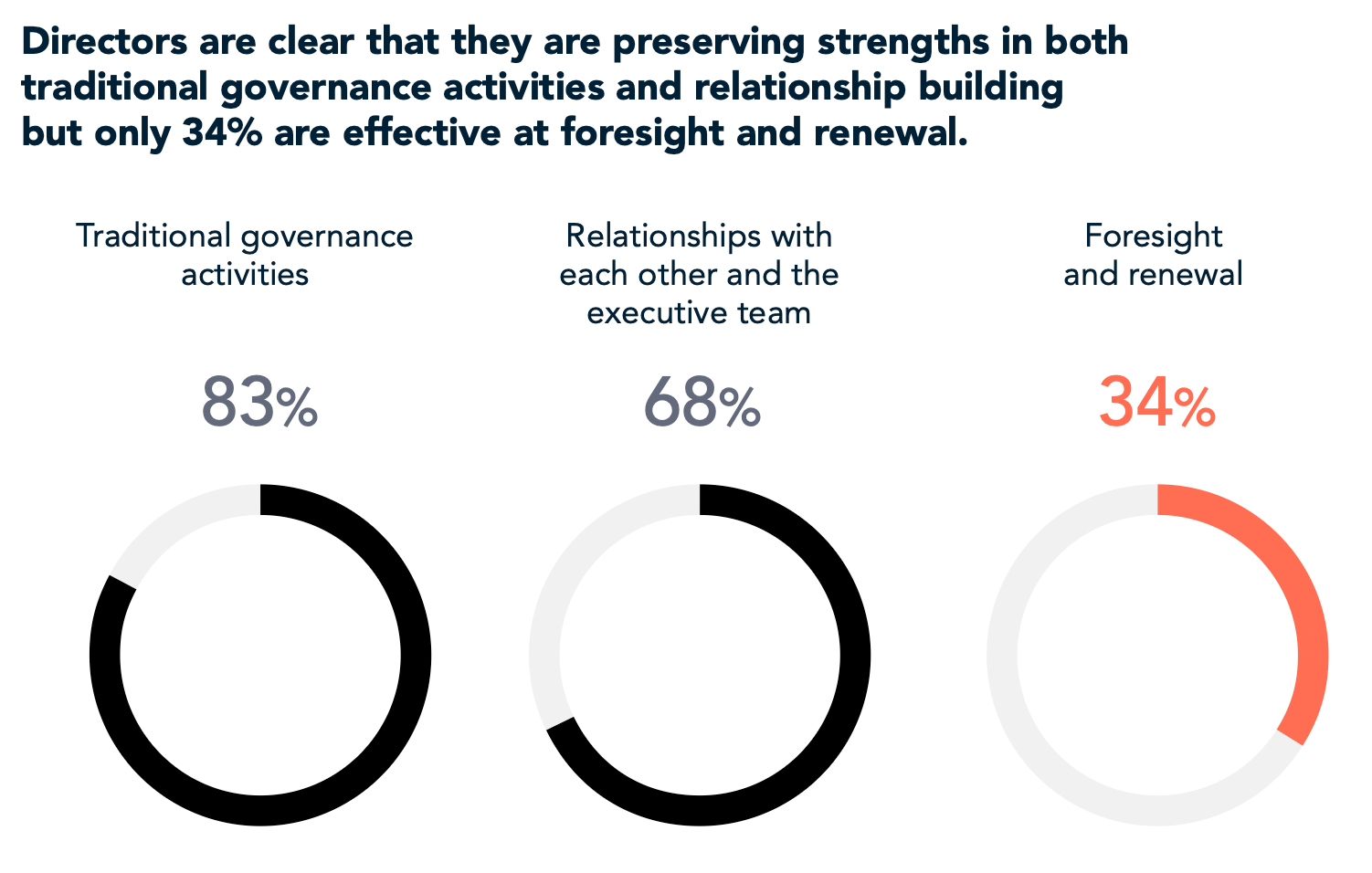
This relative imbalance is likely why boards are seeing gaps in their own capabilities that are affecting their ability to oversee governance, strategy, performance, and executive leadership effectively—particularly as executive leadership teams themselves are evolving rapidly to meet the new demands organizations are facing.4

When we looked at how strongly effectiveness in each of these areas correlated with financial performance, a clear front-runner emerged: foresight and renewal. When board members say their board is future focused, they also report measurable benefits for organizational performance. Companies that reported at least one strength categorized as “future focused” achieved higher total shareholder return (TSR) than those with strengths only in traditional governance activities and relationships.
But given that boards aren’t renewing themselves often enough to be as effective at being future focused as they are in other areas, we decided to dig deeper into board succession planning practices in this context. Our decades of experience in working with boards, combined with our years of research, have shown that leadership succession planning is most effective when it is closely aligned with business strategy. This applies at every level—board, CEO, and executive. Outcomes further improve when those succession practices are closely aligned with business strategy as well as with each other, and when they are carried out consistently and holistically across the organization.5
This led us to consider whether there are linkages between leadership alignment—starting with the constructive relationships among leaders that a majority of boards say they’re good at—and alignment of succession planning practices across the organization.
We investigated how these factors may contribute to developing more strategic—and future-focused—leaders. We examined three aspects of alignment together:
- Alignment among leaders
- Alignment between strategy and leadership pipeline management
- Alignment among executive development succession-planning processes
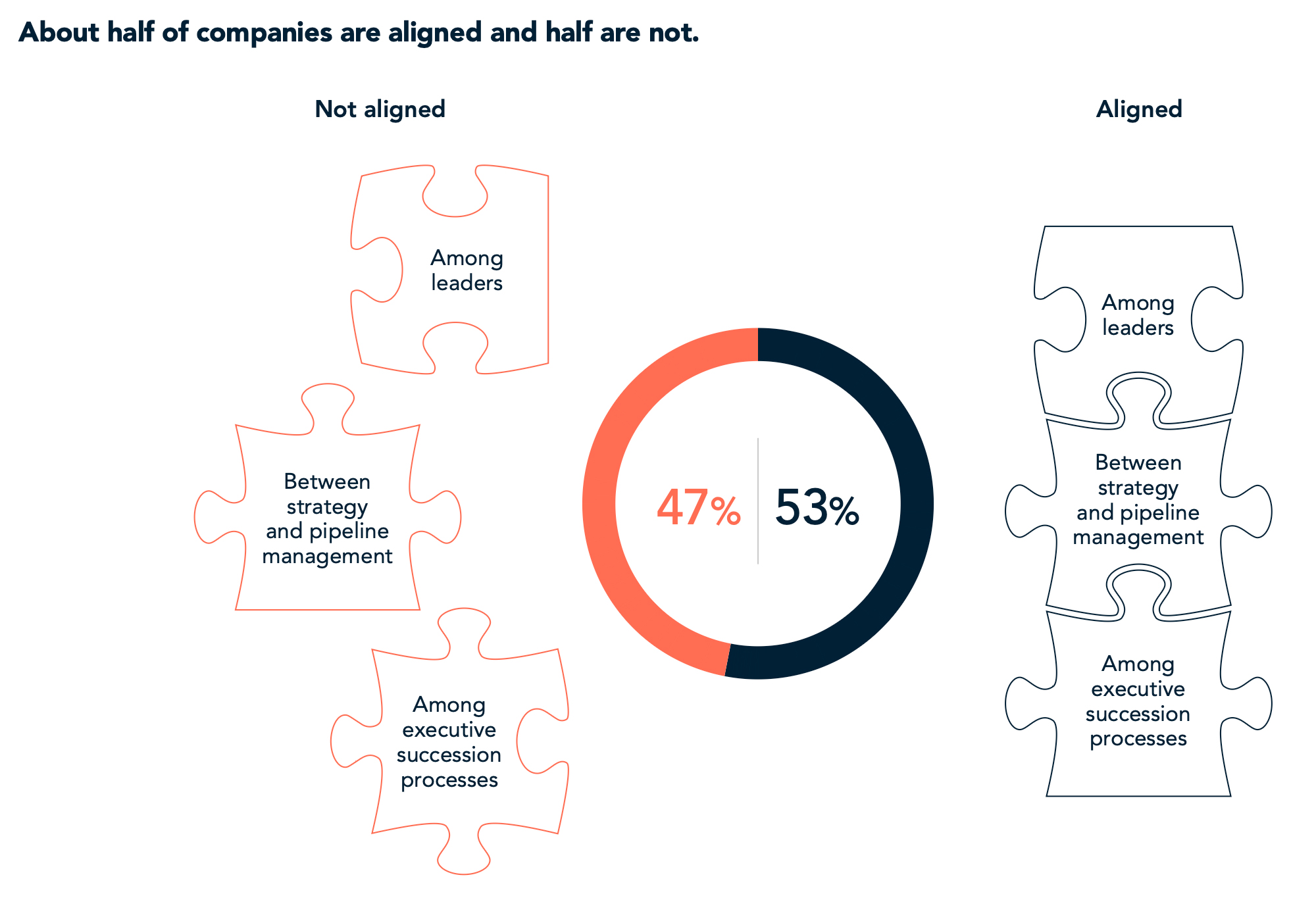
Looking across all three areas, we found that about half of companies are aligned and half are not.6 Interestingly, the majority of aligned companies are only moderately so, meaning alignment is fragile, even for those in the better-performing group.
When directors add true enterprise-wide alignment that encompasses all of these areas to a board that’s strong in foresight and renewal, the performance benefits multiply (see sidebar, “Comprehensive alignment”). These directors were more likely to say organizational performance had exceeded their own expectations and less likely to say it had fallen short, in comparison to leaders at other organizations. In addition, the data show a directionally positive relationship between being aligned and future focused, and higher TSR. (The sample for this report is too small to report a specific TSR boost. However, this finding is consistent with other research we have conducted, and we are designing additional research to further explore the effects on TSR.)7
Benefits beyond financial performance
Directors at companies where boards are future focused and the company is aligned are far less likely to report a capability gap—52% compared to 62%.
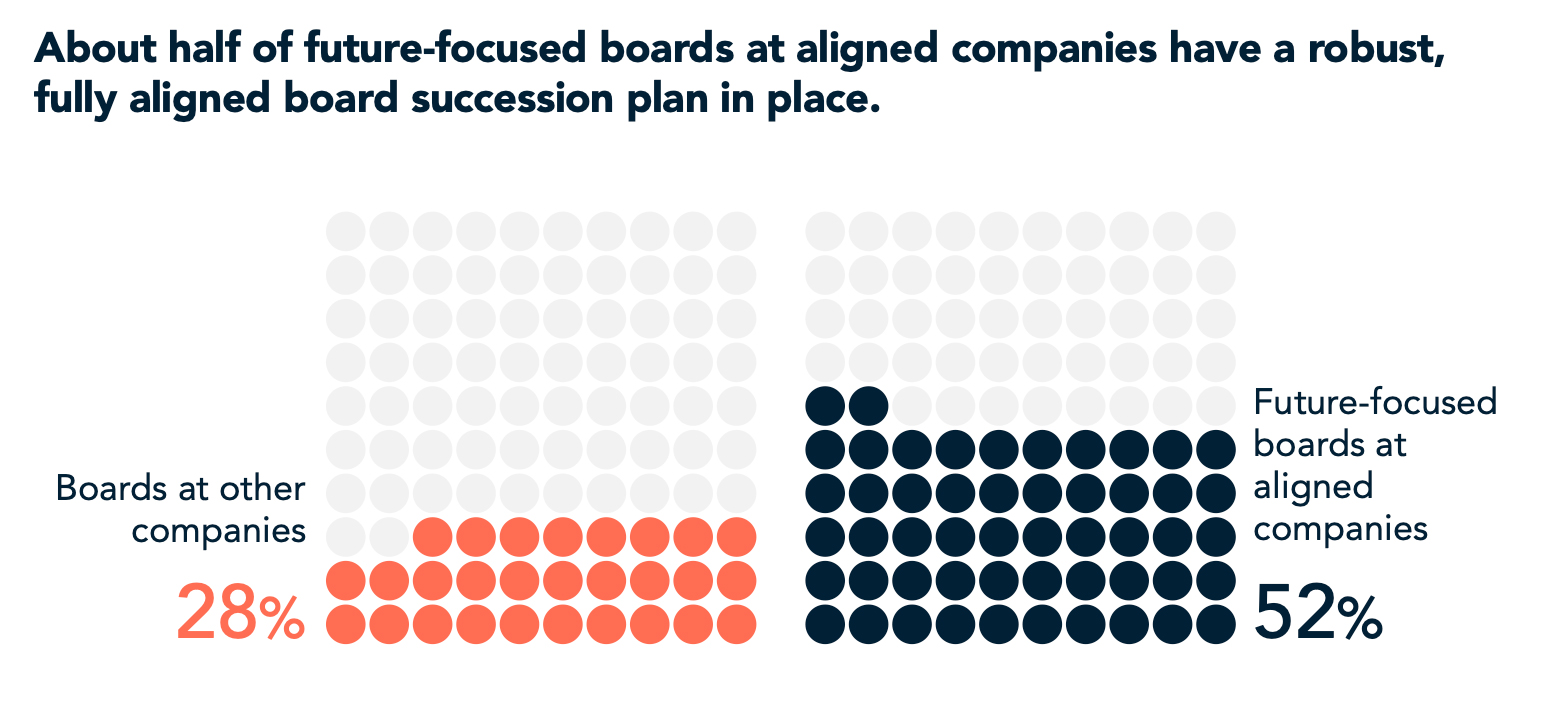
Future-focused boards at aligned companies far more often take steps such as ensuring their own access to external expertise, establishing clear timelines and decision criteria, aligning planning with business strategy, and regularly updating their capability matrices. About half of these organizations have a robust, fully aligned board succession plan in place, compared to just 28% of other organizations.9
But that’s only the beginning. CEOs and directors at these organizations also report better performance across a range of leadership and governance activities, such as decision making, volatility management, and leadership readiness, than those at other organizations.
The importance of balancing board harmony and constructive challenge
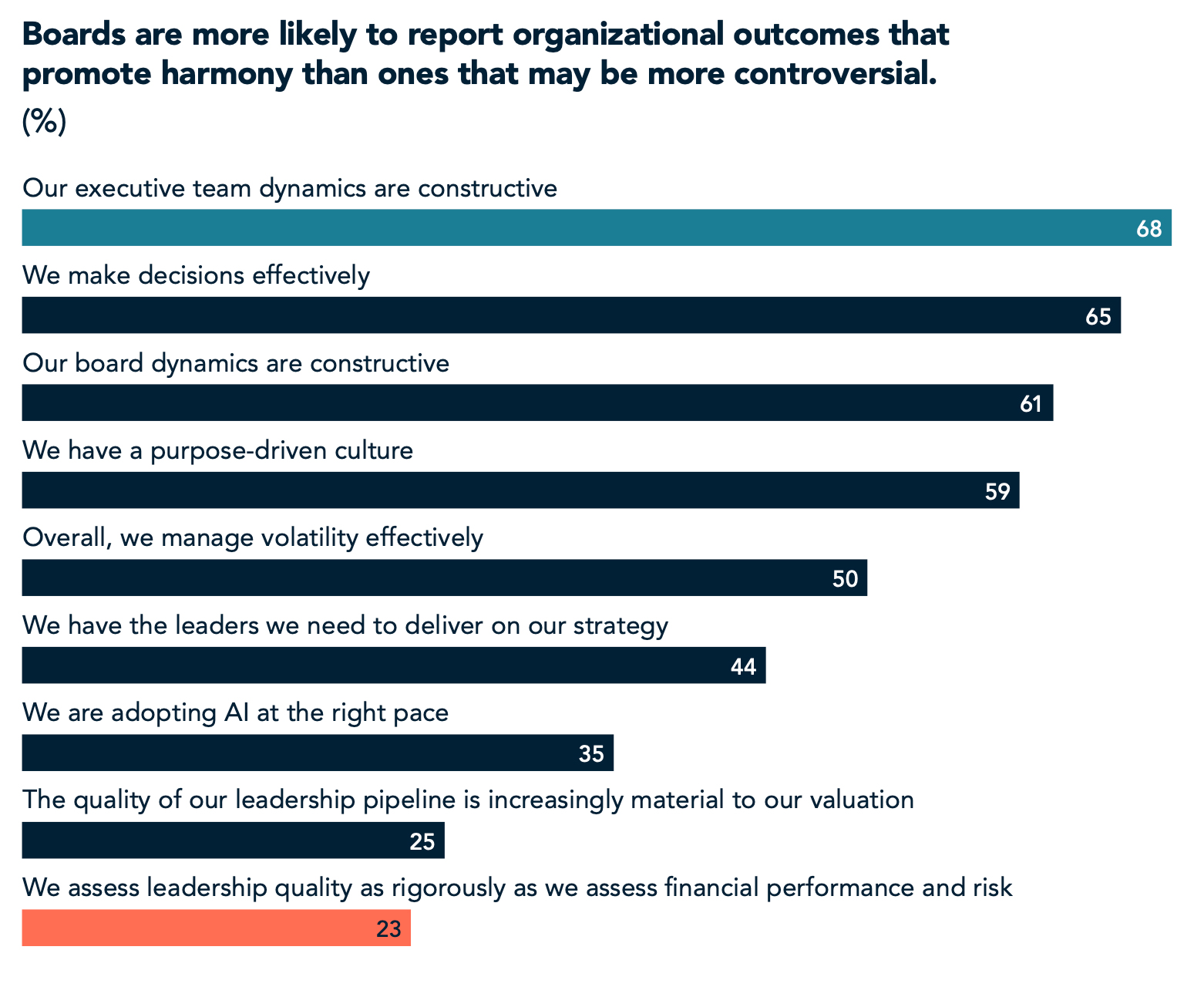
It’s also notable, though, that leaders at all companies more often say they’re good at actions that inherently are not divisive—such as having constructive executive team and board dynamics—or typically less contentious, such as making decisions efficiently. Leaders far less often say they’re good at potentially more polarizing activities, such as rigorously assessing leadership quality. Leaders at higher-performing companies differ little from their peers in these areas.
This pattern, along with boards’ overall strengths in relationship skills, suggests an emphasis on maintaining harmony, which can come at the expense of necessary candid conversations. When taken too far, this is a reason that boards bring on people with whom they already have good relationships as new directors, rather than seek more diversity in backgrounds, experiences, or areas of expertise. However, as we have noted, healthy tension challenges directors and executives, and can improve board dynamics.
Looking ahead
All this quantifies just how much difference it makes to both organizational and financial performance when boards actively anticipate change, adapt themselves accordingly, and build alignment and holistic succession planning across the organization.
Boards have a clear opportunity—and responsibility—to close their own capability gap, and doing so is firmly within their direct control.
In practice, this starts with:
- Taking ownership of developing the skills needed for success. While it is too simplistic to suggest that high-performing boards are defined by any single attribute, both strong relationships and foresight are core elements of good governance. Leading boards intentionally build and apply these capabilities—maintaining constructive dynamics while also exercising the judgment and confidence to challenge and support the executive leadership team. Especially in times of volatility, this balance is critical to ensuring the right strategy and leadership are in place.
- Maintaining an ongoing focus on board composition. Boards benefit from both continuity and voices that are prepared to meet the future during periods of disruption. While some boards may worry that more frequent or thorough refreshment could disrupt constructive dynamics, mature succession does not require constant turnover, simply a balance between continuity and renewal.
- Continuing to strengthen practices that foster alignment. This includes regular board and committee evaluations, more frequent and substantive discussions on strategy and succession, and immersive sessions—whether in the field or focused workshops—that allow directors to engage more deeply with the business and each other. These practices create the structure and discipline needed to translate foresight into action. Foresight shapes direction; alignment determines whether the organization can execute against it.

Boards excel at building cohesive relationships today, but they also need to actively prepare leaders at the board, CEO, and executive levels who can sustain performance in the years ahead. The question isn’t whether the board has been effective historically, but whether it is best positioned for what’s next.
An expanding mandate
The expectations placed on boards are evolving. In an era defined by AI, geopolitical uncertainty, and rapid shifts in business models, boards are increasingly expected to engage on issues that were previously considered outside their scope.
This raises important questions, such as: Should boards opine more actively on technology adoption? How deeply should they engage in assessing geopolitical risk?
While execution remains firmly within management’s remit, the bar for board engagement is rising. Directors are now expected not only to oversee risk and governance, but also to bring informed perspectives on volatility, technology, and long-term resilience.
References
1 For additional analysis, see our 2026 CEO & Board Confidence Monitor, February 12, 2026.
2 Unpublished data from a survey reported in “CEO and board confidence monitor: Beating the succession planning paradox,” October 30, 2024.
3 For additional analysis, see the companion “2026 US Board Monitor demographic dashboard,” April 9, 2026.
4 For additional analysis, see our research on executives who report to the CEO at Fortune 100 companies.
5 For example, “CEO and board confidence monitor: Beating the succession planning paradox,” October 30, 2024, and “Route to the Top 2025 | The ascent redefined: Charing more effective routes to the summit,” June 23, 2025.
6 See the online methodology for details on how the alignment score was calculated.
7 New research forthcoming.
8 For additional analysis, see our 2026 U.S. Route to the Top survey report.
9 See the online methodology for details on the categorization of board succession plan maturity.
Stay connected
Stay connected to our expert insights, thought leadership, and event information.
Leadership Podcast
Explore the latest episodes of The Heidrick & Struggles Leadership Podcast.