Boards & Governance
2026 Board Monitor US | The day-one director: Fortune 500 boards are placing a premium on operational expertise and prior board experience
Stability matters today. Long-term board effectiveness, however, depends on cultivating a robust and diverse executive pipeline for the future.
March 11, 2026
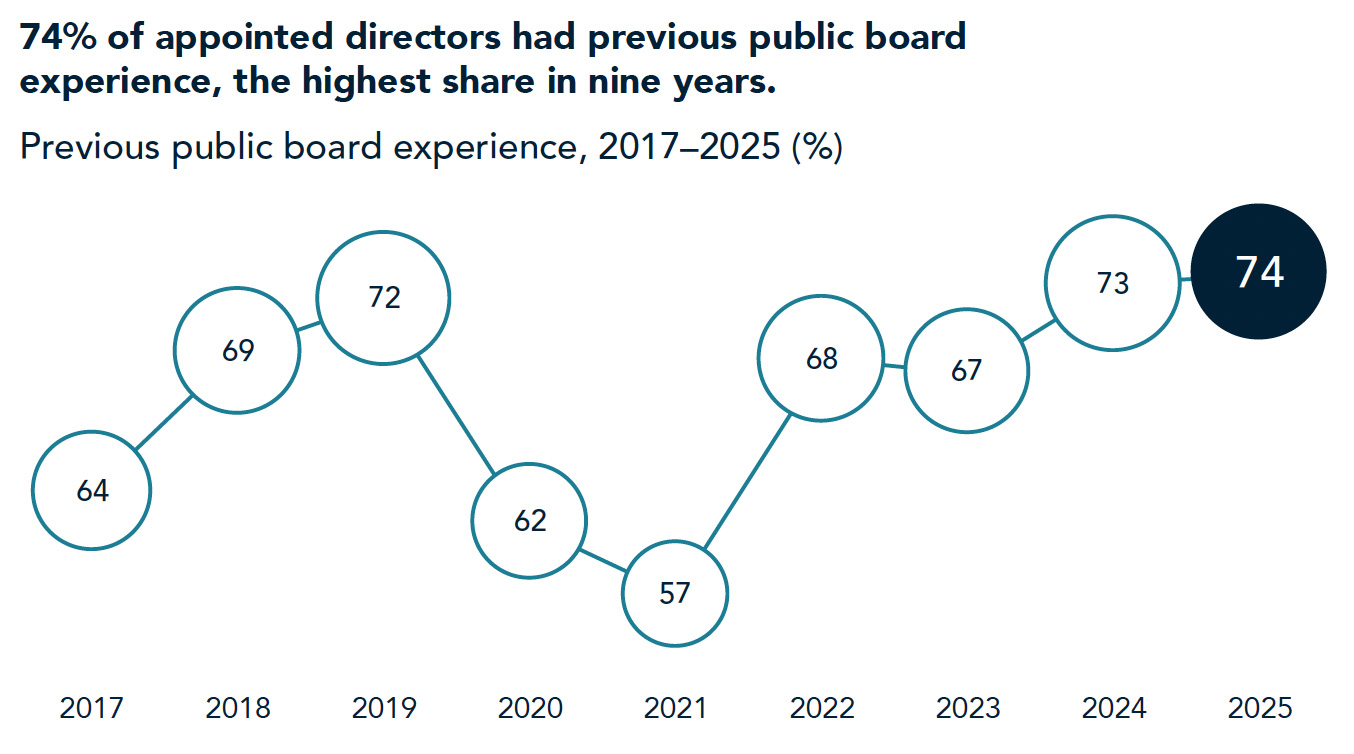
Significant levels of economic uncertainty, political volatility, and ongoing generative AI disruption have continued to drive boardroom discussions across the United States over the past year. After a prolonged period of unpredictability, Fortune 500 boards responded by seeking stability in their new members in 2025: 74% of seats filled in that year went to people with prior public board experience—the second-highest share since we began tracking in 2011. In other words, boards prioritized proven directors who would have the calmness and stability that comes from already having managed prior volatility.
But this preference for experience came at a cost, most notably, reduced diversity, in terms of both backgrounds and experience. After years of progress, 2025 saw the lowest share of seats filled by both women and non-white directors since at least 2016. We also saw notable drops in seats filled by people who were first-time directors. That may be one reason why few boards have rich knowledge about the strategic and operational effects of AI.
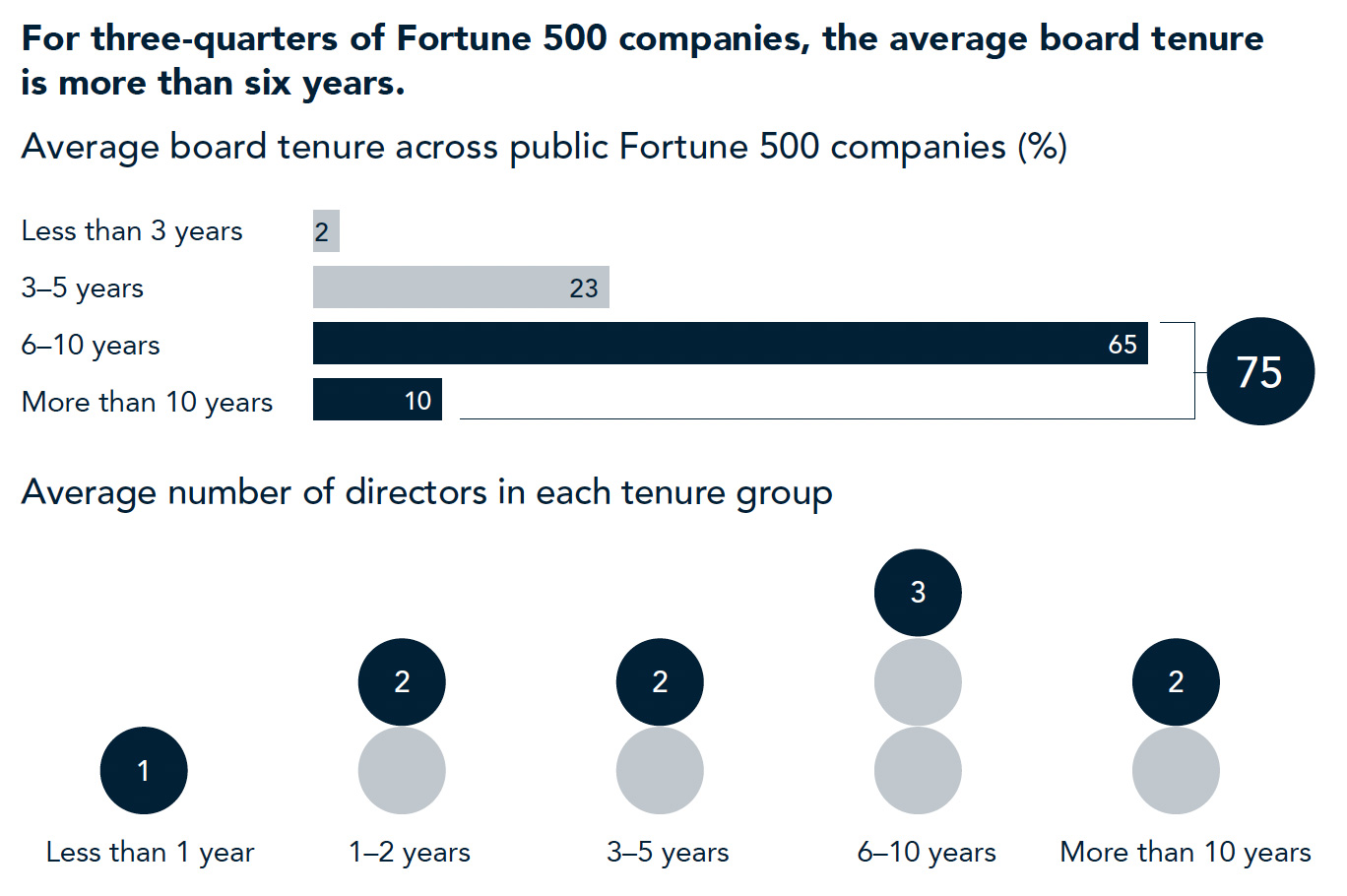
The pattern reveals an uncomfortable truth: when boards draw from these executive ranks, they're pulling from less diverse talent pools. Furthermore, the average board tenure is 7.7 years and boards don’t appoint new directors every year—in fact, there’s an average of 2.3 years between board appointments. This means that the new 2025 directors will be a part of Fortune 500 company leadership for years to come.
Less than half of CEOs and board members are confident that their organization’s board evaluation and refreshment practices are positioning them well for the future.1 To build their confidence, and to ensure a pool of board members who have both proven expertise and the diversity of background and experience needed for the future, boards must take a forward-looking approach not only to their own succession planning but also to the executives leading their organizations today and tomorrow.

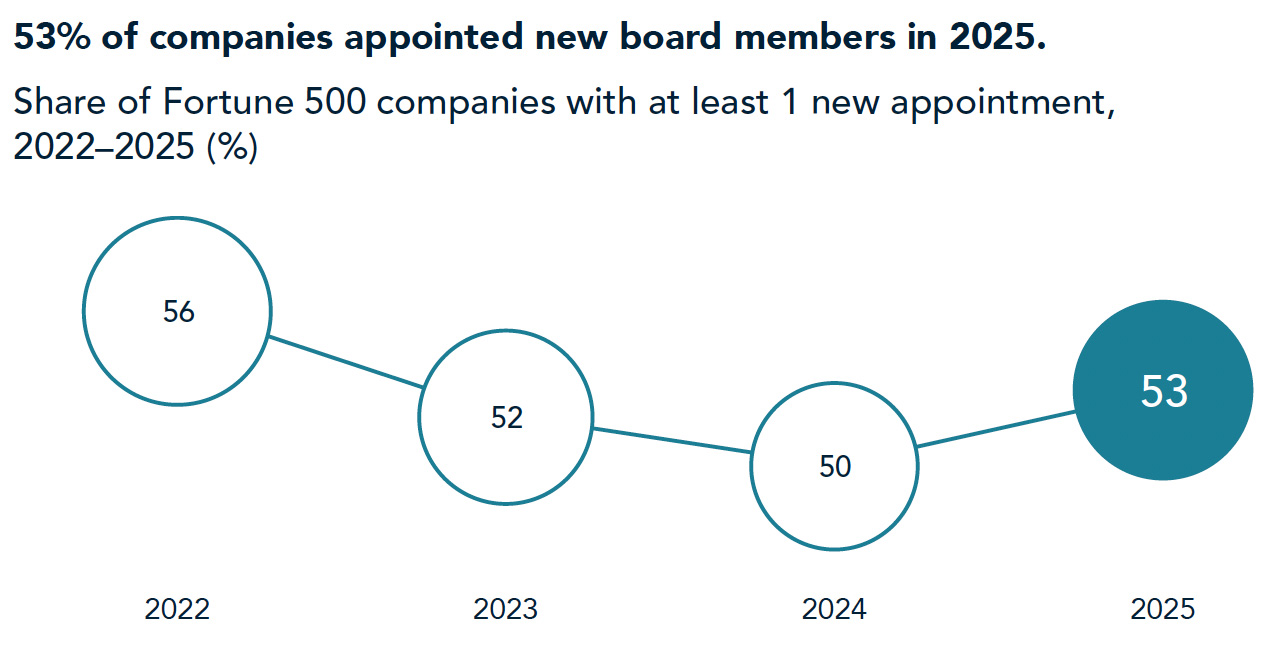
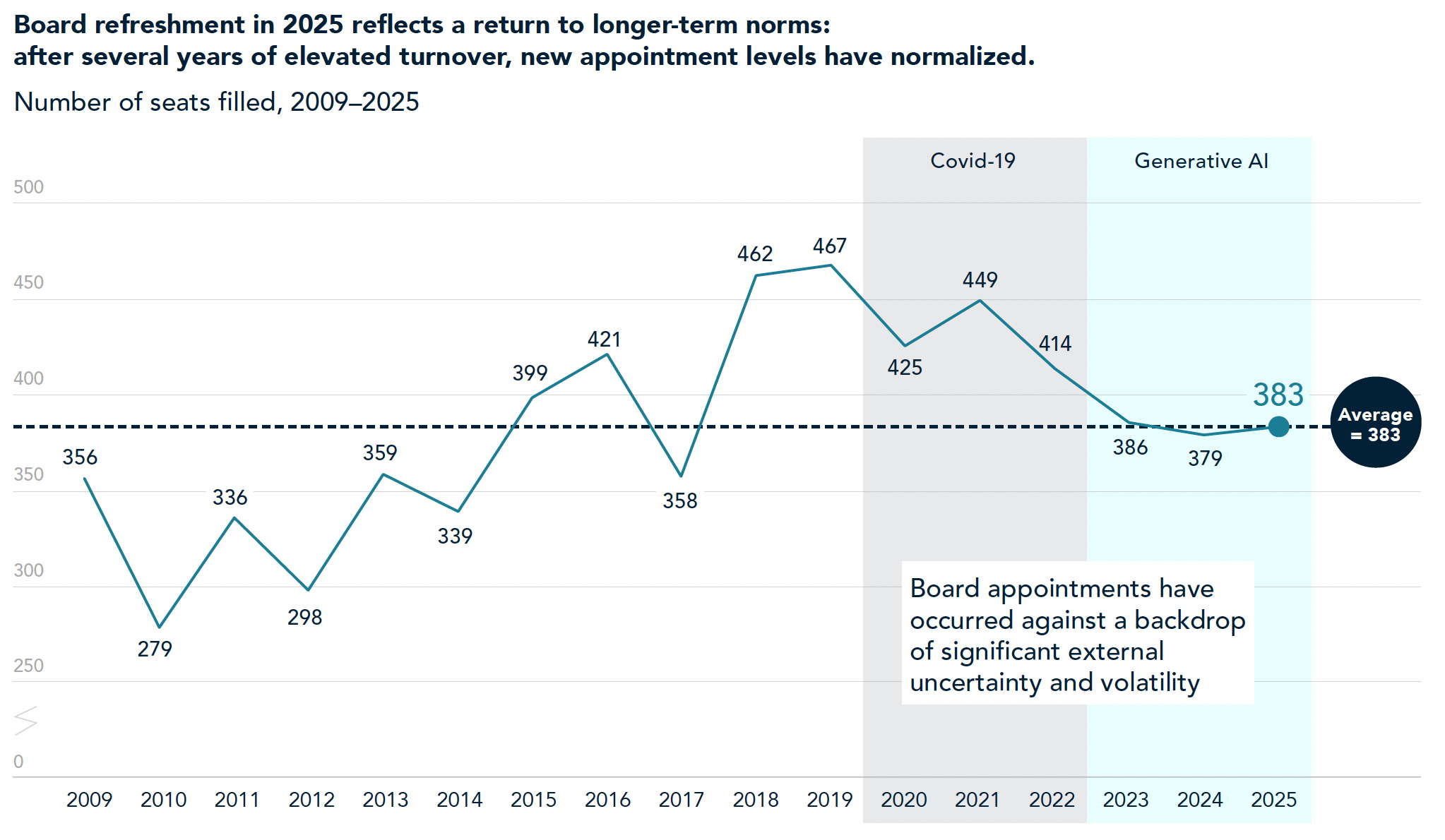
After years of elevated turnover beginning prior to the Covid-19 pandemic, board appointments in 2025 returned to a longer-term pattern: 53% of companies appointed new board members and 383 seats were filled—exactly the average number of seats filled over the last 17 years. This could signal a return to more traditional succession cycles as volatility becomes the new norm.
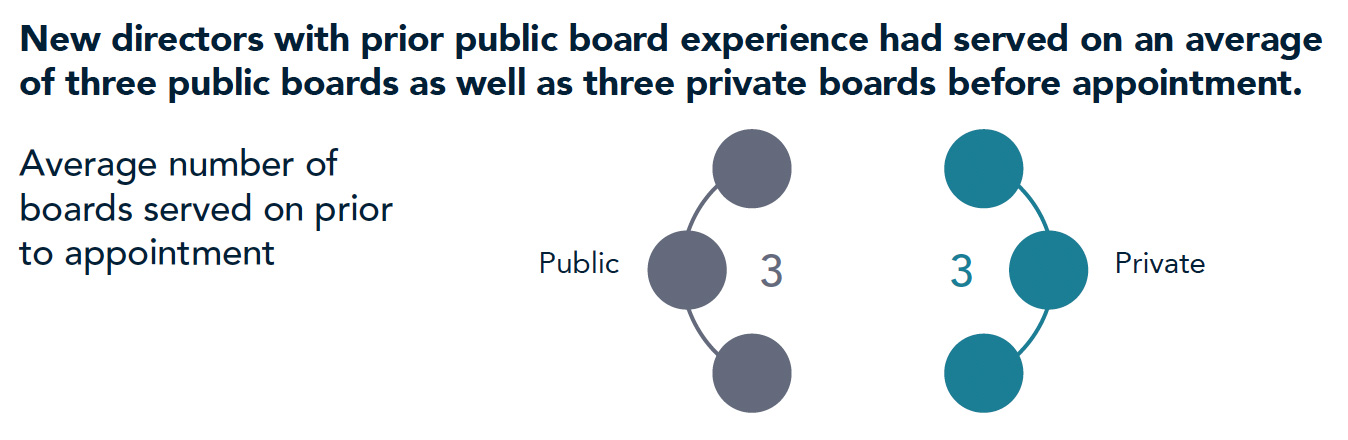
In that context, boards sought directors who have the confidence to navigate complexity with minimal onboarding, as reflected in the fact that 74% of directors had prior public board experience, with many serving on multiple boards.
This highlights that board service has become a career in itself, with directors moving fluidly from private to public boards and accumulating governance experience along the way.
The preference for immediately useful expertise is especially evident in financial oversight, with 45% of new director appointments being to the audit or finance committees. This focus aligns with directors’ own concerns: our CEO & Board Confidence Monitor revealed 55% of directors cite economic volatility as their top concern for 2026.2
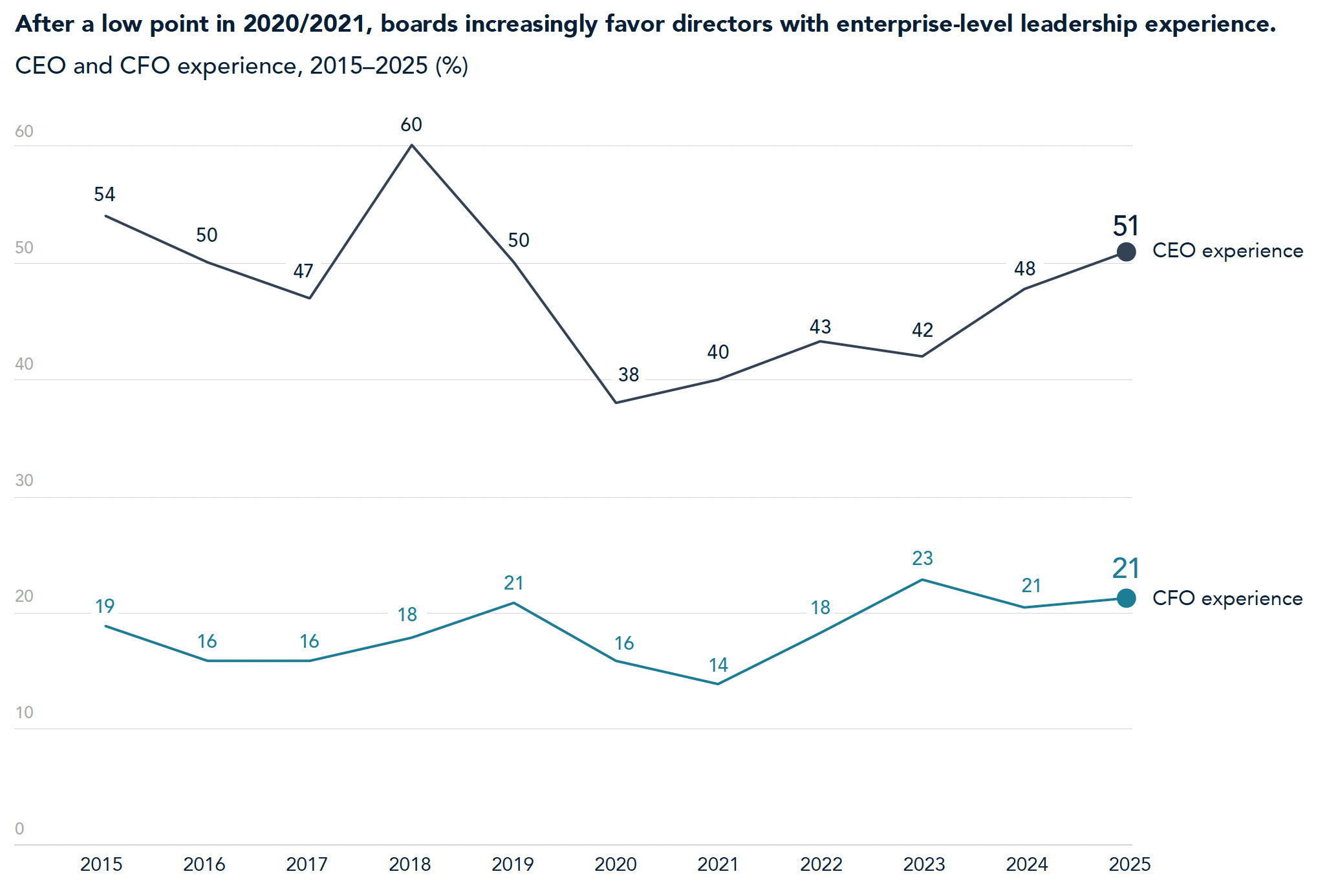
Financial experience remains a core credential. The proportion of new CEOs with prior CFO experience has held relatively steady over the past several years, suggesting that financial acumen is now a baseline expectation rather than a differentiator. What has shifted more noticeably is the rise in prior CEO experience among new directors. In an environment marked by sustained performance pressure and uncertainty, boards are pairing financial expertise with enterprise-level leadership experience, adding broader operational and strategic judgment to their oversight capabilities.
Valuing active and retired executives
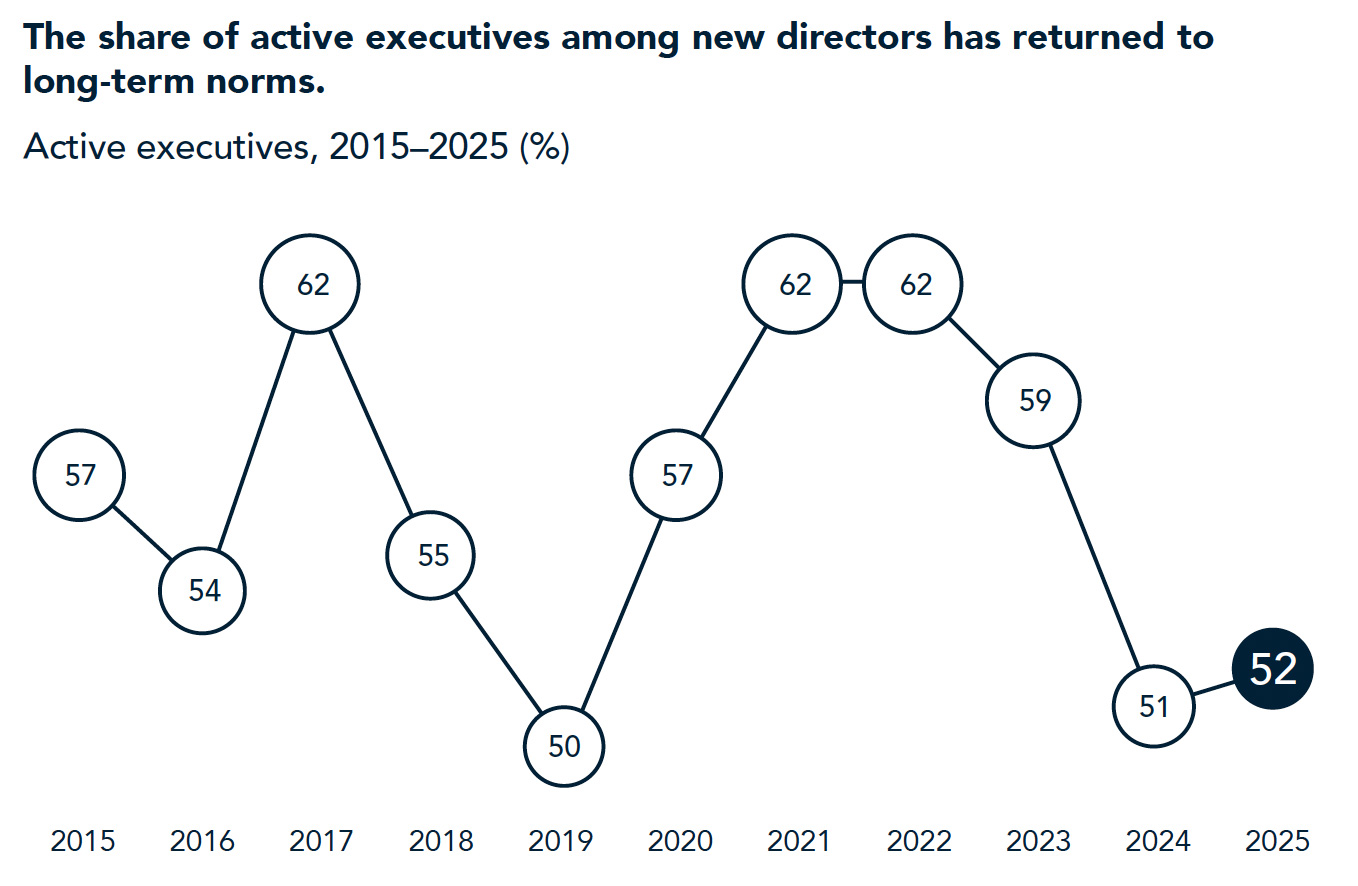
The share of active executives among new directors has also returned to long-term patterns, with 52% of new directors in 2025 active and 48% retired. This balance suggests boards are deliberately drawing on the distinct strengths of each group, rather than relying more on active executives to cope with increasing volatility.
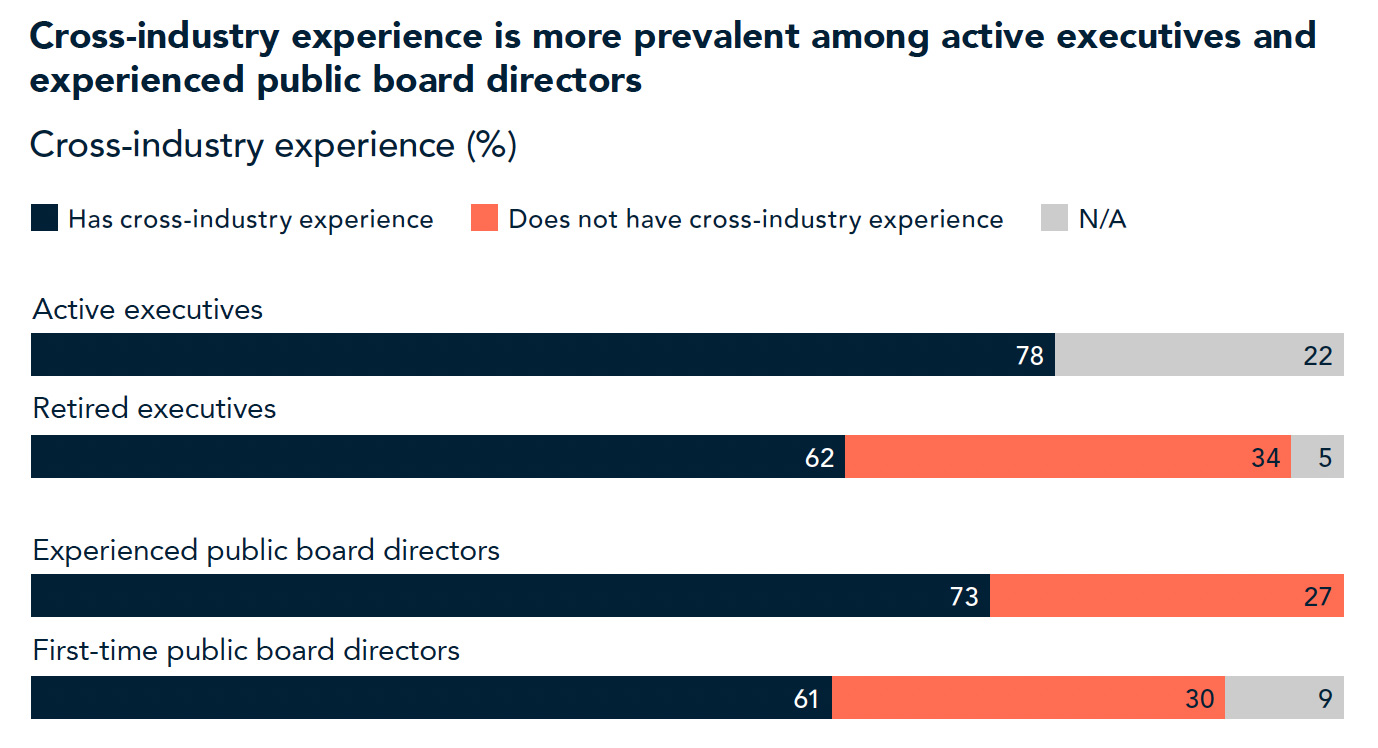
Retired executives have more time for deep board engagement, with one-third serving on three or more boards. Active executives, on the other hand, bring operational currency but are time constrained: 83% serve on only one or two boards. Broadly, boards appear to turn to retired executives for sector-specific experience and active executives for transferable leadership capabilities.
Balancing experience and breadth
The preference for proven, experienced directors in 2025 came at a cost: diversity among new board appointments declined. First, crucially, women comprised only 31% of board seats filled, the lowest share in the last decade and down from a peak of 45% in 2021. Similarly, non-white directors made up only 19% of board seats filled, down from 41% in both 2020 and 2021.
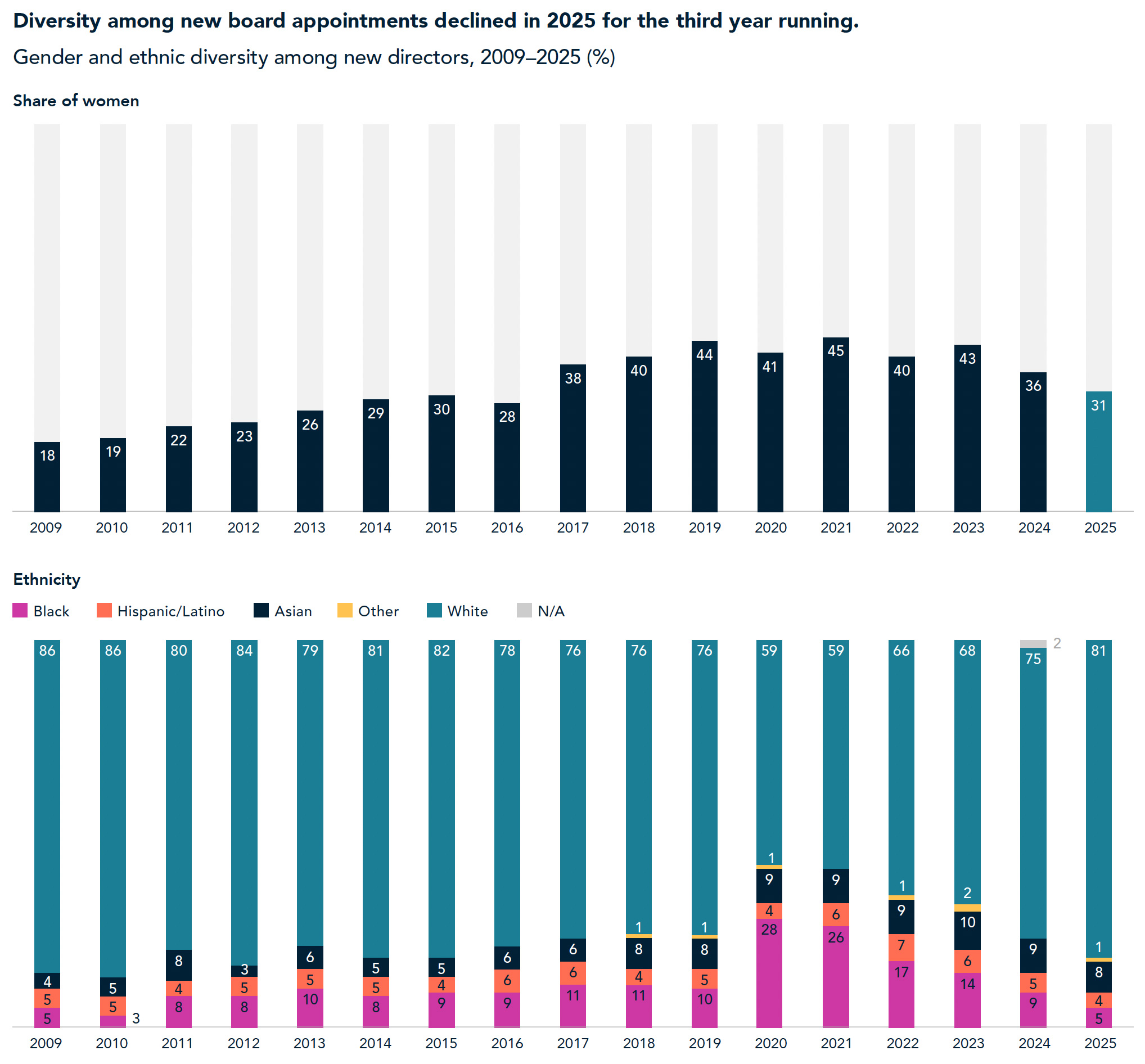
Notably, this decline in appointments of people with diverse backgrounds comes even as overall board diversity has improved. For example, the share of women on Fortune 500 boards has risen steadily over time, reflecting years of sustained effort.
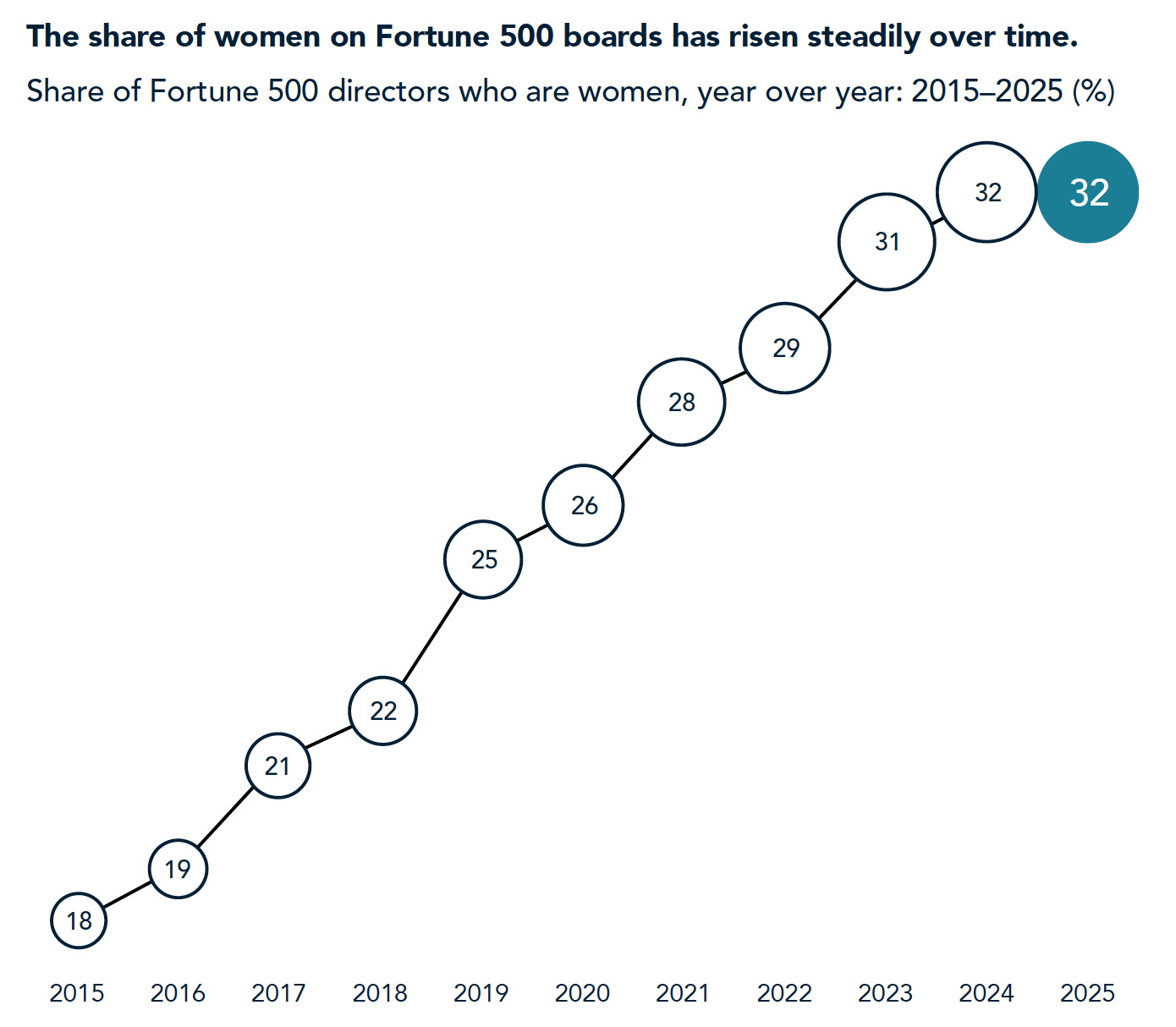
This is good news for companies’ financial performance, other work we have done suggests.3 Two-thirds of CEOs and directors say the ability to lead across boundaries—including across those created by functions, geographies, stakeholder groups, and lived experiences—is foundational to achieving their strategic goals. Organizations led by boundary-spanning leaders are viewed as better positioned to grow, innovate, and withstand shocks, and more than half of executives link this capability directly to improved financial performance. While boundary-spanning leadership is not defined solely by gender or racial diversity, broader lived and professional experiences at the top materially expand an organization’s ability to navigate complexity.
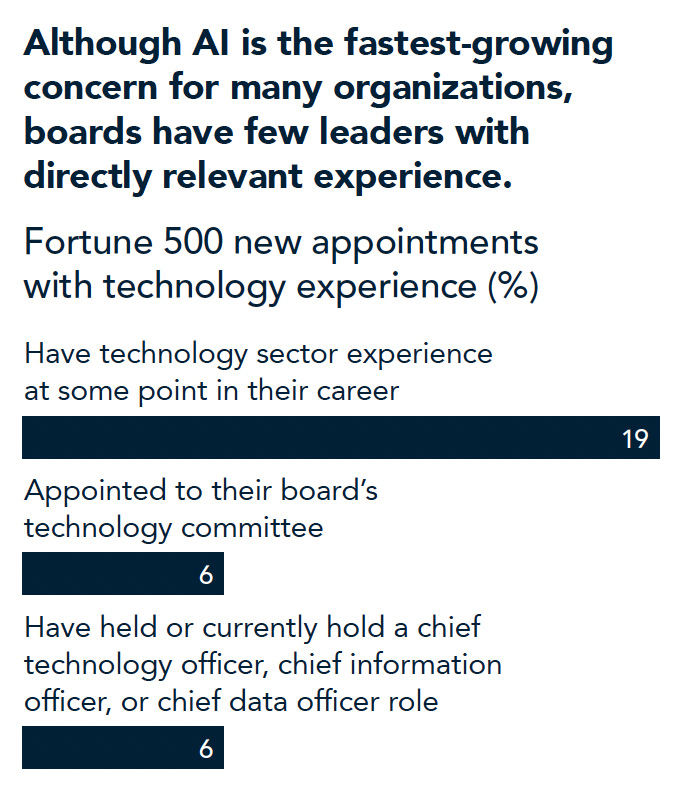
But slowing progress on gender and racial diversity is not the only risk boards are running by focusing on appointing directors with proven readiness. Another is a continued lack of AI knowledge. Although AI is the fastest-growing concern for many organizations, boards have few leaders with directly relevant experience. Only 6% of newly appointed directors have previously served as a chief technology officer, chief information officer, chief data officer, or chief AI officer. This is particularly problematic because almost half of current directors say AI is a significant issue for their organization.4 Boards are still determining how to acquire AI expertise, whether through director appointments, advisory structures, or other governance mechanisms.5 This fact underscores not only that a large pool of deeply experienced AI-literate directors has not yet fully emerged, but also that longtime directors and CEOs very often don’t have current AI expertise.
Board appointments in 2025 thus raise a critical question: have some boards begun to view their composition as “good enough”? As aggregate metrics improve on gender or racial diversity, for example, the urgency behind intentional recruitment may fade. Yet narrowing the profile of new appointees risks slowing future progress, especially as today’s diverse directors age out alongside their peers. And it is clear that other areas of expertise that are increasingly important to board effectiveness are also lacking in the most recent appointments.
The data suggest a more structural dynamic at work. When boards prioritize operational experience above all else, the candidate pool shrinks. From 2020 to 2022, when boards took chances on younger appointees and first-time directors, progress on diversity skyrocketed.
The inverse relationship between experience and diversity therefore has large implications for how companies recruit and develop leadership pipelines. If companies want diverse and experienced boards in the future, they must invest in building diverse executive teams today.
Similarly, companies must ensure they have the executive attraction, retention, development, and succession planning processes to ensure they will have leaders—including on boards—with the other forms of knowledge and expertise they will need in the future. And many leaders don’t think their companies are doing that well right now: 42% of CEOs and board members say they are not confident that these strategies are positioning their organizations well for the future.6
Excellence today and strategy for the future
This tension will define the next era of corporate governance. Companies’ preference for proven, experienced directors—those with prior CEO or CFO roles or prior board service—is a rational response to uncertainty. These directors bring immediate value: they understand governance, need minimal onboarding, and can navigate complexity from day one. In other words, they are current-focused. But this approach comes with costs, as the most experienced executives emerge from talent pools shaped by less-diverse corporate environments that provide less varied knowledge overall and less awareness of emerging trends. In other words, boards may be losing some of their future focus.
The question is not whether boards should value experience; they should. The question is whether they will be willing to balance immediate expertise with long-term capability building, resisting the temptation to put the most emphasis on current-focused candidates, when doing so runs the risk of a future lack of knowledge. As well as maintaining capability for today, the value of board succession is about deliberately building for challenges boards cannot yet see.
These questions sit at the center of the governance challenge ahead. The boards that confront their own succession directly will define the standard for future leadership.
In the coming months, we will examine how top organizations are addressing these questions, exploring the succession models and leadership strategies that are reshaping board composition for sustained performance and long-term value creation.
References
1 “2026 CEO & Board Confidence Monitor,” Heidrick & Struggles, February 12, 2026, Heidrick.com
2 “2026 CEO & Board Confidence Monitor,” Heidrick & Struggles, February 12, 2026, Heidrick.com.
3 For more detail, see our work on Leading Across Boundaries.
4 “2026 CEO & Board Confidence Monitor,” Heidrick & Struggles, February 12, 2026, Heidrick.com.
5 Ryan Bulkoski, “AI focus: How boards are finding expertise to chart the unknown,” Heidrick & Struggles, November 13, 2025, Heidrick.com.
6 “2026 CEO & Board Confidence Monitor,” Heidrick & Struggles, February 12, 2026, Heidrick.com.
Stay connected
Stay connected to our expert insights, thought leadership, and event information.
Leadership Podcast
Explore the latest episodes of The Heidrick & Struggles Leadership Podcast.