Human resources officers focus: The CHRO search has outgrown the traditional pipeline
The traditional CHRO pipeline was built for an HR value logic that is disappearing. Previously, it was enough to reward mastery of the function and prepare leaders to run programs consistently, protect the enterprise, and deliver reliable employee services. As we have been exploring for several years, those demands—while still important—no longer define the full scope of the role.1
The mandate for CHROs now starts with a much more foundational enterprise problem: leadership and talent are becoming companies’ most reliable source of competitive advantage in a period of fast-moving volatility. CHROs must be able to add value to the enterprise by addressing questions such as “What work must change? Which capabilities will our strategy require? Where can technology expand human performance? How should leadership adapt?”
Our work and interviews with seven current and former CHROs suggest that finding answers requires a shift in the operating logic of the people function itself—one that begins with the enterprise problem, uses first-principles and product thinking to design a response, and measures success through organizational capability and business value. Jacqui Canney, chief people and AI enablement officer at ServiceNow, says succinctly, “HR has to start with the business results. Otherwise, you’ll be stuck in the box of a cost instead of value.”
This has created a pipeline problem that searching harder within the same pool will never solve, because the experiences that produced yesterday’s most effective HR leaders do not always develop those capabilities. Although deep HR expertise remains essential, succeding under today’s broader mandate requires a broader set of capabilities. A recent Heidrick & Struggles survey of CHROs around the world found that only 25% are currently fully working in this newer way, which we call being an “enterprise CHRO.” 2
CEOs seeking CHROs should explore how to strategically widen their search aperture. This may involve exploring new routes to CHRO readiness through candidates with nontraditional backgrounds. It can also mean ensuring that career HR leaders have opportunities to develop new strengths through assignments that stretch beyond their historic function. Any CEO seeking to ensure their CHRO can deliver on this new mandate also needs to make sure their CHRO has access to and alignment with them and that the CHRO’s role and team are defined starting with business strategy.
A new HR value logic
For decades, much of HR’s authority came from functional expertise. The function created policies, managed risk, ran processes, and deployed programs. Our survey data shows that current scorecards still reflect this legacy: 67% of CHROs are evaluated on HR cost efficiency, 64% on employee engagement, and 62% on retention, while 58% report a KPI tied to contribution to business performance.3
What’s changing as CHROs take on an enterprise-value mandate is where HR starts. Today, the work needs to start with the enterprise problem and the customer experiencing it, rather than with a program, policy, or process waiting to be deployed. The people function asks whose needs matter, what outcome must change, and which organizational capability will deliver the strategy. Product discipline then turns that understanding into a response that can be tested, adopted, and improved.
Emily Field, chief people officer at LPL Financial, explains that “There are not playbooks for this. You have to be able to structure the problem: What are the component parts? What are the options? What are the choices and trade-offs?”
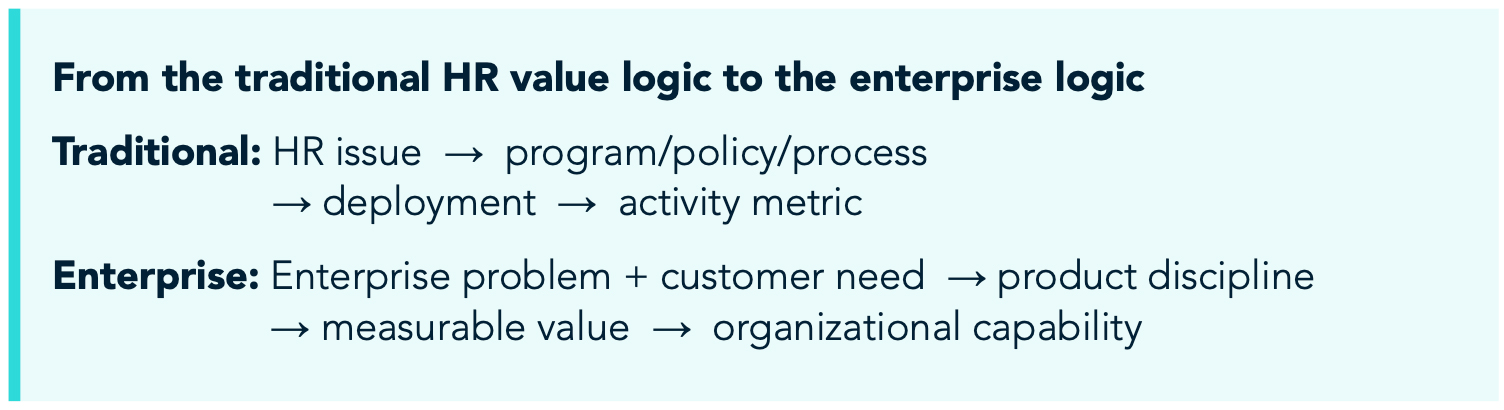
This new starting point changes the work of HR. Workforce planning, for example, becomes an exercise in designing how humans and AI can contribute together. Leadership development becomes the work of building a development and succession planning system capable of guiding the enterprise through whatever comes next.
This is why business fluency has become the new price of entry. An enterprise CHRO needs a systems-level understanding of how the enterprise creates value, where strategy will strain the operating model, and what those tensions imply for work, leadership, talent, and technology. Functional excellence remains essential, however, because it creates the credibility to do something larger: build the organizational capability the business will need next. Hannah Pritchett, Anthropic’s chief people officer, explains, “I want the deep experience to be balanced against fresh, first-principles thinking. We produce our best results when somebody is thinking from first principles and somebody else can say, ‘I’ve tried that—and here is why it failed.’”
The pressure to adapt is visible and has been exacerbated by AI. In our recent survey, 78% of CHROs identified preparing the workforce for AI and technological change as critical to organizational success over the next two to three years; only a quarter said their function was mostly or highly effective at that. Across all six areas we asked about, only 22% of CPOs averaged mostly or entirely effective.4
Neal Narayani, former CPO at Block and now in a dedicated AI automation role for the company, expressed the urgency of change. He notes, “The ability to build solutions that make sense for HR is different today than it was six months ago.”
This broader mandate also changes what it means for HR to have a seat at the table. Strategic authority comes from improving the quality of enterprise choices. An enterprise CHRO brings a view on where work should move, which capabilities deserve additional investment, and what the company can stop doing. HR creates value when those choices strengthen the organization’s ability to perform.5
A supply problem
Most CHRO pipelines were designed to build deep HR expertise through successive functional roles. A leader might have rotated through talent, rewards, employee relations, business partnering, and operations, gaining institutional judgment and pattern recognition along the way. That traditional development pipeline is still valued. Of the CHROs who responded to our recent survey, 61% reported that they had always worked in HR. In the minority of leaders with outside experience, 15% had moved from HR into other work and later returned, 23% began elsewhere before moving into HR, and just 1% had worked only outside HR before taking the CPO role. 6
However, today’s mandate requires additional experience that may come from owning a product, restructuring an operating model, leading a transformation, or making trade-offs against a commercial P&L. These skills often come from backgrounds not traditional in HR leaders, such as engineering or product. Our analysis of the backgrounds of sitting Fortune 1000 CHROs brings the supply constraint into sharper relief. Only 4% hold an undergraduate degree in a hard-science field and 6% in a soft-science field.7 Additionally, only 3% began their careers in strategy consulting, product, or engineering. Parallel analysis across 260 late-stage, high-growth companies shows a similar pattern: 3% of their CHROs have a hard-science degree, 6% a soft-science degree, and 5% began in strategy consulting, product, or engineering.
In other words, the traditional CHRO pipeline has overall not kept pace with the role’s expanded strategic responsibilities; companies are broadening expectations faster than they are broadening the experiences that prepare leaders to meet them. If CEOs continue drawing mainly from a pipeline optimized for the old value logic, the gap between aspiration and readiness is likely to persist.
It doesn’t have to: organizations have successfully invested in CHRO leadership from a broader range of functions and backgrounds. Prasad Setty, former vice president of people operations at Google, explained that “We staffed the HR function [at Google] with three types of backgrounds: consulting or business; academic or analytics; and HR. To those three, I would certainly add product thinking and technology acumen.”
What nontraditional experience can add
Across the interviews we conducted with leading CHROs with nontraditional backgrounds, two capabilities stood out: first-principles thinking and product thinking.
First-principles thinkers challenge the starting point, separating a real constraint from an inherited convention by asking why a process exists, which assumption holds it in place, and what the organization would build if it were starting today. This instinct is especially valuable as artificial intelligence (AI) destabilizes old role boundaries and forces companies to imagine a new operating model from the ground up.
Product thinking changes how an idea is developed, tested, and translated into value by bringing the discipline of identifying a customer, defining the problem from that customer’s point of view, and using a roadmap to test and refine the response. Prasad Setty captured the behavioral shift succinctly: “Programs, policies, and processes are deployed, whereas products are adopted.” For a function that can still treat launch as proof of impact, that distinction is profound.
CHROs we spoke with also highlighted a few other newly important areas of expertise. These included a business lens to anchor choices in enterprise value and analytics and technical fluency to make new forms of evidence and automation possible. In parallel to these new competencies, respondents stressed an important counterweight: deep HR experience that protects the judgment, trust, and regulatory context that human systems require.
The value for successful CHROs and their companies today comes from combining lenses rather than treating any one background as a shortcut to readiness. Building an HR function that delivers enterprise value is not a simple switch. The goal is to create productive tension between fresh thinking and human-capital judgment, with both held accountable for enterprise value.
A portfolio of HR capabilities for today and tomorrow
Expecting to find one single person with the full range of experiences needed to succeed as an enterprise CHRO is a trap. Few leaders will be exceptional across every dimension, and acting as if one person can cover them all turns a search into fiction.
In our experience, CEOs most often succeed when they begin by considering which capabilities the CHRO must have and which can be assembled across the people leadership team. For example, the CHRO personally needs the judgment to frame enterprise problems, earn the CEO’s trust, and integrate competing forms of expertise without losing sight of the human consequences. Direct reports can supply complementary depth in product, technology, workforce strategy, operations, analytics, and the core HR disciplines.
This portfolio view creates the potential to bridge between the HR leader and function companies have and the areas they need to augment. A CHRO with product and business depth may require exceptional rewards, employee-relations, and regulatory expertise nearby. A career HR leader may need stronger product, technology, and transformation capability embedded in the people leadership team. In either case, the CHRO appointment and the design of their team become one unified strategic decision.
AI is underscoring the need for a CHRO who can take the enterprise value view. Jacqueline Arthur, global head of human capital management at Goldman Sachs, explains that “AI is a way to reimagine how you do work. But it is not going to work unless you reinvent the workflows. For us, it is about reimagining the way we work, not just embedding AI in different processes.” Our recent survey of CHROs found that many aren’t there yet: just 30% reported new or reclassified AI roles, and another 38% said AI had not changed their organization’s overall talent structure.8
Four moves CEOs can make now
1. Start with the enterprise problem
Whether you are actively seeking a new CHRO or considering how your HR function could add more value, start by defining what your CHRO must make possible for your company’s strategy to succeed. The answer will look different for a company redesigning work around AI than for one integrating a major acquisition, rebuilding leadership, or moving from growth to disciplined execution. Iain Roberts, former CHRO of Airbnb, cautions, “Don’t start with the profile of the CHRO. Start with the enterprise problem you need them to solve. Only then should you ask where the person capable of solving it might come from.”
From there, when you start looking for people, widen the aperture with purpose. Look to leaders from product, engineering, strategy, operations, finance, and transformation, as well as to career HR leaders who have built comparable range through cross-functional work. Assess the evidence behind the resume: Can this person frame an ambiguous business problem, redesign a system, earn trust in a human moment, and turn an idea into adoption? A candidate’s background should generate hypotheses about readiness; it should never decide the outcome.
2. Design the CHRO role and the people leadership team as one portfolio
Map the capabilities required by the enterprise problem and determine which must sit with the CHRO. Build the remaining strengths into their direct reports and, where needed, a cross-functional network around them. Align remit and authority at the same time. An expanded mandate paired with a conventional team and limited authority is an invitation to fail.
A redesign should also reshape KPIs. Of the CHROs we surveyed, 37% said their metrics had become more focused on business and strategic outcomes over the past few years, and another 21% reported greater emphasis on transformation and future readiness.9 CEOs who want a CHRO who can deliver enterprise value should accelerate this shift. Operational HR metrics should serve as supporting indicators.
3. Start developing the next generation of HR leaders now
As with any key leadership role, you should ensure you have a robust pipeline before you need to fill the role. Give high-potential HR leaders ownership of products, transformations, operating-model work, or business outcomes. Then reverse the flow: rotate high-potential business, product, engineering, and transformation leaders through meaningful people work so they experience the judgment required in employee relations, leadership, culture, workforce decisions, and trust. These proving grounds allow unconventional talent to acquire human-capital depth while career HR talent develops new ways of creating value.
4. Get aligned with your CHRO
To ensure your CHRO is able to deliver enterprise value and support innovation in all of the aforementioned areas, the CEO and CHRO need to be aligned. Yet only 22% of the CHROs we surveyed described themselves as entirely aligned with the CEO, and more than a third reported no more than partial alignment.10
Without access to the decisions that shape the organization, clear permission to challenge inherited work, and visible support when the function crosses old boundaries, no CHRO will be able to add lasting value. Without your backing, unconventional leaders will be pulled toward a conventional service mandate; career HR leaders attempting to change the existing model will face the same gravity.
The CHRO pipeline is a choice
The current scarcity of enterprise CHROs is a direct consequence of how companies have defined the role, developed talent, and rewarded experience. The old pipeline made sense for the value logic it served, but the enterprise now needs a wider route to readiness.
CEOs should widen both the search and the route that prepares leaders for it. Your next great CHRO may come from engineering, product, operations, strategy, or elsewhere in the business. They may also rise through HR after accumulating new cross-functional experiences that the traditional ladder rarely required. Ultimately, readiness comes down to whether that person can convert enterprise strategy into organizational capability and orchestrate the portfolio needed to make it real.
Your CHRO decision is more than just a functional succession choice. It is the decision about the leadership architecture of the company’s future.
Acknowledgements
That authors wish to thank Katie Frederick, Bridget Graham, and the following executives for their contributions to this article:
Jacqueline Arthur, Global Head of Human Capital Management, Goldman Sachs
Jacqui Canney, Chief People and AI Enablement Officer, ServiceNow
Emily Field, Chief People Officer, LPL Financial
Neal Narayani, Former Chief People Officer, Block
Hannah Pritchett, Chief People Officer, Anthropic
Iain Roberts, Former Chief Human Resources Officer, Airbnb
Prasad Setty, Former Vice President of People Operations, Google
About the Authors
Brian Kropp (bkropp@heidrick.com) is vice president of CPO Insights & Community Engagement; he is based in the Washington, DC office.
Brad Warga (bwarga@heidrick.com) is a partner and co-head of the Global Human Resources Officers Practice; he is based in the San Francisco office.
References
1 Emma Burrows, Sharon Sands, Brad Warga, and Jennifer Wilson, “Chief people officers in focus: What new HR leaders need to know,” Heidrick & Struggles, October 24, 2024, heidrick.com; Sunny Ackerman, Darren Ashby, Emma Burrows, Sharon Sands, Brad Warga, and Jennifer Wilson, “Chief people officer of 2030: Building a tool kit to get from here to there,” Heidrick & Struggles, February 20, 2025, heidrick.com; and Brian Kropp, Brad Warga, and Jennifer Wilson, “Chief people officer focus: 2026 agenda—becoming an enterprise CPO,” Heidrick & Struggles, February 3, 2026, heidrick.com.
2 For more on how enterprise CHROs’ relationship with the board differs from that of other CHROs, see Brian Kropp, Brad Warga, and Jennifer Wilson, “Chief HR officer focus: What high-performing CEOs want from their CHROs,” Heidrick & Struggles, October 7, 2026, heidrick.com.
3 Heidrick & Struggles survey of chief human resources officers, June 2026, n=600.
4 Heidrick & Struggles Enterprise CHRO Survey, June 2026, n=600.
5 For more on how enterprise CHROs’ relationship with the board differs from that of other CHROs, see Kropp, Warga, and Wilson, “Chief HR officer focus: What high-performing CEOs want from their CHROs,” Heidrick & Struggles, October 7, 2026, heidrick.com.
6 Heidrick & Struggles Enterprise CHRO Survey, June 2026, n=600.
7 Hard sciences were defined as computer science, engineering, or physics; soft sciences were defined as biology, chemistry, economics, or math.
8 For more on how CHROs are driving enterprise value from AI by building relationships across the C-suite, particularly with senior technology leaders, see Kropp, Warga, and Wilson, “Chief HR officer focus: What high-performing CEOs want from their CHROs,” Heidrick & Struggles, October 7, 2026, heidrick.com.
9 Heidrick & Struggles Enterprise CHRO Survey, June 2026, n=600.
10 Heidrick & Struggles Enterprise CHRO Survey, June 2026, n=600.