Human Resources Officers
Chief HR officer focus: What high-performing CEOs want from their CHROs
Human resources leaders have been building strategic influence for a decade or more. Today, their potential impact on performance is greater than ever, and the C-suite relationships they need to succeed are broader than ever. New data and conversations with CHROs around the world explore what it takes to succeed.
October 07, 2026
For decades, HR leaders were expected to build strong leadership teams, develop talent, manage succession, and shape culture. Those responsibilities remain essential, but they are no longer sufficient. Today, leadership and talent are becoming companies’ most reliable source of competitive advantage. In that context, CEOs are asking more of their top people officers than at any point in the past: to simultaneously reinvent work with AI, redesign operating models, build new capabilities, accelerate transformation, navigate unprecedented workforce disruption, and deliver sustained growth all while maintaining employee trust and organizational resilience.
AI, in particular, is forcing organizations to rethink what work gets done, how it gets done, and how senior leaders work together to lead hybrid organizations. Seventy-eight percent of CHROs expect preparing the workforce for AI and technological change to be among the most critical issues for their organization’s success in the near future; only a quarter say they’re effective at doing so today.1 Successfully navigating this transformation requires CHROs to expand the core set of relationships they have long relied on.
The traditional CEO-CFO-CHRO triad—connecting business strategy, financial resources, and human capital—is increasingly becoming a quartet that includes the senior technology leader. At the highest-performing companies, this shift is at the center of a set of transformations that also includes CHROs’ remit, KPIs, and topics they cover with the board. Notably, the shifts don't include any increase in budget.
CEOs at high-performing companies have identified a fundamental reality of leading today’s organizations: most organizational challenges, at their core, are talent challenges that cannot simply be delegated to HR, nor can they be solved without it. They are working with their CHROs to reshape the function to succeed.


45% of Fortune 1000 CEOs have specifically tasked their head of HR to play a lead in the AI transformation of their organization.
In response to elevated demands, CEOs have been evolving what they want from CHROs. Based on analysis of 2,716 searches for CHROs, the number of skills that CEOs are looking for in their head of HR has climbed from roughly 8.6 in 2016 to nearly 13.0 in 2026. CEOs have also increased the span of control of their CHRO. In 2022, only 13% of CHROs had direct managerial responsibilities outside of HR. Now, that share has risen to 29%, including responsibility for functions such as enterprise transformation, communications, and workplace strategy. Perhaps most telling, 45% of Fortune 1000 CEOs have specifically tasked their head of HR to play a lead in the AI transformation of their organization.
The CHRO portfolio today reads less like an expert in traditional human resources and more like a business strategist responsible for corporate strategy, capital allocation, and operating-model design. In response, boards and CEOs are seeking more experienced CHROs. The number of externally hired Fortune 1000 CHROs who have previous experience in the role, for example, grew from 41% in 2022 to 75% in 2025. In their external hires, CEOs and boards also increasingly value experience in the same industry: this has risen from 23% to 34% over the same period. Conversations with CEOs underscore that they are not seeking experience just for the sake of experience. Rather, they want a CHRO who can deliver quickly—someone who will not be learning on day one, but will be contributing on day one.2
…Without more budget
Despite all these rising expectations, CEOs at the highest-performing companies aren’t increasing budgets in parallel, our analysis shows. This counterintuitive finding is also one of our most important: spending more on HR is not a necessary condition to ensure delivery of improved organizational outcomes. In fact, we found there is no statistically significant difference in HR-to-employee ratio or HR spend per employee when comparing companies with high total shareholder return (TSR) against companies with lower TSR relative to their industry peers. High-TSR companies are not simply out-resourcing their competitors in the people function.
The difference, our research and conversations show, starts with who is hired in the CHRO role and includes what they are measured against, how they show up in the boardroom, and who they partner with day to day. In other words, the differentiator is not how much organizations invest in HR, but how they position the CHRO, and the HR function, to create value across the enterprise.
The enterprise CHRO
CEOs recognize that leadership and talent quality has become one of the few reliable competitive advantages today. Strategy can be copied. Products can be replicated. Technology diffuses quickly. Capital is abundant. It is far more difficult to maintain an edge in an organization’s ability to continually build leaders, adapt to change, develop new capabilities, and mobilize thousands of people around a common direction. Increasingly, the most successful organizations put the CHRO at the heart of a team with the CEO, CFO, and senior technology leader to create that advantage by delivering the organizational capabilities that drive long-term performance.
We analyzed how CHROs are working at companies that consistently outperform their industry peers on TSR and found that these organizations are significantly more likely to have what we define as an enterprise CHRO.3 This definition is based on three sequential criteria:
- Strong operational effectiveness across the core responsibilities of the HR function;
- Advancing strategic capability in integrated workforce planning, executive succession planning, and AI workforce transformation
- Strong alignment with the CEO, reflecting the executive sponsorship required for the CHRO to operate as an enterprise leader.
Only 25% of CHROs are currently operating at this level.
Enterprise CHROs operate in a different environment and set of relationships in three specific, observable ways.
1. Measuring what comes next, not what already happened
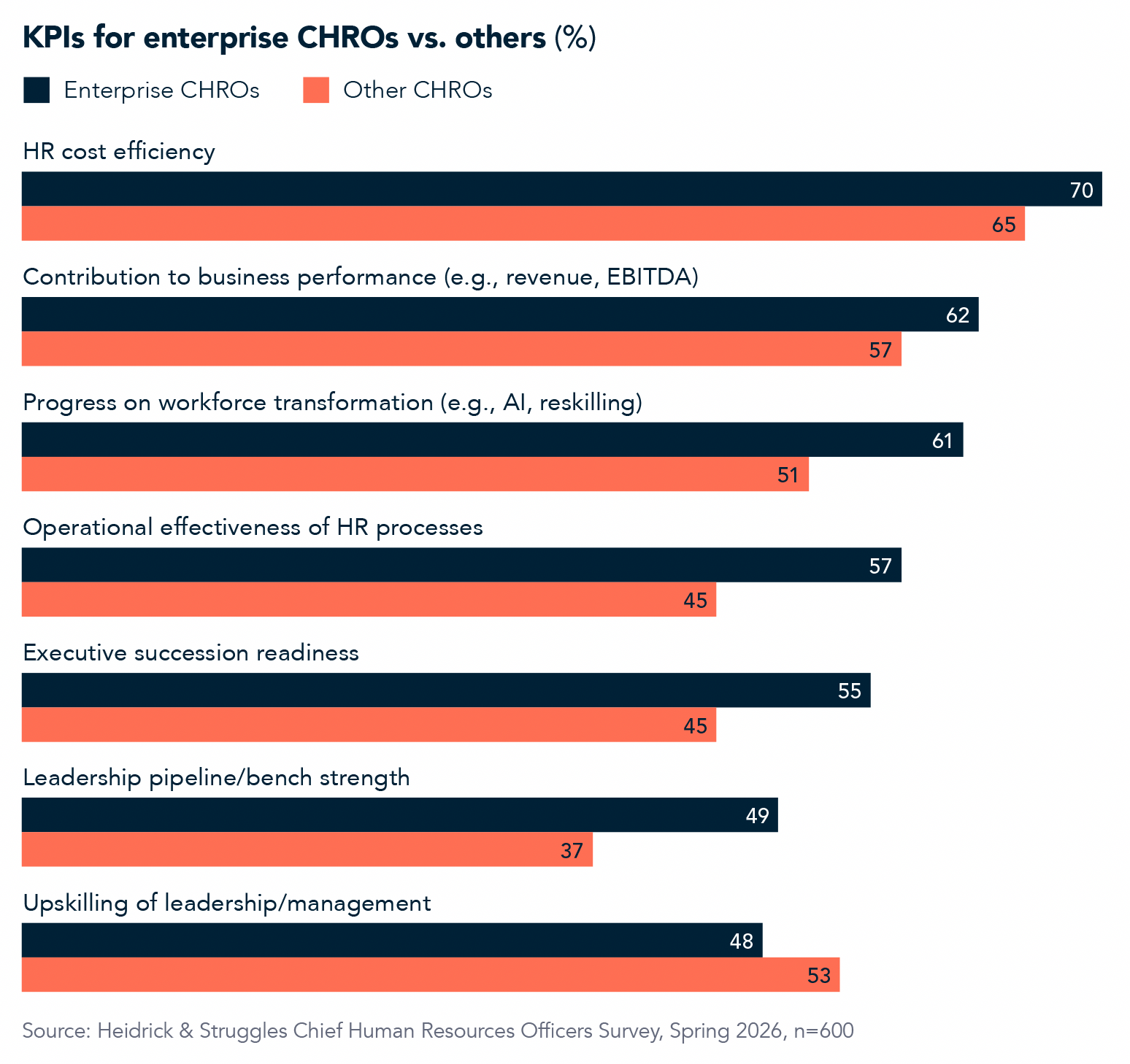
Enterprise CHROs are still evaluated against traditional measures of HR performance, the most common being overall HR cost efficiency. However, they are also held accountable for more KPIs than CHROs at other companies, and those KPIs are shifting away from "plumbing KPIs" and toward "performance KPIs," such as forward-looking measures of organizational and business outcomes.
A perfect example of this is the measurement of leadership talent outcomes. Enterprise CHROs are 32% more likely to be held accountable for the strength of the leadership bench (often measured through various assessment tools), while CHROs at other companies are 10% more likely to be held accountable for the inputs that could create a strong leadership bench (for example, number of trainings provided to senior leaders).
Another example of this shift is how enterprise CHROs are measured when it comes to the workforce. While all types of CHROs are equally likely to be measured on employee engagement and retention scores, enterprise CHROs are 20% more likely to be measured on whether the workforce is transforming to meet the needs of an AI-enabled future.
2. Same seat in the boardroom, different story
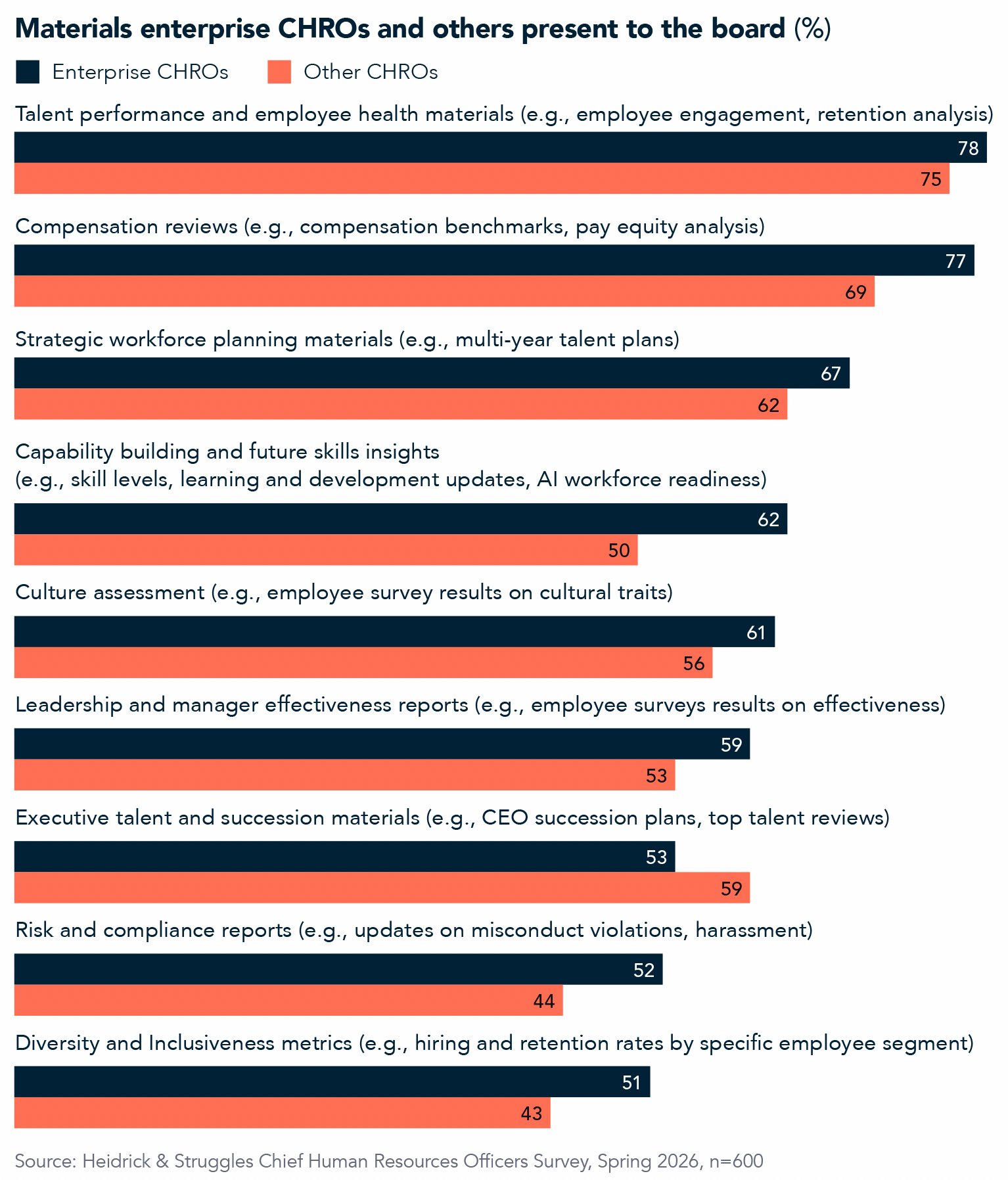
A second key differentiator of enterprise CHROs is their relationship with the board. They attend an average of two board meetings per year, almost identical to their peers. They are in the same meetings, engage with the same board members, and are on the same board committees. Their seat at the table looks structurally identical.
What changes is the substance of what they bring to the conversation. The material they bring to the board focuses more often on the future of the organization. They overweight their information around topics like strategic workforce planning (8% more likely), future skill needs (23% more likely), and leader effectiveness (11% more likely). They are helping the organization evaluate enterprise risk and opportunities to improve the likelihood of transformational success in addition to traditional HR reporting metrics.
3. From a triad to a quartet
Perhaps the most structurally significant of the three differentiators—and the one that most clearly illustrates the emergence of the CEO-CFO-CHRO-technology leader quartet—is the increasing prominence of the relationship between the CHRO and the senior technology leader.
For the last decade, a commonly repeated mantra was the importance of a CHRO building a strong and lasting relationship with the CFO. The conventional wisdom has been that the CFO manages the financial resources of the firm, the CHRO manages the human resources of the firm, and, with the CEO, they form a stable triad.
While this still holds true, as AI transforms work, enterprise CHROs are building partnerships with senior technology leaders that are as strong as, if not stronger than, their relationships with CFOs. This newer relationship is about building workforce capability, shaping how AI, automation, and digital tools reconfigure how work gets done. It’s innovative and makes CHROs co-architects of the future organization, not merely providers of HR systems with a focus on costs.4
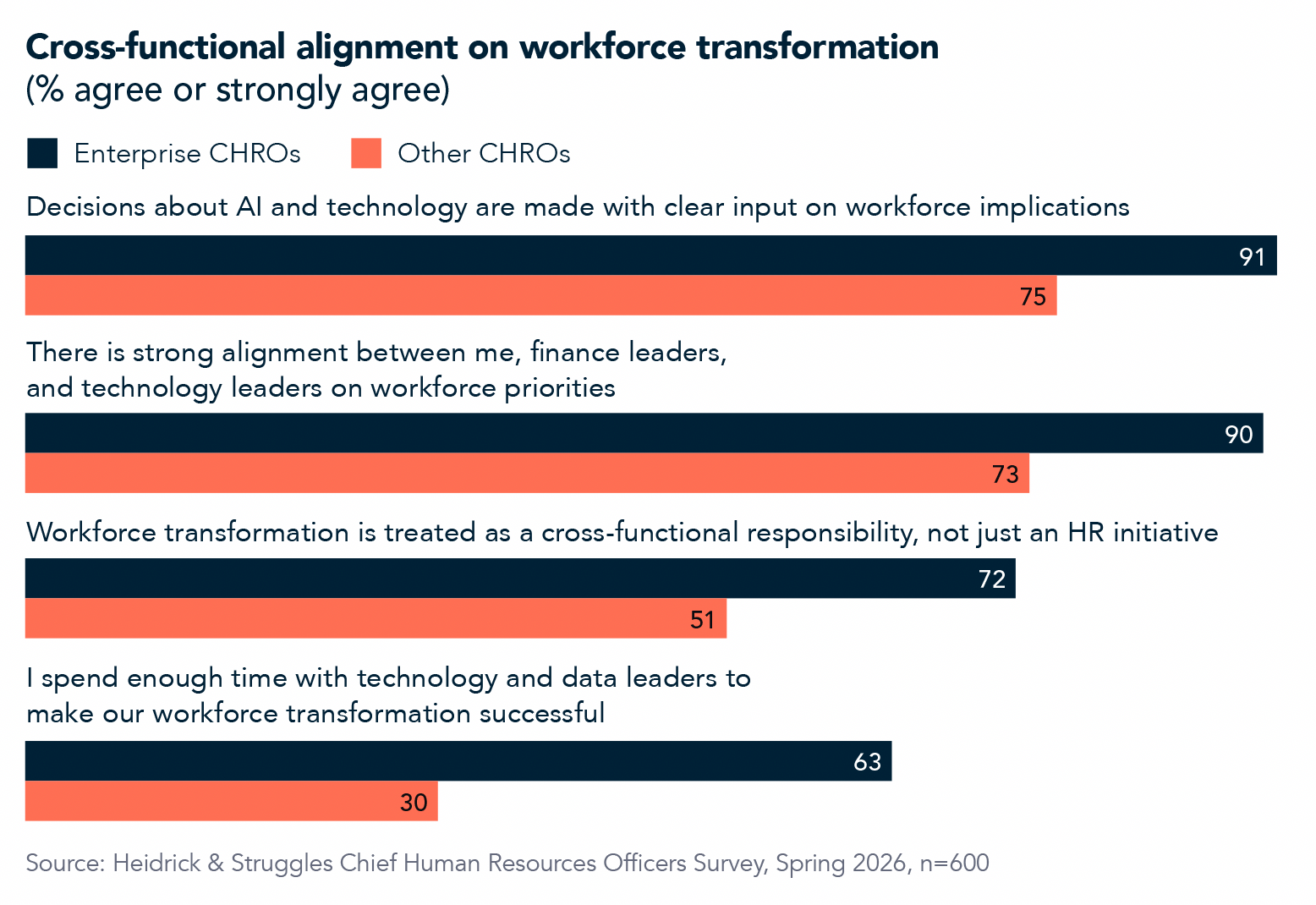
Our survey data highlights the difference: while most CHROs have increased the amount of time they spend with their CTO, enterprise CHROs have disproportionately increased that investment. They spend 10 additional hours per month collaborating directly with their CTO to drive the AI transformation of work. The result is that 90% of enterprise CHROs say they have a strong degree of alignment with their CTO, compared with 73% of others.
What this means for CEOs and boards
In a world where leadership quality is an increasingly important competitive advantage, CEOs and boards need better and higher performance from their CHROs. We know they don’t need to provide more budget to their HR function. Rather, they succeed by reorienting the role and relationships of their CHRO to drive enterprise outcomes rather than HR outcomes.
Specifically, they have:
- Evolved the capabilities they require from the CHRO. They are looking for people who can build a forward-looking workforce plan, with the corresponding leadership strategy to deliver on the AI transformation of work.
- Increased the number of KPIs they hold their CHRO accountable for, with a heavier focus on KPIs that measure what is next rather than what happened.
- Changed the information the CHRO brings to the board to focus on the risks and opportunities of their leadership bench and workforce.
- Expanded the critical executive leadership relationship structure from the traditional CEO-CFO-CHRO triad to a quartet, in which the senior technology leader plays an increasingly important role.
This means supporting strengthening the CHRO-CTO relationship to the same level as that of the CHRO-CFO.
For CEOs evaluating their current CHRO or considering succession planning, our research and experience suggest a few clear questions:
- Does the CHRO’s skill profile map to what will drive organizational performance, or does it map to traditional HR generalist competencies?
- Are the CHRO’s KPIs framed around enterprise and business outcomes, or around HR process metrics?
- Is the data the CHRO brings to board meetings materially different from what a traditional HR leader would bring?
- Is the relationship between the CHRO and CTO strong enough to successfully drive the AI transformation of work?
Finally, this work suggests a few questions for CEOs to ask themselves:
- Have I created the conditions for my CHRO to operate as an enterprise leader? Am I supporting them in developing the right peer relationships and connecting with the board on the most important topics?
- Am I involving my CHRO early enough in strategic decisions to ensure we understand potential impact on the workforce and organization and respond effectively?
- Have I created enough alignment with my CHRO on where the business is going, and what that means for leadership, talent, and succession planning?
Conclusion
The role of the CHRO is expanding because leadership quality has become one of the few sustainable competitive advantages. As strategy, technology, and capital become easier to replicate, the ability to build leaders, transform work, and continually adapt the organization increasingly determines long-term performance. The best CEOs recognize this shift and empower their CHRO to help create that advantage through broader capabilities, greater accountability for enterprise outcomes, more forward-looking insight, and strong partnerships across the C-suite.
About the authors
Brian Kropp (bkropp@heidrick.com) is the vice president of CPO Insights & Community Engagement; he is based in the Washington, DC office.
Brad Warga (bwarga@heidrick.com) is a partner and co-head of the global Human Resources Officers Practice; he is based in the San Francisco office.
Jennifer Wilson (jwilson@heidrick.com) is a partner and co-head of the global Human Resources Officers Practice; she is based in the Dallas office.
References
1 In late spring 2026, Heidrick & Struggles conducted an online survey of 600 HR leaders at companies across sectors in 11 markets around the world. All were at companies with $1b or more in revenue; a third were at companies with $10 billion or more. Half were at companies traded on public markets; the rest were a mix of other ownership types.
2 Proprietary Heidrick & Struggles analysis of head of human resources at Fortune 1000 companies.
3 This analysis builds on our earlier research in this area, such as in Sunny Ackerman, Darren Ashby, Emma Burrows, Sharon Sands, Brad Warga, and Jennifer Wilson, “Chief people officer of 2030: Building a tool kit to get from here to there,” Heidrick & Struggles, February 20, 2025, heidrick.com; and Brad Warga and Jennifer Wilson, “Chief people officer monitor: Building HR functions that are effective and strategically influential,” Heidrick & Struggles, September 24, 2025, heidrick.com.
4 Ryan Bulkoski, Jaimee Eddington, Katherine Graham Shannon, and Brad Warga, “AI and leadership: How finance, HR, and technology leaders are collaborating to make the most of AI across the enterprise,” Heidrick & Struggles, September 3, 2025, heidrick.com.
Stay connected
Stay connected to our expert insights, thought leadership, and event information.
Leadership Podcast
Explore the latest episodes of The Heidrick & Struggles Leadership Podcast.