AI focus: Framing the AI leader’s role to fit your organization
Despite enormous investment, 63% of companies have yet to see AI contribute to bottom-line earnings, even as it has become embedded in most organizations.1 The idea of simply encouraging adoption and hoping that good things will emerge is clearly in the rearview mirror. CEOs need to build and evolve their leadership teams to drive the ROI of their AI investments. But there is still no single, proven template for the chief AI officer (CAIO) role,2 and no single organizational approach that works best. In fact, it is clear that different solutions suit different companies, depending on industry, maturity, and strategic intent.3 Given the speed of technological change, cost pressures, and innovation breakthroughs, most companies will benefit from regularly revisiting their operating model and the role of their CAIO as their use of AI matures.
Many CHROs and technology leaders start with the question of who should be their CAIO. While this question is obviously critical, they can answer it successfully only by defining what their company is trying to accomplish: clearly articulating the objective, strategy, and authority needed for the role will define the type of candidate who will succeed in it.4
We have analyzed 456 CAIO hires from 2023 through 2026 across industries and geographies at companies with more than $500 million in revenue and combined those insights with our ongoing work to map out the critical decisions that can help CEOs, CHROs, and technology leaders decide on the right approach for them.
Objective before org chart
The profile of an effective leader depends entirely on the mandate, and the mandate cannot be defined without first aligning on the objective. Is the priority building a scalable platform other teams can use? Proving business value quickly in a handful of workflows? Establishing governance and risk controls before deploying at scale?
Each objective calls for a different leader, reporting relationship, and definition of success. When leaders skip this step, and plunge right into searching for a leader, they risk finding someone who is technically strong but organizationally mismatched to the task.
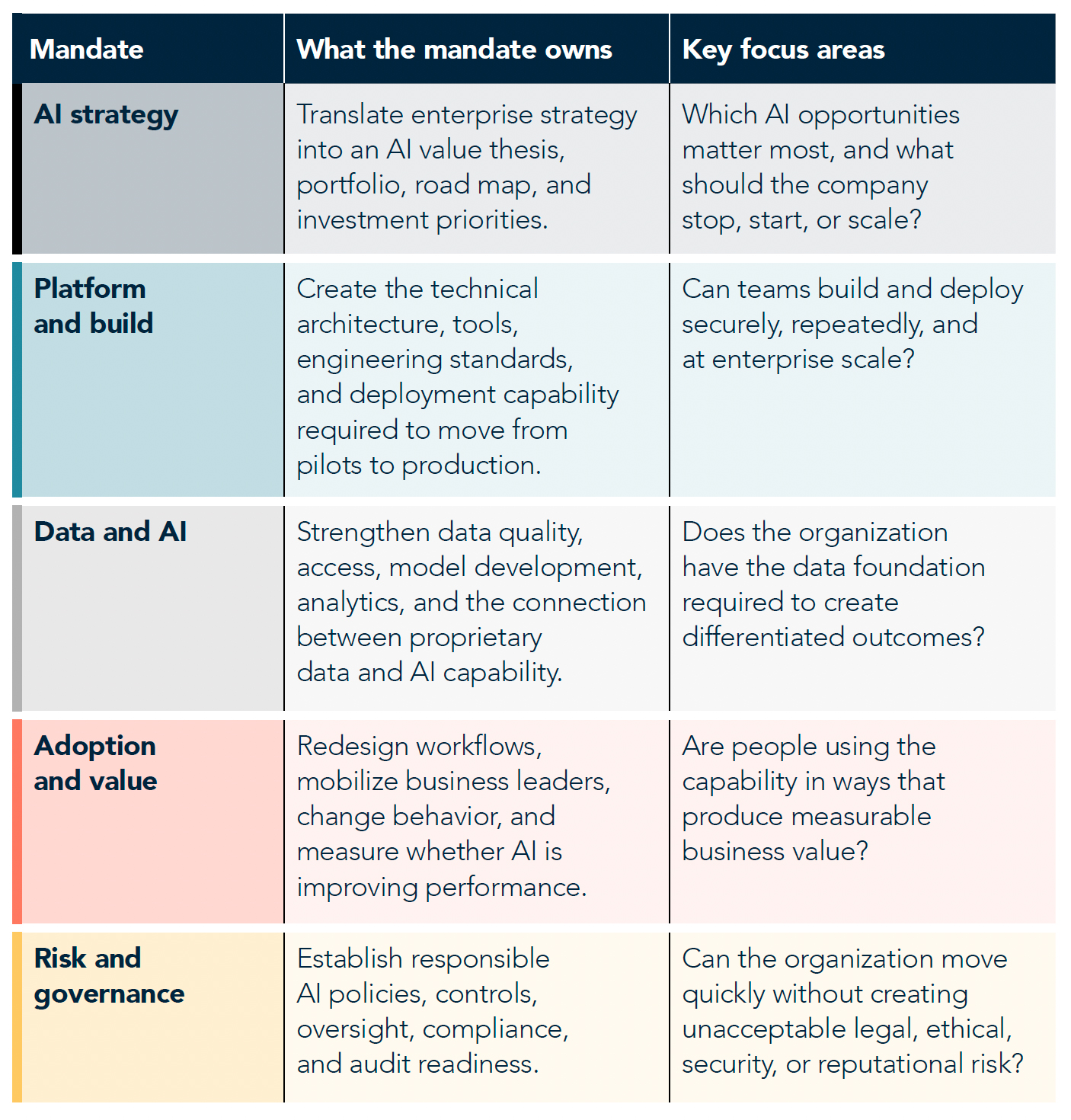
Our analysis finds that the CAIO mandate is not one job but a bundle of five mandates, each of which has different priority in each organization:
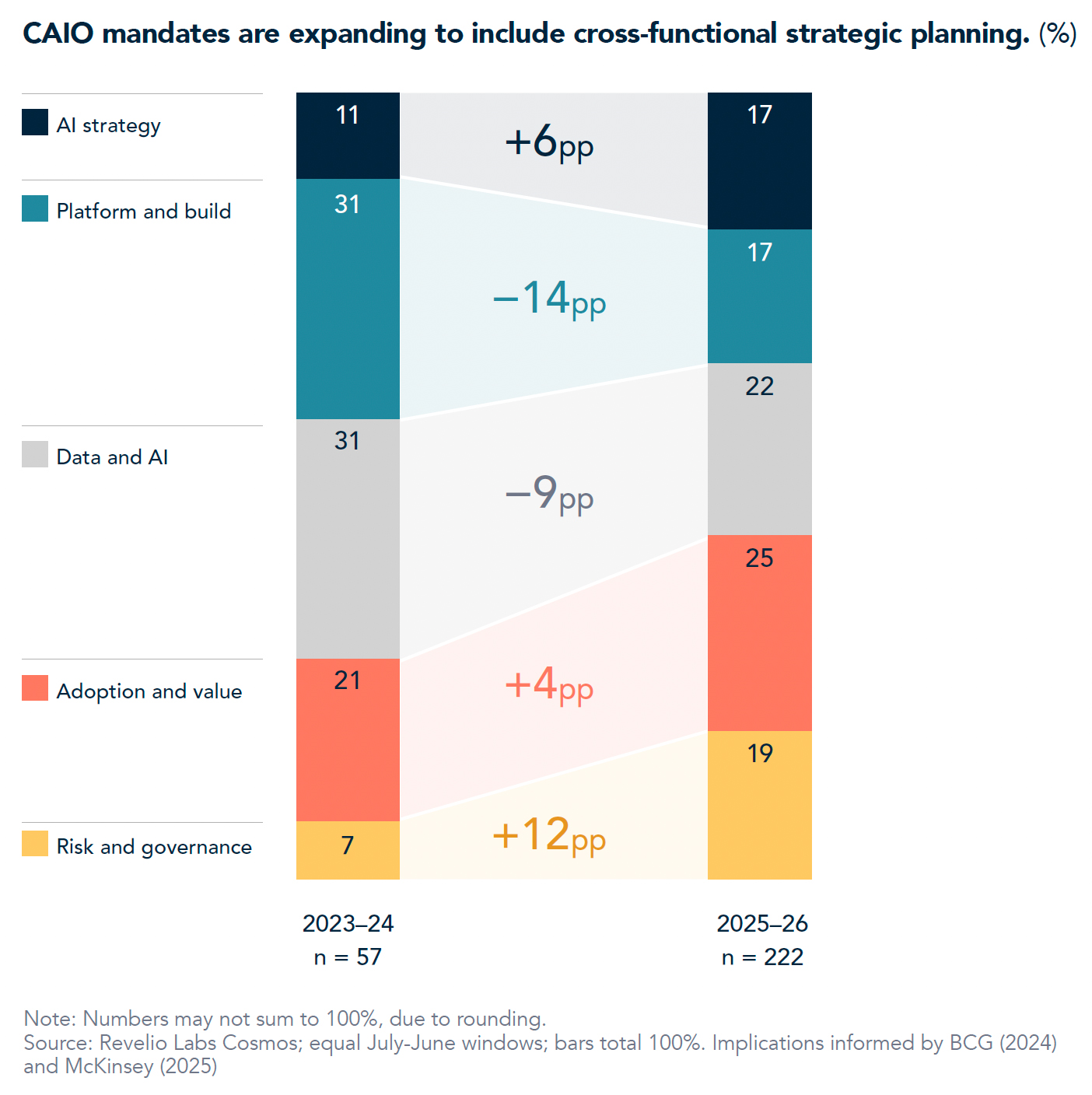
Comparing CAIOs hired in 2023 to those hired in 2026 shows two critical evolutions in expectations. First, CAIOs are now being asked to do more of everything. In 2023, the role was largely defined with a singular focus: only 23% of CAIOs were asked to work across multiple mandates. In 2026, 51% are being asked to work across multiple mandates. Second, CAIOs are now expected to know business as well as technology. In 2023, the role leaned heavily into building the data, platform, and infrastructure of the role. In 2026, there is more emphasis on AI strategy, an increase from 11% to 17%, and governance, up from 7% to 19%. In parallel, our most recent annual survey of chief data, analytics, and AI officers found that strategy is now owned by CAIOs at 21% of companies, up from 0% in 2023.5
These insights are also relevant for sitting CAIOs and their CEOs, CHROs, and senior technology leaders, implying that a CAIO hired in 2023 is very likely operating with a mandate that has grown far beyond the original scope. Job descriptions and compensation benchmarks written even two years ago are likely already outdated. Organizations revisiting the role, whether as part of a reorganization or to make a new hire, should assume the necessary scope has gotten broader, more strategic, and more governance oriented, whatever their immediate strategic goal.
Choosing the operating model
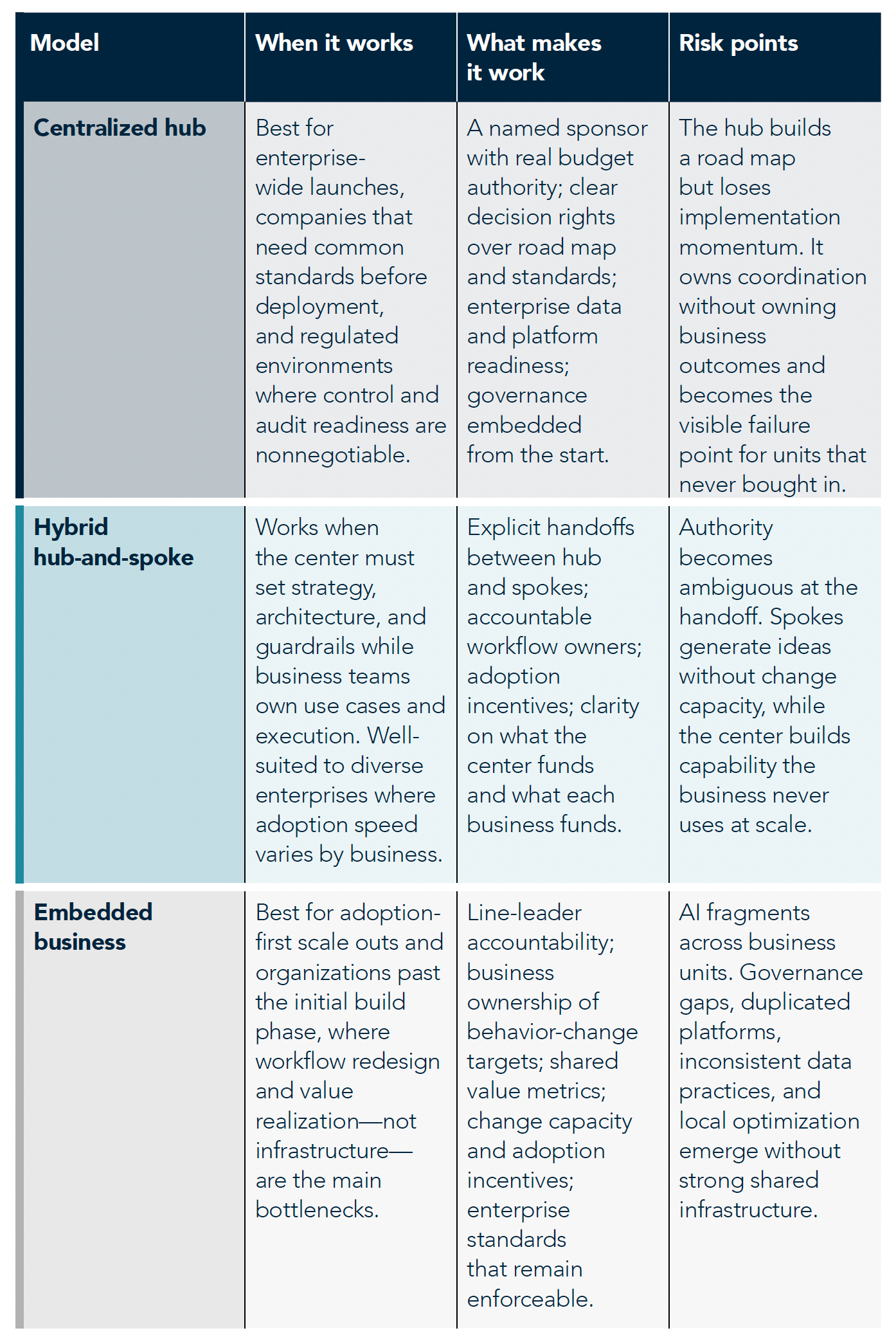
The AI operating model decision should follow the strategy decision, but it is also dependent on internal AI maturity. Three distinct operating models are emerging, with varying degrees of external provider support.
While the types of operating models are generally consistent, there has been a directional but not whole-hearted shift toward embedded structures. In 2023, centralized hub structures accounted for 44% of observed operating models, hybrid 19%, and embedded 38%. By 2026, centralized eased to 37% while hybrid rose to 45% and embedded fell by more than half, to 18%.
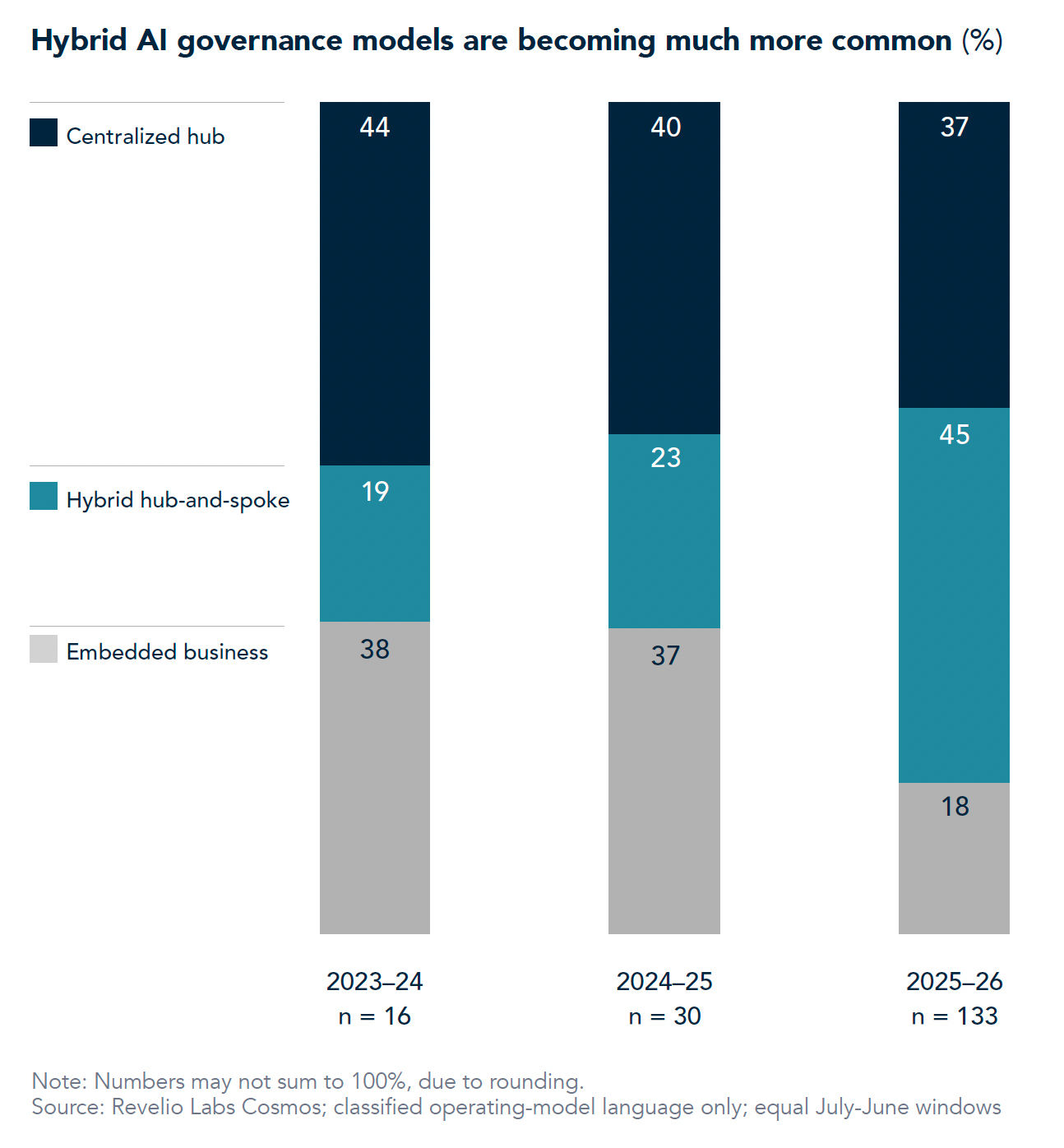
One reason is that companies are migrating toward hybrid structures upon discovering the governance costs of decentralized AI. It is not unreasonable, however, to imagine a future state in which AI-related capabilities are fully embedded within the business as companies become more mature. In other words, it is likely that companies will continue to evolve their AI operating model as their maturity continues to evolve. CEOs, CHROs, and senior technology leaders will benefit from revisiting their operating model on a regular cadence rather than seeing today’s model as permanent.
Mandate mix differs by operating model
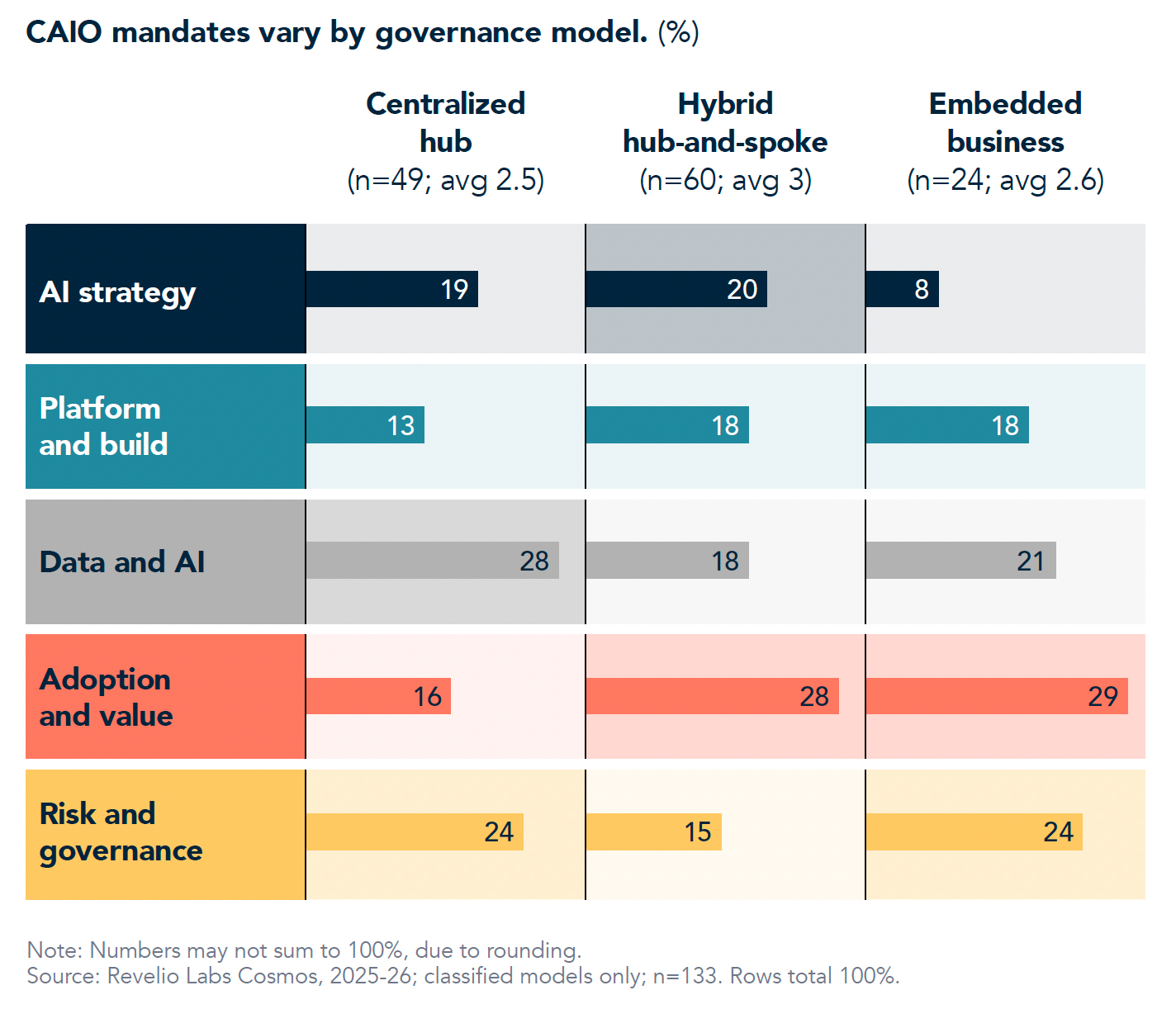
A correlation exists between the operating model and which CAIO mandates are emphasized most. In centralized hubs, for example, data management and governance take the forefront. Hybrid structures show a more balanced mix, with AI strategy and adoption being the key focus areas. Embedded structures skew toward adoption and value and governance. This underscores how important the operating model is to the decision of whom to hire. In this context, it’s notable that we see many companies focus on hiring for AI strategy alone, even though it is the smallest lever for value realization in most models.
Scoping the CAIO role for success
Once the mandate and operating model are mapped, CEOs, CHROs, and senior technology leaders can answer the next set of questions: Where does the role report? What decision rights does the CAIO have? And what team structure and span of control does the role command?
When companies put this question last—and then start to figure out whom to hire—the CAIO becomes a structured extension of the organization's actual AI strategy rather than a talent-market gamble. Any other process seems likely to leave value stubbornly unrealized.
About the authors
Ryan Bulkoski (rbulkoski@heidrick.com) is the global managing partner of the AI & Data Practice and co-leads the AI & Technology Officers Practice; he is based in the San Francisco office.
Brian Kropp (bkropp@heidrick.com) is the vice president of CPO Insights & Community Engagement; he is based in the Washington, DC office.
References
1 Dan Tinkoff, Lieven Van der Veken, and Michael Chui with Tara Balakrishnan, “The state of AI in 2026: On the road to ROI,” McKinsey & Company, August 25, 2025, mckinsey.com.
2 In this article we are using the term “chief AI officer” to mean an organization’s senior-most technology leader responsible for driving its AI transformation. As we’ve detailed in our annual surveys of AI leaders, different organizations use different titles to capture the role, and titles continue to evolve.
3 For more on current governance models and strategies, see Ryan Bulkoski, “2025 Artificial Intelligence, Data, and Analytics Officers Artificial Intelligence Report,” Heidrick & Struggles, February 24, 2026, heidrick.com.
4 We last wrote about creating an operational model for AI two years ago, and the fact that companies are still struggling with these foundational questions underscores the pace of change of both the technology and the leadership capabilities needed to use AI successfully.
5 Ryan Bulkoski, "2025 Artificial Intelligence, Data, and Analytics Officers Artificial Intelligence Report," Heidrick & Struggles, September 24, 2026, heidrick.com.