CEO Succession Planning
Route to the Top United Arab Emirates 2026: Creating a deep bench, not a single successor, positions organizations best for the future
Organizations in the UAE have made significant progress in strategic alignment, but sustained success will require succession planning to become a continuous capability rather than a one-time governance exercise.
September 14, 2026
Organizations in the UAE have made significant progress in strategic alignment, but sustained success will require succession planning to become a continuous capability rather than a one-time governance exercise. Boards that develop multiple future leaders, not just a single successor for the top role, will be better positioned to adapt as strategy and market conditions evolve.
CEO succession has always been one of the board's most consequential responsibilities. Today, however, it has become significantly more complex. Organizations across the United Arab Emirates are navigating an environment shaped by war and geopolitical tensions, shifting trade dynamics, evolving energy markets, and persistent global economic uncertainty. Even companies that have not been directly affected by regional conflict face greater volatility through its impact on investor sentiment, supply chains, and the broader operating environment.
Our survey of 1,033 CEOs and directors globally, including 59 in the UAE, shows that Emirati organizations have made meaningful progress in aligning leadership with strategy and embedding succession planning into board governance. Yet many continue to prepare leaders for the business they know rather than the business they may face. In a world where strategy can shift quickly, succession planning should not be about identifying a single successor for a role. The organizations best positioned for long-term success are those that cultivate multiple leadership options, giving boards the flexibility to match future leaders to the strategic scenarios that ultimately emerge.

Nine out of ten CEOs and board members in the UAE expect their organization's strategy and operating model to change within the next two to three years. They recognize that the volatility they are currently experiencing is likely to remain a defining feature of the operating environment, reinforcing the need for leaders who can adapt strategy and execution as conditions evolve.
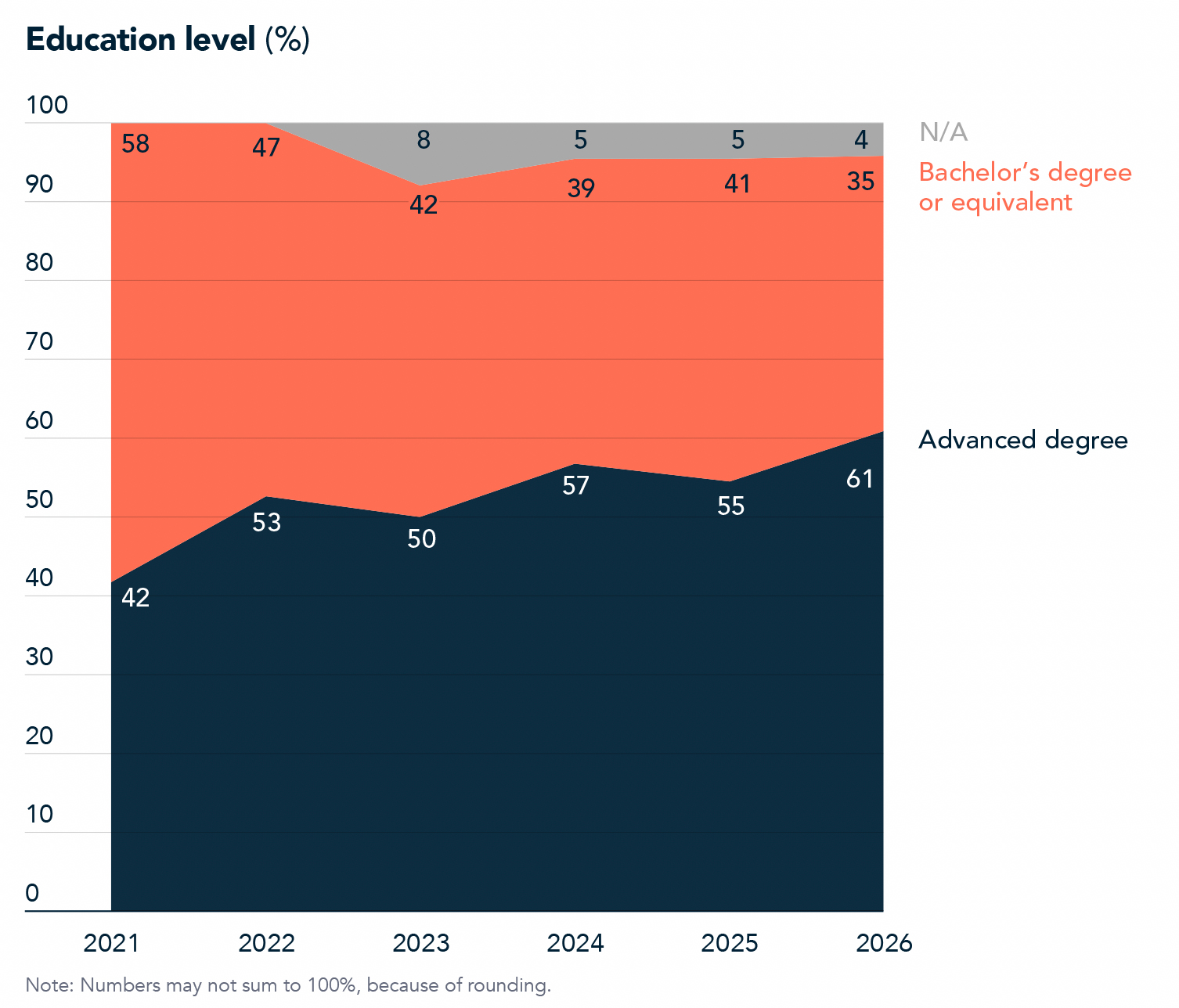
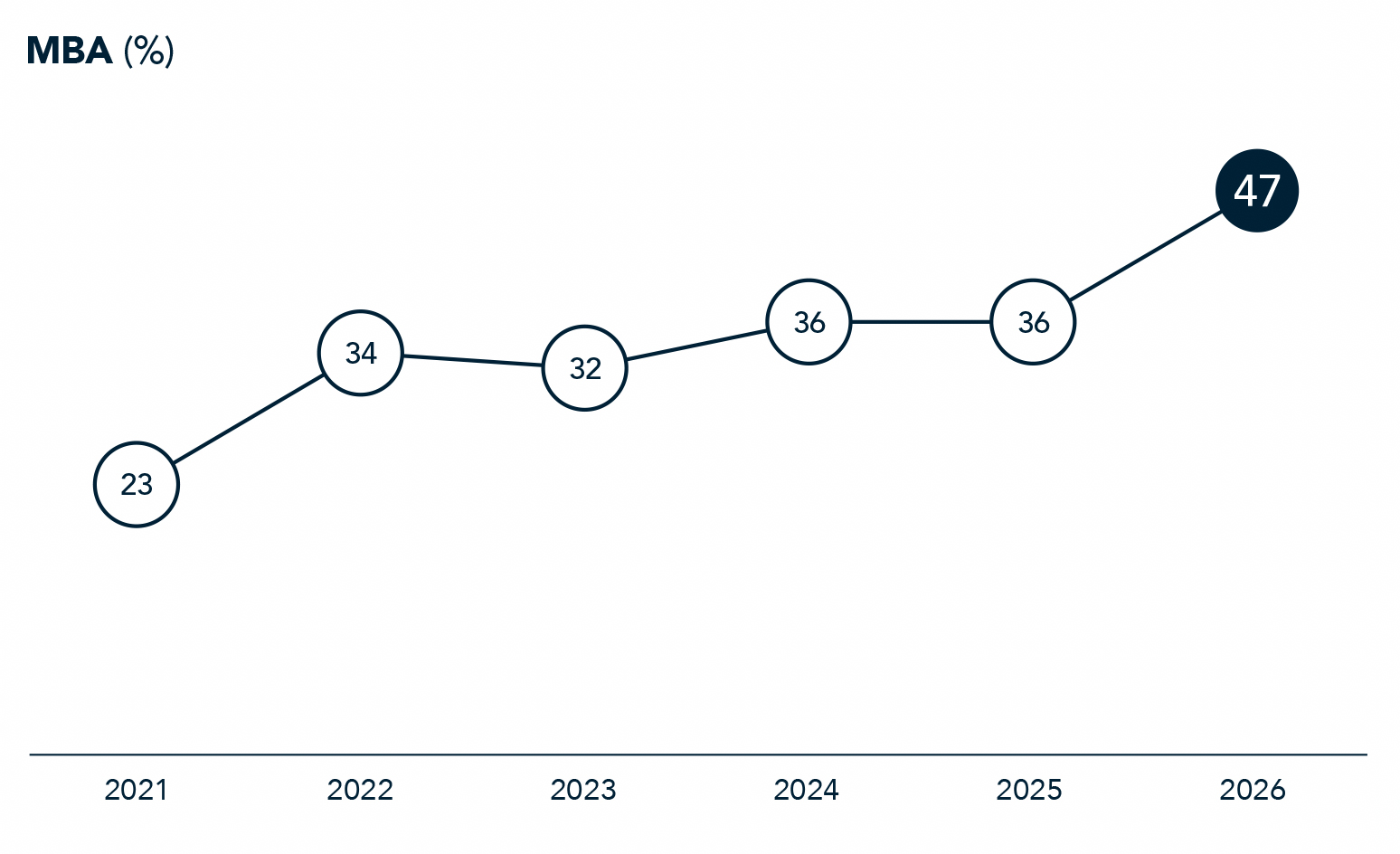
In response, the UAE's largest companies are placing a premium on formal credentials in CEO appointments. For example, higher education is becoming a more prominent feature. Today, 61% of CEOs hold an advanced degree, including 47% with an MBA, compared with 42% and 23%, respectively, when we began tracking these data points in 2021.
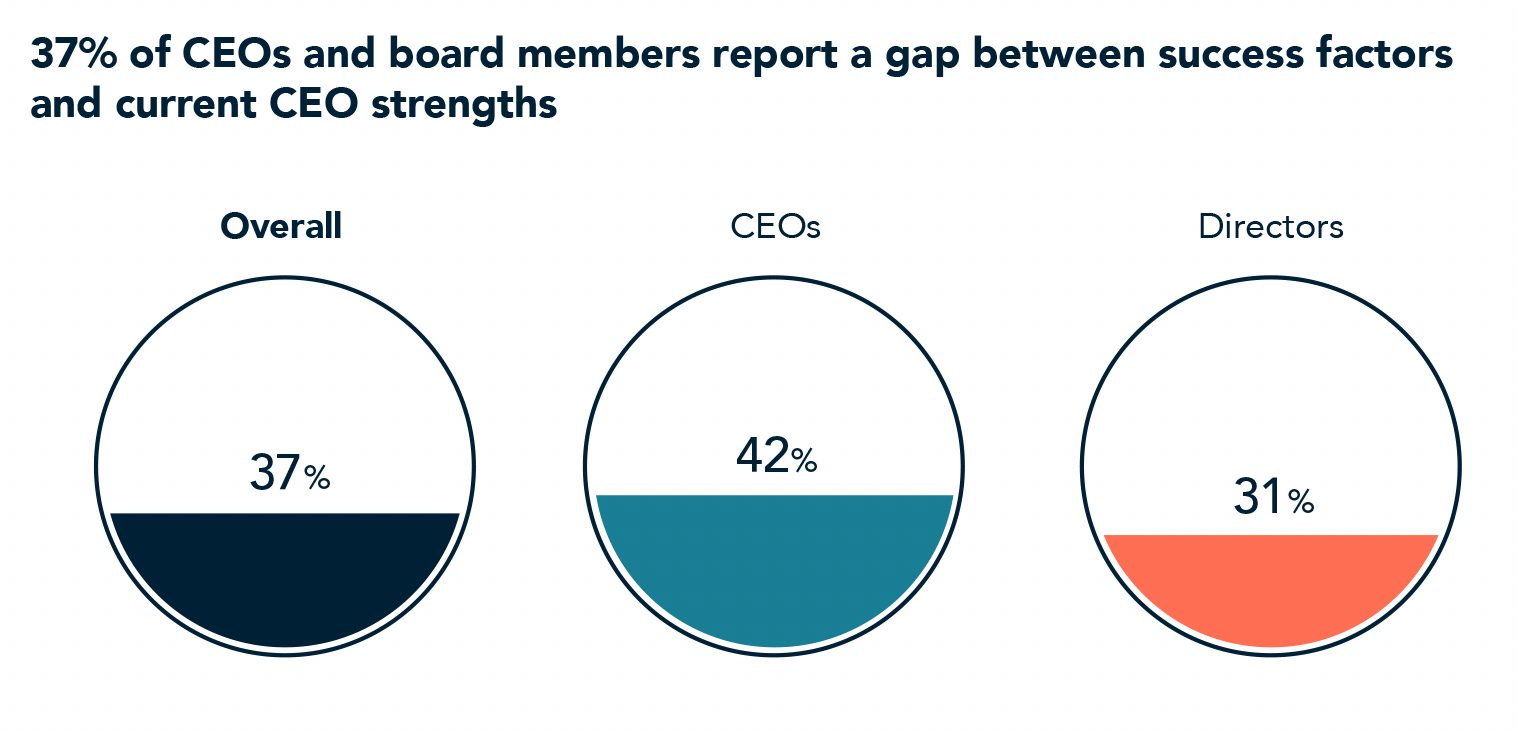
However, stronger CVs alone are not solving organizations' leadership challenges. More than one-third (37%) of CEOs and directors report a gap between the capabilities they believe will be most critical to their organization's future success and the greatest strengths of their current CEO.
Cross-dimensional alignment is the core of future success
The disconnect between the capabilities organizations will need to execute their future strategies and those of their current leaders points to a broader challenge: succession planning remains underdeveloped in many companies. Based on decades of advising boards and executive teams, combined with our research, we have consistently found that succession planning is most effective when it is treated as a strategic capability rather than a periodic talent exercise. The strongest outcomes emerge when these succession practices are directly informed by business strategy at every level and integrated, creating a consistent and holistic approach to identifying, developing, and preparing future leaders across the enterprise.
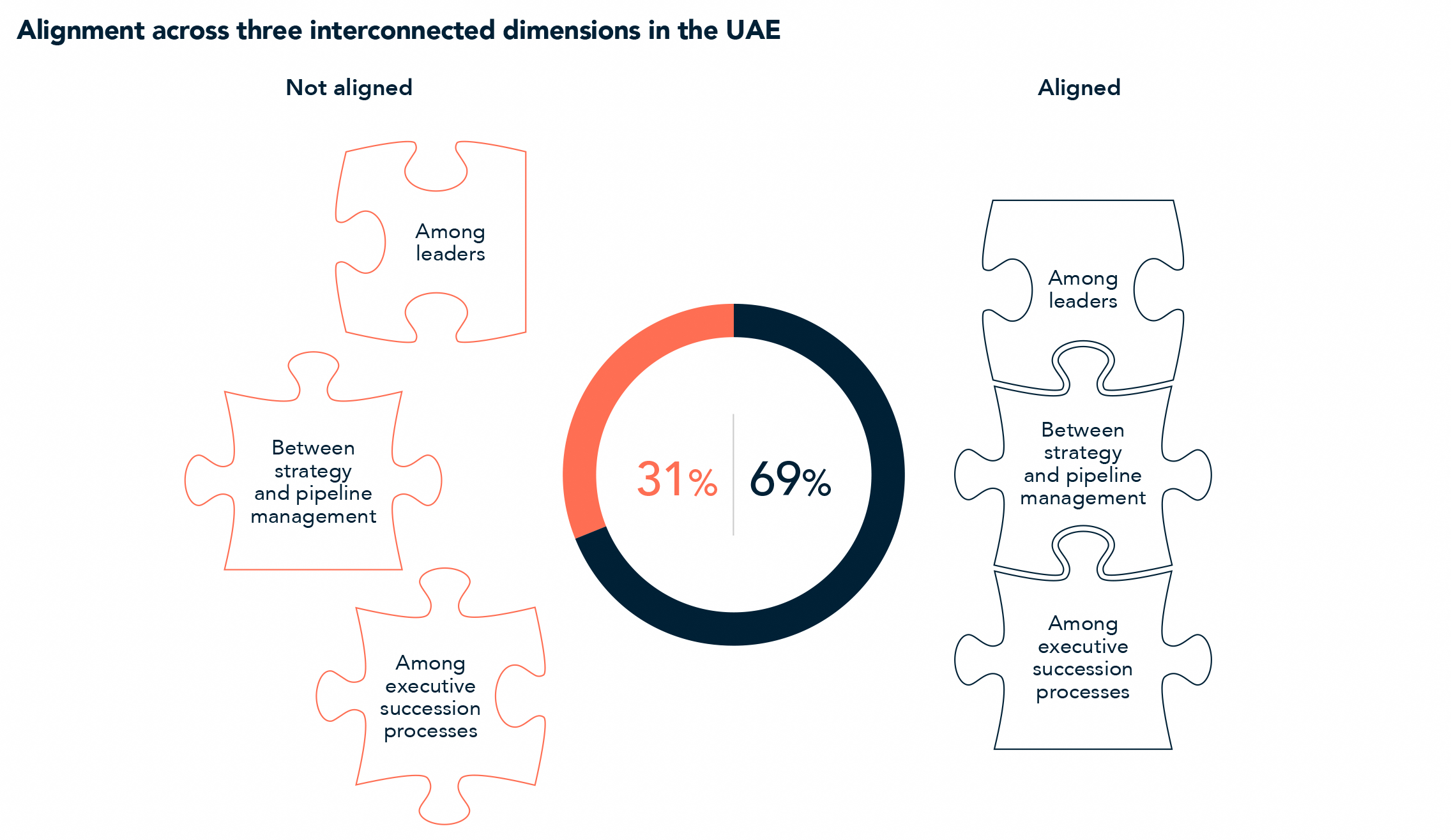
To better understand what differentiates organizations that are prepared for strategic change, we examined the role of organizational alignment across three dimensions:
1. Alignment among leaders
2. Alignment between business strategy and leadership pipeline management
3. Alignment among executive development and succession planning processes
Our findings are encouraging. Sixty-nine percent of Emirati organizations report alignment across all three dimensions—a higher proportion than in many other markets. For example, in the United States, about half of organizations (53%) report this level of alignment.1
Even so, the most common area of weakness in the UAE remains the link between strategy and talent management, including leadership pipeline management. As organizations redefine where they compete and how they create value, many have yet to fully translate those strategic ambitions into the capabilities they build fully, the leaders they develop, and the succession decisions they make. Closing this gap will be essential for organizations seeking to sustain performance through continued transformation.2
The multiplier effect of the right CEO
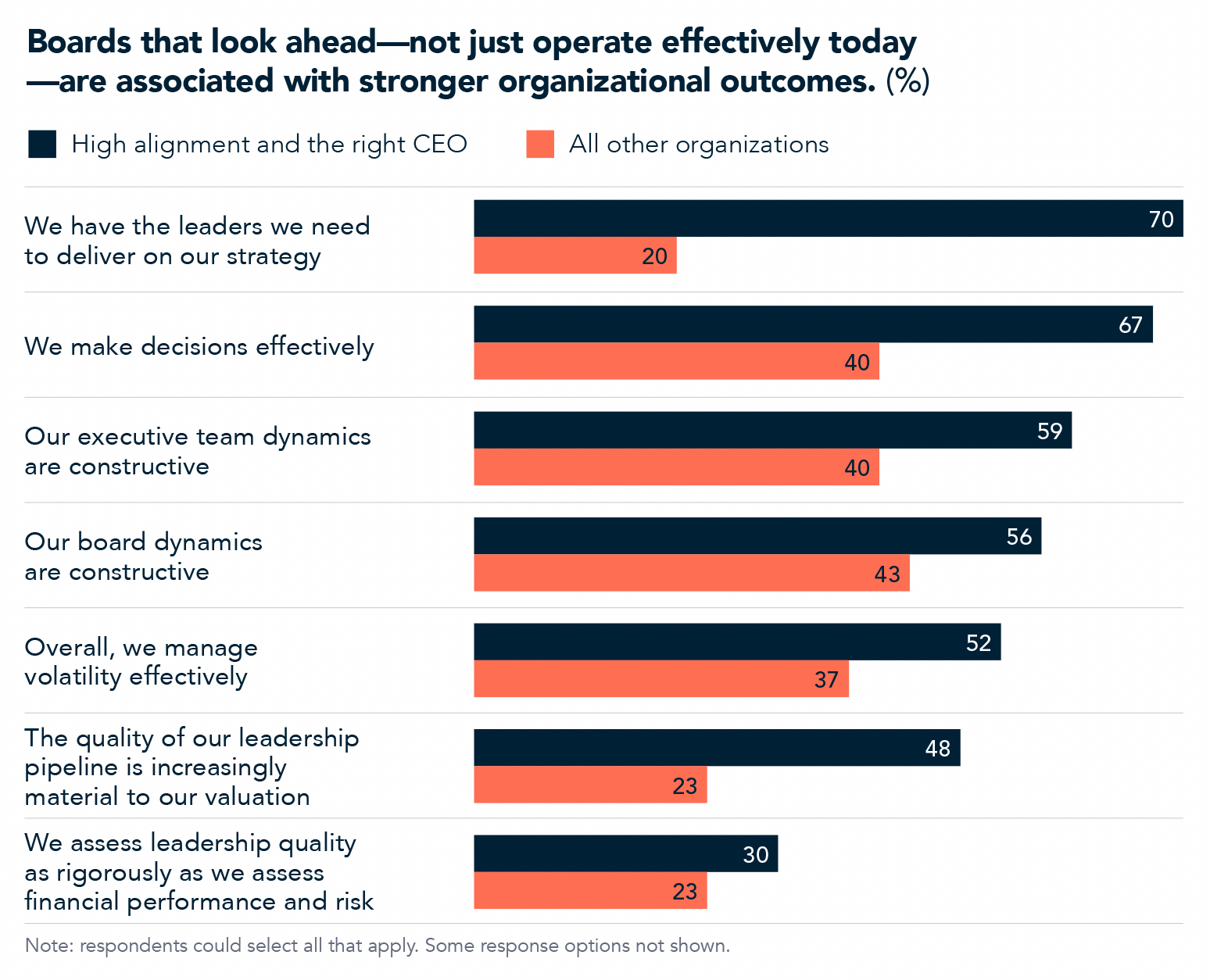
The benefits of aligning leadership with strategy extend well beyond better governance, translating into stronger business performance. Organizations that combine enterprise-wide alignment with a CEO whose strengths closely match the factors most critical to future success consistently outperform their peers.
Among these organizations, 33% exceeded their own financial performance expectations at the start of the year, compared with just 20% of all other companies. These organizations are also more likely to report stronger organizational outcomes, including more effective decision-making and greater resilience in the face of volatility.
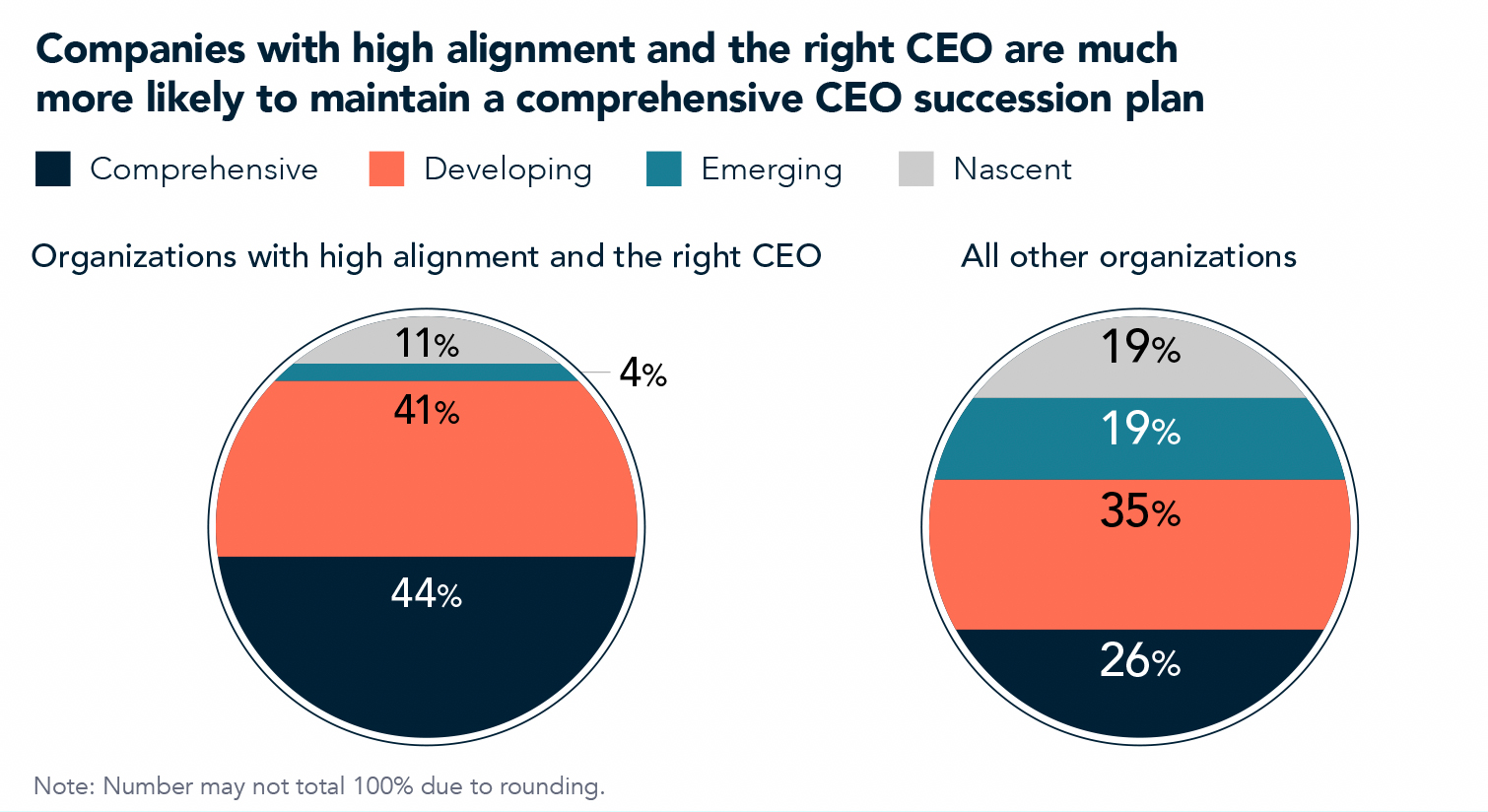
Importantly, organizations that have the right CEO for today's challenges also appear to be better positioned for tomorrow's. They are significantly more likely to have a comprehensive CEO succession process—one that is regularly updated, incorporates evolving capability requirements, and takes decisive action when leadership performance falls short. Forty-four percent of these organizations report having such a comprehensive succession plan, compared with only 26% of other organizations.
This more disciplined approach to succession also gives boards greater confidence in their leadership pipeline. Thirty-seven percent of leaders at these organizations say they are not at all concerned about overlooking potential CEO candidates within their own organization, compared with just 10% elsewhere. That confidence matters because future strategic scenarios are unlikely to demand a single leadership profile. Organizations that develop multiple credible successors are building strategic optionality, giving boards the flexibility to select the leader best suited to the circumstances they ultimately face rather than being constrained to a single predetermined choice.
Multiple possible futures require multiple possible leaders
Organizations in the UAE have made meaningful progress in enterprise-wide alignment. Compared with many regional and global peers, they are well positioned for future success. But in an environment where strategy, markets, and regulation continue to evolve, leadership alignment must also become continuous.
That requires a fundamental shift in how boards think about succession. Rather than preparing a single replacement for a future vacancy, succession planning should become an ongoing process of building leadership capability. The most resilient organizations continually reassess the leadership profiles they may need under different strategic scenarios and develop multiple leaders capable of succeeding in each. In doing so, they create strategic optionality, giving boards the flexibility to respond confidently as circumstances change.
Even among organizations with strong enterprise-wide alignment and CEOs whose capabilities closely match their strategic priorities, succession planning remains an opportunity for improvement. Only 15% say CEO succession is a top organizational priority and treat it accordingly. Yet our findings suggest that organizations with more comprehensive succession processes are not only better prepared for leadership transitions, but also more confident that they are not overlooking internal talent. The objective is no longer to identify the successor; it is to ensure the organization has multiple credible leadership options.
Building those options also requires boards to broaden how they define leadership potential. Experience and credentials remain important, but they are increasingly table stakes. The leaders most likely to succeed in uncertain environments are distinguished by qualities such as curiosity, humility, self-awareness, sound judgment, an appreciation of risk, and the ability to bring diverse perspectives together. These characteristics should not be confused with indecision. Rather, they enable leaders to adapt strategy, make better decisions, and build commitment when circumstances change.
For some boards, making succession planning a more continuous discussion may seem uncomfortable, raising concerns about market speculation or uncertainty within the executive team. In practice, however, the opposite is often true. When succession is embedded into regular governance rather than triggered by an impending leadership transition, it becomes less about individuals and more about organizational preparedness. Regular succession discussions become a hallmark of disciplined governance, not a signal that change is imminent.
As uncertainty becomes a permanent feature of the operating environment, succession planning must evolve from a governance requirement into a strategic capability. Organizations that continuously align leadership development with evolving strategic priorities will be better positioned to adapt, execute, and sustain performance over time.
References
1 “Board Monitor US 2026 | Future-focused boards: Linking renewal, alignment, and performance,” Heidrick & Struggles, May 12, 2026, heidrick.com.
2 See the online methodology for details on how the alignment score was calculated.
Stay connected
Stay connected to our expert insights, thought leadership, and event information.
Leadership Podcast
Explore the latest episodes of The Heidrick & Struggles Leadership Podcast.