On-Demand Talent
2026 Talent Lens Survey: The State of Interim Talent
Global insights from the interim leader and expert economy
February 12, 2026
9m to read
A market defined by never-ending transformation
The world of work has not stabilized—it has recalibrated. In 2026, organizations are operating amid persistent volatility: uneven economic growth, geopolitical disruption, tighter capital discipline, and unrelenting pressure to move faster. Transformation is no longer a phase; it is the default. Yet many traditional approaches to leadership and talent remain too rigid for the environment leaders now face.
At the same time, a growing cohort of highly experienced executives and consultants—professionals with decades of leadership experience in top consultancies and global corporations—are choosing independent careers. Lower barriers to entry and shifting professional expectations have made independence more viable and attractive than ever before. What was once a niche career path has evolved into a scaled, credible, and increasingly mainstream option at the senior level.
Together, these forces are reshaping how organizations access leadership capacity. Demand for flexible, high-caliber executive expertise has accelerated as companies seek to fill critical skill gaps, gain objective perspective, and rapidly mobilize talent for specific moments in time. Interim leaders and experts are no longer viewed as stopgaps, but as a strategic extension of the leadership bench—bringing speed, precision, and impact without long-term structural commitments.
To better understand how this market is evolving, Heidrick & Struggles surveyed 3,810 seasoned interim leaders and experts across the Americas and Europe in August 2025. These talent represent the high end of the independent market—former business executives and C-suite leaders, classically trained consultants, and subject matter experts who bring niche skills to today’s most challenging business problems.
The findings point to an interim talent economy expanding in both scale and sophistication—one shaped by deliberate career choice, broader organizational adoption, and new technologies that continue to redefine how expertise is deployed. The data that follows sheds light on the professionals powering this shift, the work they are doing, and why interim talent are becoming a strategic component of modern leadership models.
A snapshot of today’s interim leaders and experts
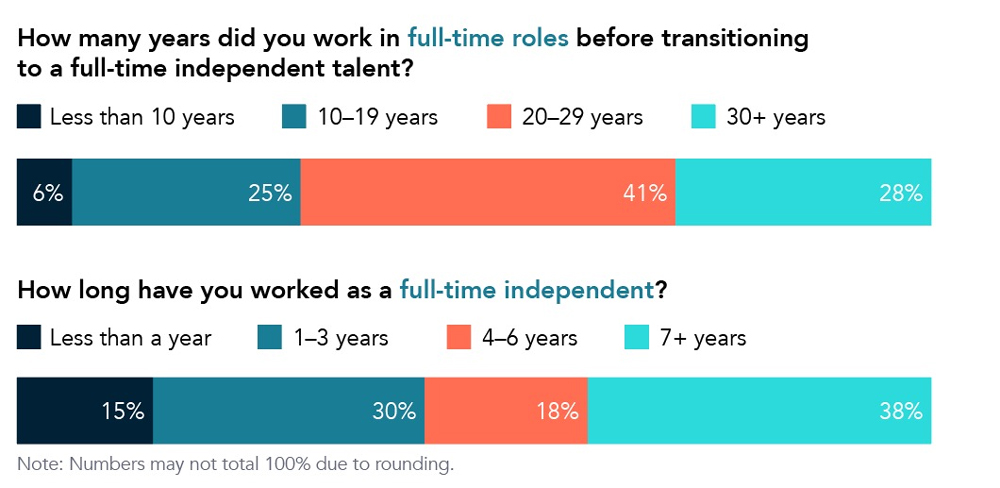
A growing cohort of skilled professionals, with a typical 20+ years building expertise in leading consultancies and corporations, are choosing independent careers as their vehicle to navigate—and even thrive—in today’s complex, dynamic environment.
Among those surveyed, 85% have been working independently for more than a year, reinforcing that interim work is a sustained career choice rather than a short‑term stopgap. The share of respondents newly entering the interim talent market (those with less than one year of full-time independent tenure) increased from 6% in 2020 to 15% in 2025—driven by lower barriers to market entry via interim talent providers, changing professional work preferences, and recognition of a growing corporate appetite for flexible capacity. It’s a destination for established leaders seeking variety, control, and flexibility.
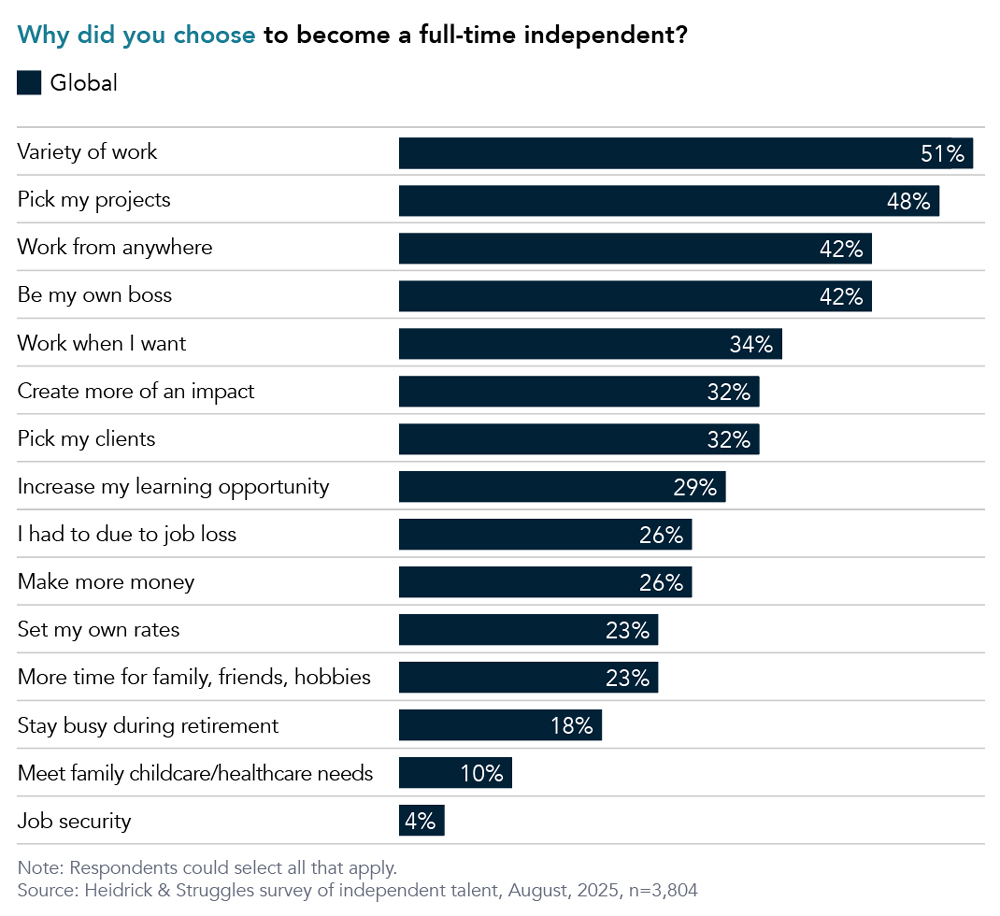
Top 5 reasons leaders chose to become full-time independents
| Europe | Americas |
|---|---|
| 1. Variety of work | 1. Variety of work |
| 2. Pick my projects | 2. Pick my projects |
| 3. Be my own boss | 3. Work from anywhere |
| 4. Pick my clients | 4. Be my own boss |
| 5. Increase my learning opportunity | 5. Work when I want |
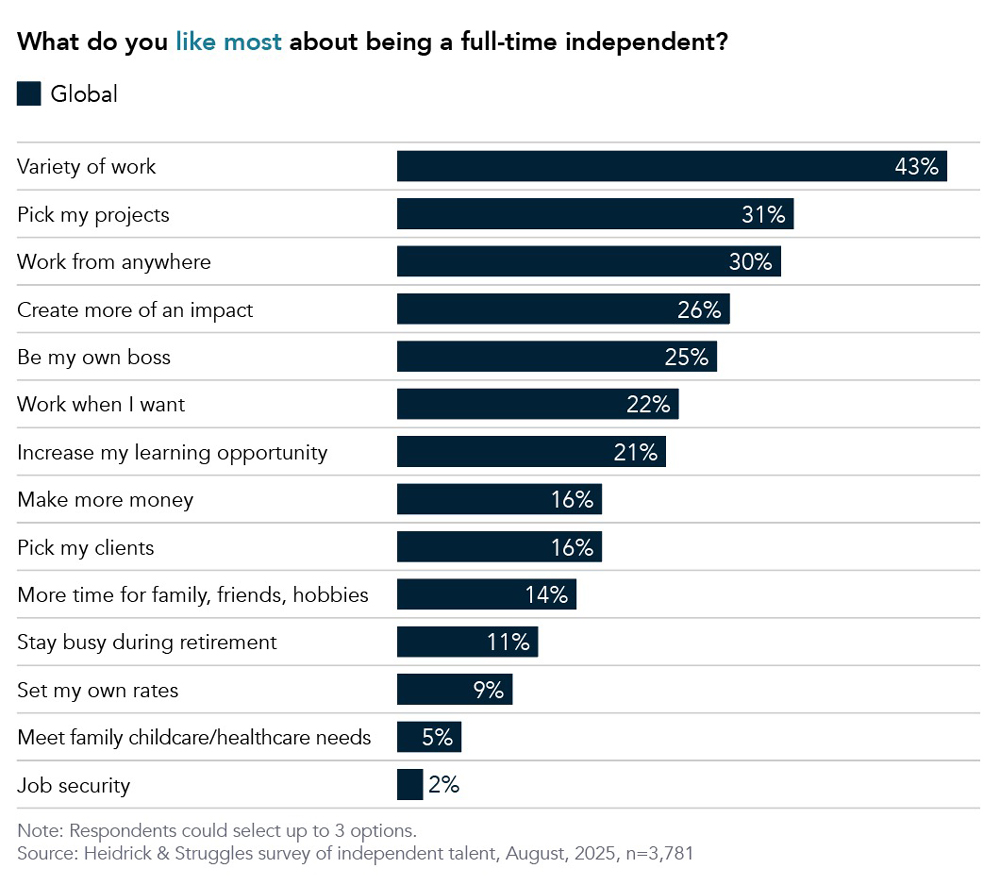
When asked what they like most about being a full‑time independent, many reinforced the same themes of variety, control, and flexibility. For organizations, this means that the interim talent pool is increasingly populated by leaders who are motivated by the work, its impact, and how they get it done—not by a lack of alternatives.
Nearly one third (30%) of independents report higher daily rates in 2025 compared with 2024, while half say their rates have stayed consistent and one in five have seen declines.
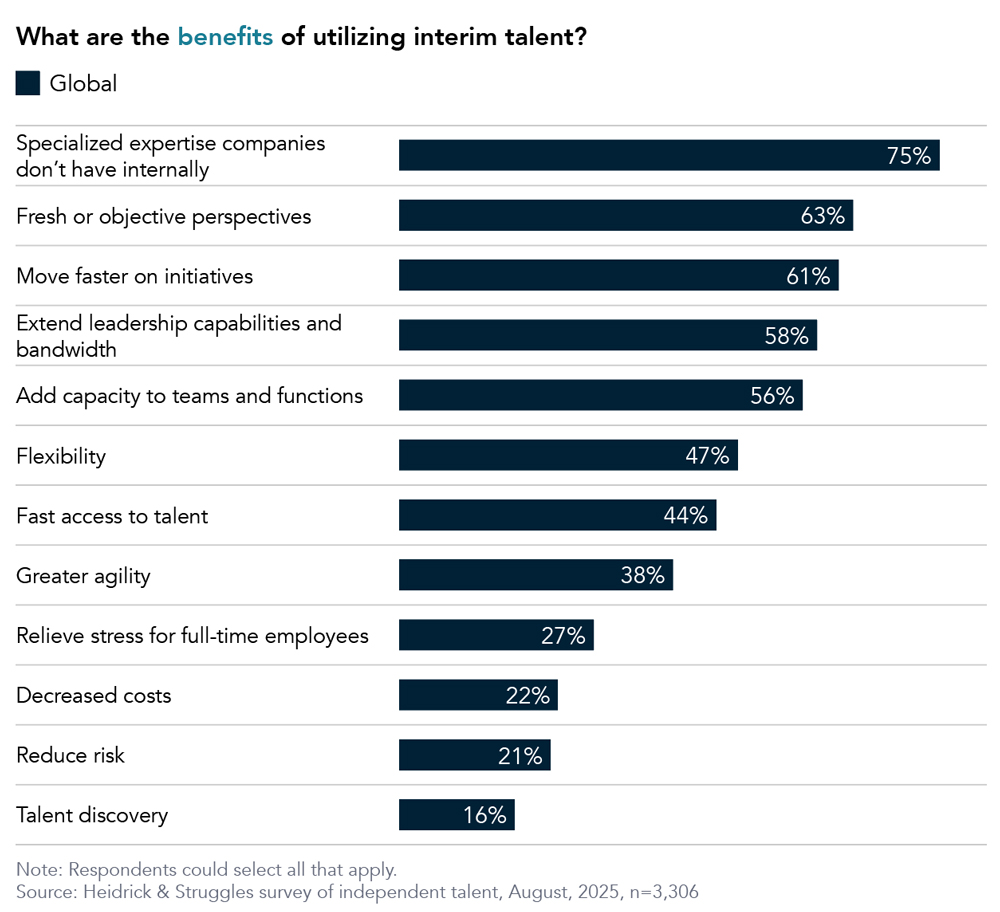
As experienced business leaders in their own right, interim talent are keenly aware of the value they deliver for their clients. Companies of all sizes rely on independent talent to fill critical skill gaps (75%), bring objective insight (63%), and accelerate key initiatives (61%). These professionals provide the specialized expertise, agility, and leadership bandwidth organizations need to move faster and compete more effectively.
The expanding scope of the interim talent market
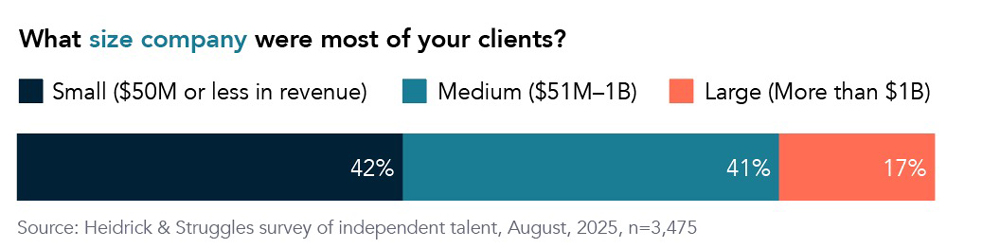
The maturing interim talent market has not only made it easier for experienced professionals to advance their independent careers; it has also made these high-end talent more accessible to a broader segment of companies. While the overall market has grown, small and medium companies now account for more than four‑fifths of demand, reflecting how widely interim talent has diffused beyond the largest enterprises.
This shift underscores that leadership teams are becoming more attuned to the strategic value interim talent can deliver—enabling teams to rapidly scale as needed and to access specialized skills for specific projects or pivotal moments.
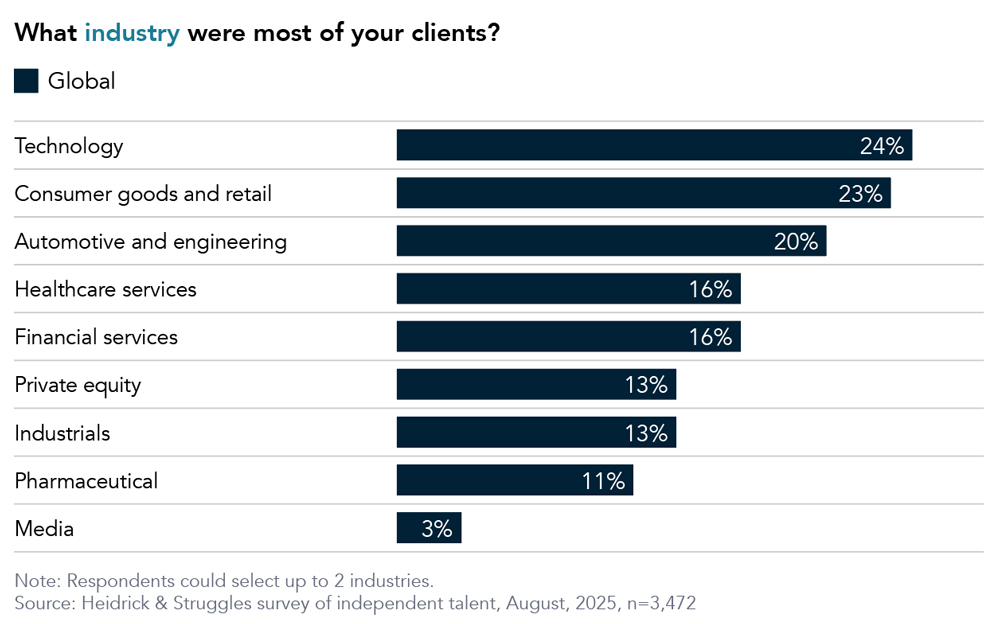
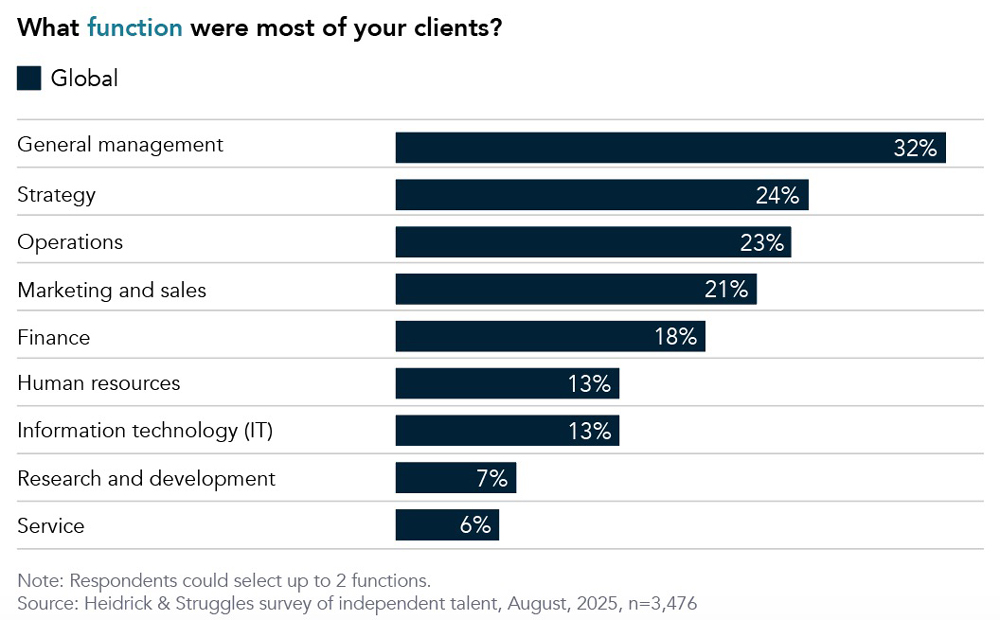
When urgent challenges or opportunities emerge, companies are tapping interim talent to ensure high-stakes initiatives stay on course and deliver results. Their work centers on strategic and operational planning, process improvement and business transformation, and firm-wide transformation—with engagements in the Americas skewing toward traditional consulting assignments, while Europe sees more transformation, restructuring, and project management mandates.
Project duration continues to lengthen, signaling both increased organizational comfort with using independent talent and the rising complexity of the work they are being asked to lead. Forty-two percent (42%) of projects now last longer than six months—up from 27% in 2021—and 16% extend beyond a year. More experience leads to longer engagements. For independents with the most tenure, 55% of projects run 12+ months, versus 13% for those early in their independent careers.
In short, interim leaders are being deployed not merely as temporary cover, but to lead some of the most consequential strategic, operational, and transformative agendas in their clients’ portfolios.

The AI-enabled interim
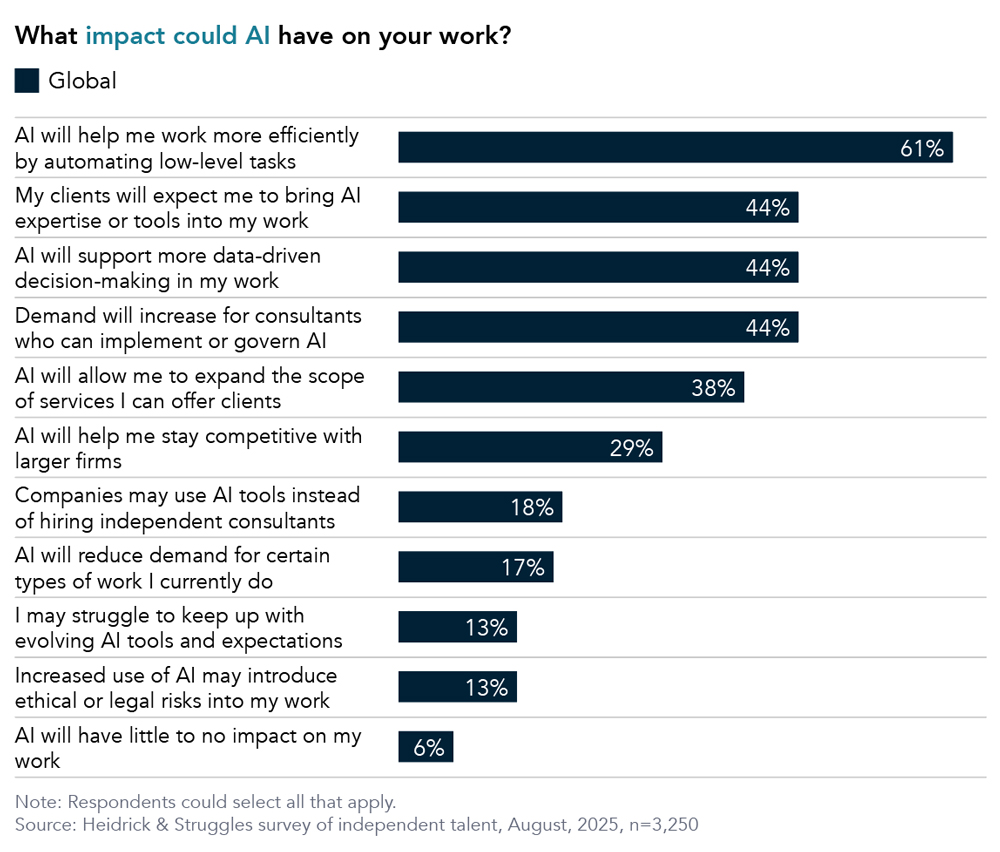
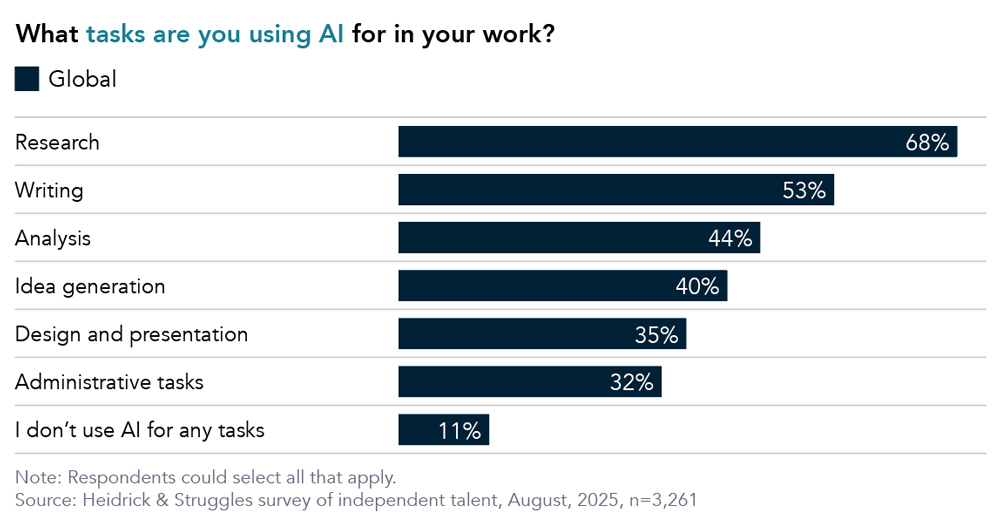
AI has quickly become foundational to the interim talent operating model. Three in four are actively upskilling—learning new AI tools and platforms—and 39% are collaborating with others who have AI expertise. Only 11% say they are not using AI at all.
Regarding potential impacts the technology may have on their work, responses indicate that interim talent view AI as a positive force—improving efficiency, supporting data-driven decision making, and expanding the services they can offer. Nearly half (44%) anticipate that clients will expect them to bring AI expertise to engagements, and only 6% believe AI will have no impact on their work.
As interim leaders take on complex mandates—enterprise transformations, post‑M&A integration, technology overhauls—the combination of deep leadership experience and AI‑enabled productivity and insight is becoming a genuine differentiator.
Onboarding interim talent for maximum benefit
Interim leaders, no matter how experienced, can only move as fast as the environment they enter. An organization’s approach to onboarding and positioning them—the pace of ramp-up, the clarity of their mandate and decision rights, and the strength of their stakeholder connections—contributes significantly to how well their expertise translates into meaningful impact.
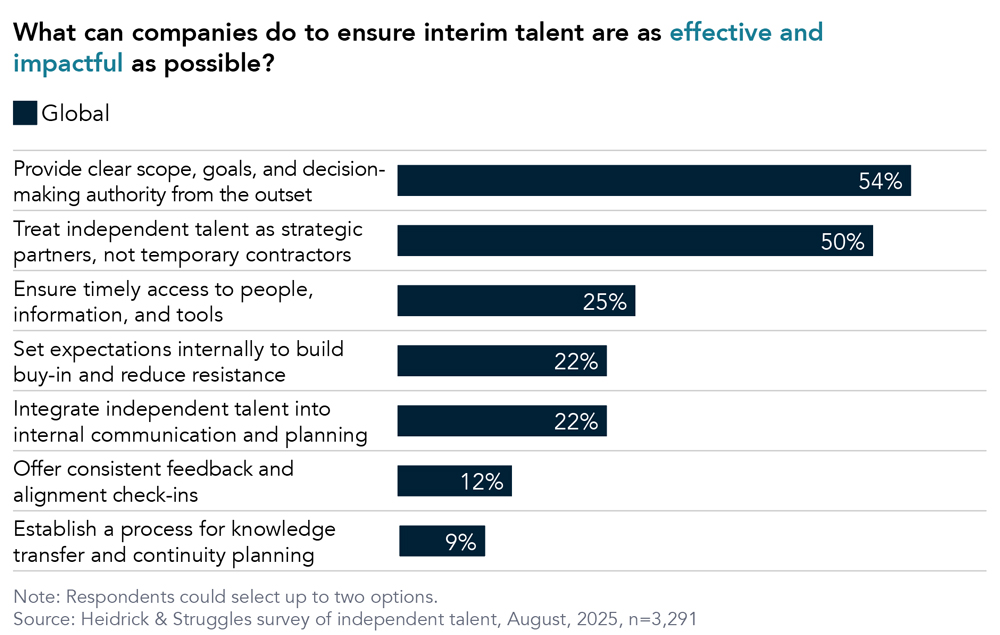
The practices below outline how thoughtful onboarding and collaboration can help turn an interim talent engagement into immediate, sustained value from day one.
- Align early on scope and goals. Ensure stakeholders and the interim leader share a clear view of objectives, success criteria, and decision rights. Define what can be decided independently, when consultation is required, and what’s out of scope. To prevent bottlenecks, assign an internal “go-to” who can grant approvals typically reserved for permanent roles.
- Provide timely access to people, information, and tools. Enable access to key tools, data, and calendars before the engagement begins. Map the stakeholder landscape early and socialize the interim leader’s mandate, background, and near-term priorities with core collaborators to build trust and context quickly.
- Establish regular structured check-ins. After the first few weeks, hold a work plan review to confirm objectives, surface dependencies, and refine scope. Maintain a light, recurring cadence to catch misalignment early, unblock decisions, and adjust priorities so outcomes stay on track.
- Plan deliberately for transitions when a permanent hire is pending. Build overlap into the engagement and ask the interim leader to document owners, open risks, and residual decisions to protect institutional knowledge and shorten ramp-up time.
Together, these practices compress time-to-impact, preserve momentum, and reduce strain on internal teams—while reinforcing stakeholder confidence through visible progress and faster decisions.
Converting flexibility into durable advantage
Our survey of interim talent shows that this dynamic market is expanding in both scale and sophistication, with more seasoned executives opting for independence, clients embracing flexible capacity, and AI becoming foundational to delivery. What was once a niche, stopgap option has evolved into a mature ecosystem of leaders and experts who choose this work intentionally and deliver impact in moments that matter.
For organizations, the implication is clear: interim leaders and experts should be treated as a structural component of the leadership and talent model, not an exception. Those that intentionally define where interim talent can add the most value—and pair that with disciplined onboarding, clear mandates and decision rights, and strong stakeholder sponsorship—are better positioned to move at the pace of change and accelerate progress on critical priorities.
Looking ahead, the companies that will benefit most are those that build repeatable ways to access, integrate, and support interim talent alongside internal leaders. By combining flexible external expertise with the institutional knowledge and continuity of their own teams, they can navigate volatility with greater confidence and convert flexibility into a durable competitive advantage.
About the research
In August 2025, Heidrick & Struggles fielded an online survey that garnered responses from 3,810 full-time independent talent. Respondents spanned all major industries and business functions, with 64% based in North America, 26% in Europe and Africa, 7% in Latin America, 2% in Asia Pacific, and 1% in the Middle East.


Stay connected
Stay connected to our expert insights, thought leadership, and event information.
Leadership Podcast
Explore the latest episodes of The Heidrick & Struggles Leadership Podcast.